I Bought a Cheap Wideband LNA from AliExpress, the Zeenko ZK06-BM
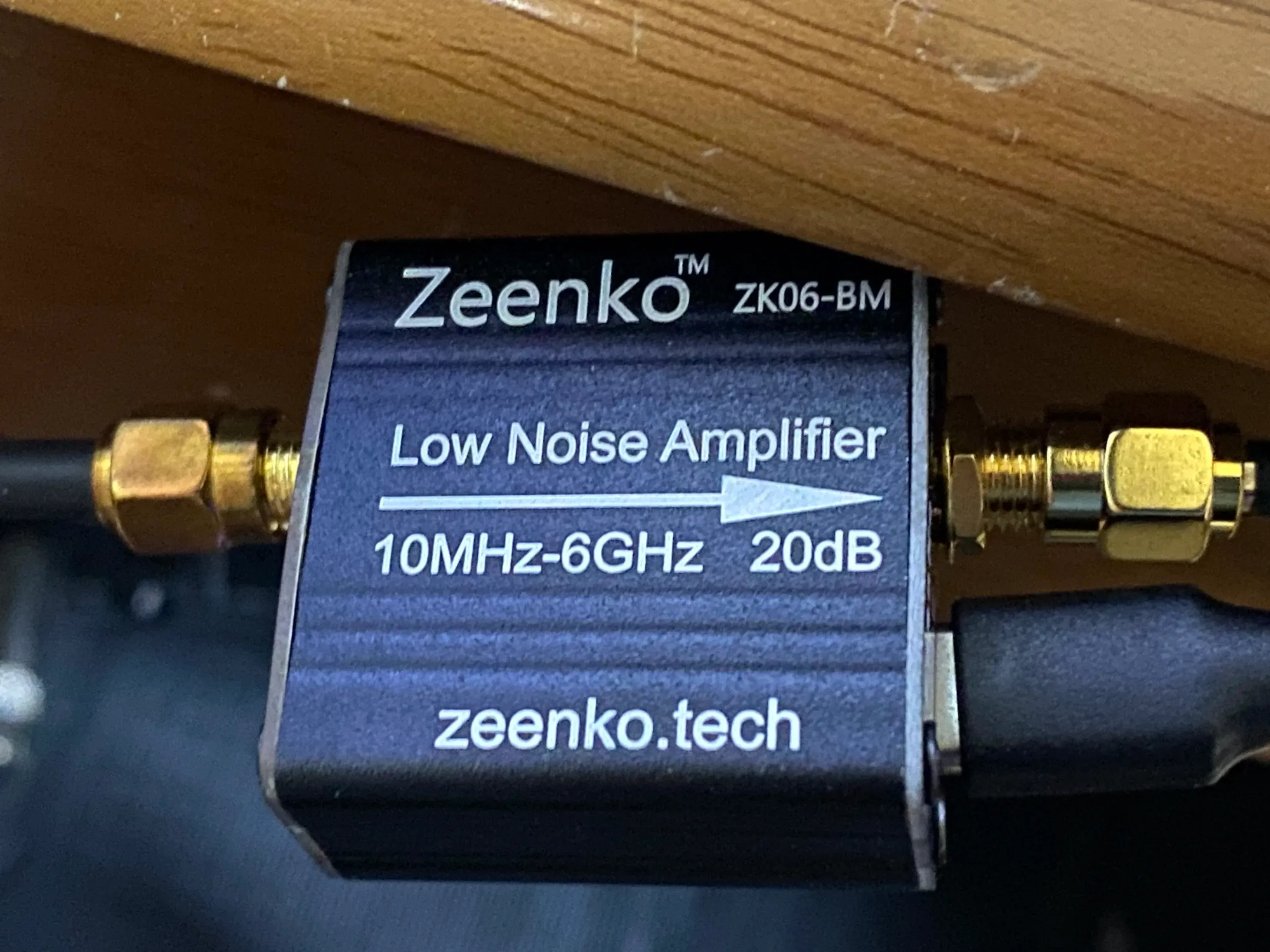
Table of Contents
I bought an LNA called the Zeenko ZK06-BM and gave it a try. It’s my first LNA purchase ever, and I’m so glad I bought it!
So, here’s the write-up.
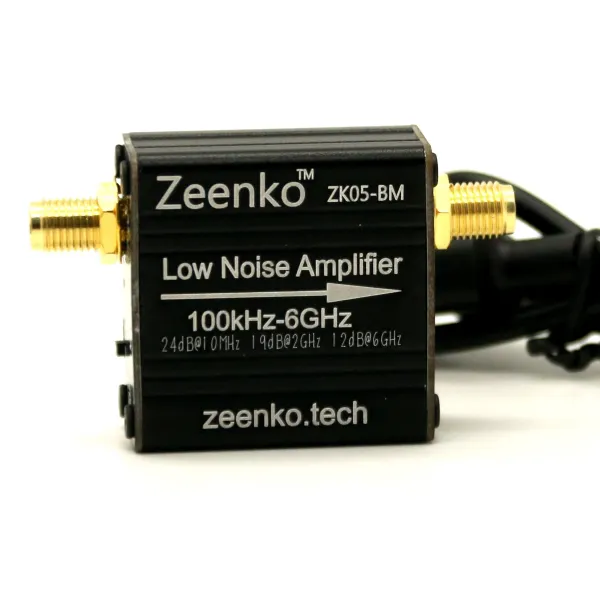
↑ Not an affiliate link, don’t worry.
Claimed Specs
The product page has a spec table for the whole series. What I transcribed (or rather, what I had an AI OCR for me) is below.
ZK06-BM Spec Sheet
- Model: ZK06-BM
- Freq range: 10M–6GHz
Gain
- 2dB @ 100kHz
- 21dB @ 5MHz
- 25.5dB @ 10MHz
- 24.5dB @ 100MHz
- 21.5dB @ 1GHz
- 21dB @ 2GHz
- 20dB @ 3GHz
- 19.5dB @ 4GHz
- 19dB @ 5GHz
- 18dB @ 6GHz
NF (Noise Figure)
- 2.3dB @ 10MHz
- 0.8dB @ 100MHz
- 0.6dB @ 1GHz
- 0.7dB @ 2GHz
- 0.7dB @ 3GHz
- 0.7dB @ 4GHz
- 0.8dB @ 5GHz
- 1.0dB @ 6GHz
OP1dB (Output 1dB Compression Point)
- 16dBm @ 10MHz
- 12dBm @ 100MHz
- 18dBm @ 1GHz
- 18dBm @ 2GHz
- 18dBm @ 3GHz
- 18dBm @ 4GHz
- 17dBm @ 5GHz
- 16dBm @ 6GHz
OIP3 (Output Third-Order Intercept Point)
- 26dBm @ 10MHz
- 31dBm @ 100MHz
- 31dBm @ 1GHz
- 30dBm @ 2GHz
- 31dBm @ 3GHz
- 28dBm @ 4GHz
- 27dBm @ 5GHz
- 24dBm @ 6GHz
Supply Current / Battery
- Charging: 210mA
- Total: 250mA
- Battery life: 6 hours
Note
- Broadband, low noise
- Good flatness in the 1-6 GHz range
- Recommended for use as tinySA ULTRA 5.8GHz preamplifier
- Can be used to replace QPL9503, QPL9504 modules
Why the ZK06-BM?
My main reason for getting a wideband LNA was to receive geostationary satellite signals in the 1.5GHz band. But if I went too specialized for that, I’d be stuck with a one-trick pony, which is a shame. Ideally I wanted to use it for the 137MHz-band low-orbit METEOR-M2 series satellites too. Heck, it’d be great if it covered all the way down to 14MHz or 7MHz.
On the other hand, if the bandwidth is too wide, the signal might saturate and turn into a catastrophe. Once you get down to shortwave and medium wave, coax cable loss is practically meaningless in the first place, so the issue should be the low noise floor, not the signal strength.
Also, the -BM series being battery-powered is nice. To avoid a tangled mess of wiring, a bias tee (which sends DC power up the coax cable) would have been ideal, but I couldn’t find a cheap one that supports it. With battery power, though, that’s not a concern. The battery only lasts 6 hours, but I’m never going to be outside using it for 6 hours straight anyway.
So I picked the ZK06-BM: a battery-powered model with decent bandwidth, the lowest NF, and a flat frequency response.
By the way, the ZK07-BM and ZK08-BM look like the strongest options on paper, with nearly +40dB of gain, but amplifying that hugely would probably cause intermodulation problems from saturation, so I steered clear.
I also bought a 10cm SMA male-to-male coax cable on AliExpress at the same time.
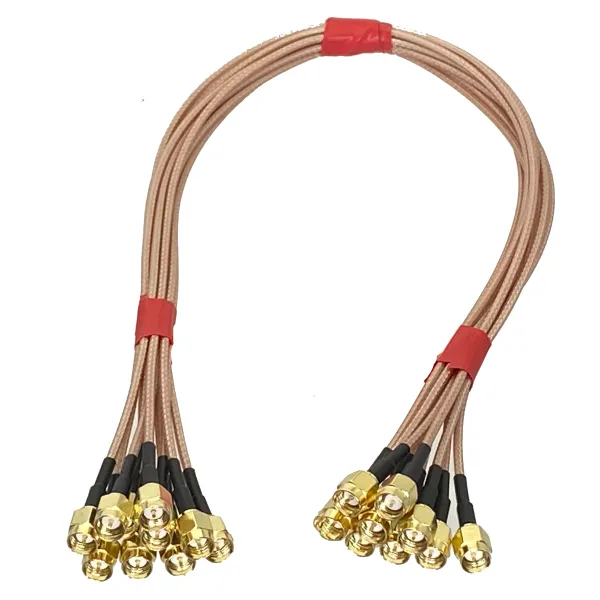
When I cut it open for a DIY project, it turned out to be extremely thin, and I’d guess the loss is ridiculously huge. It should be fine if it’s short… right?
Field Test Targeting METEOR-M2 4
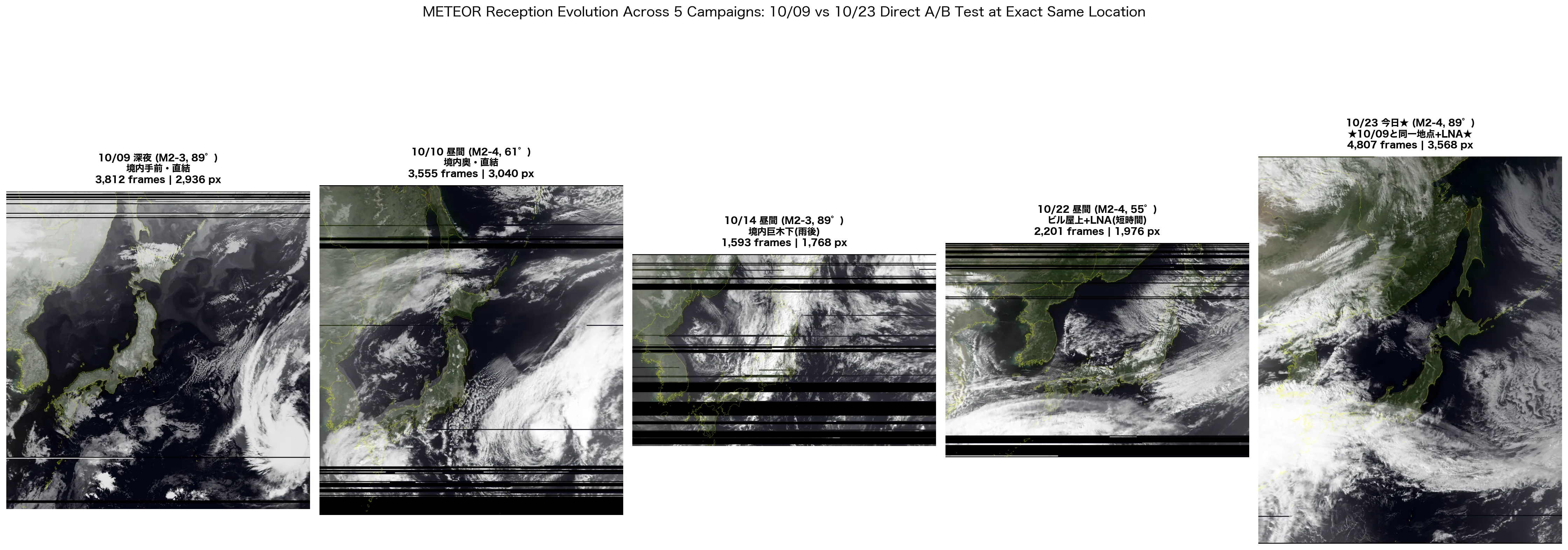
Conveniently, METEOR-M2 4 passed overhead at an elevation of 89° (!!) in the daytime today, so I tried receiving it.
Once it’s charged, you just stick it in front of the RTL-SDR, which is super convenient! Really it should go right at the feed point, but my homemade Yagi antenna runs a 3m coax cable straight out with no connector in between, so I had no choice but to put it right before the RTL-SDR. At 137MHz, the coax cable loss shouldn’t be that bad…
I don’t have any measuring equipment, so I can’t say exactly, but it seems to be working just fine.
Without the LNA I was running at +35dB, but with the LNA connected I set it to 25.4dB. Any higher and intermodulation showed up.
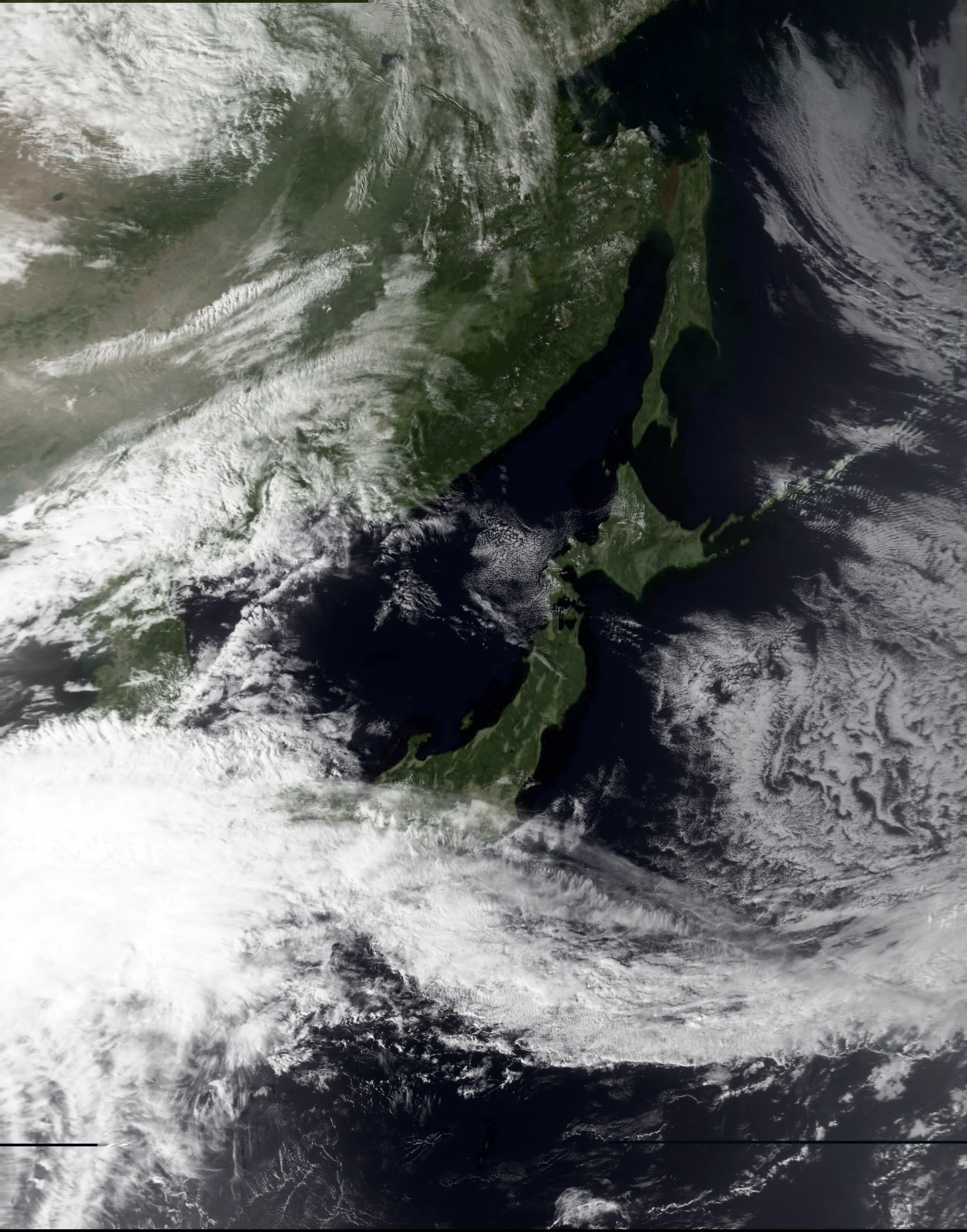
Even while receiving, the signal strength on the waterfall was clearly stronger. When I decoded it, I got the best result ever, just as hoped.
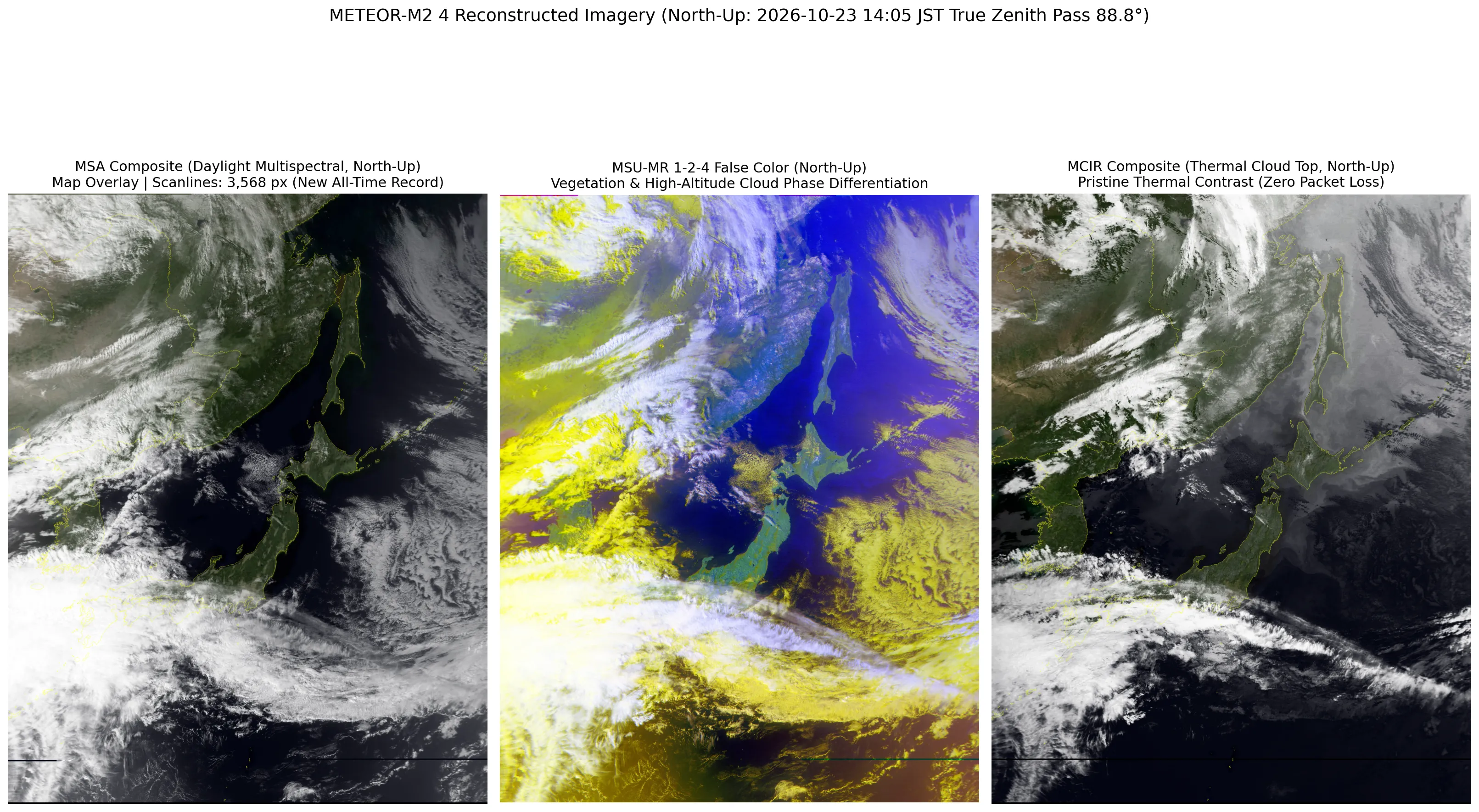
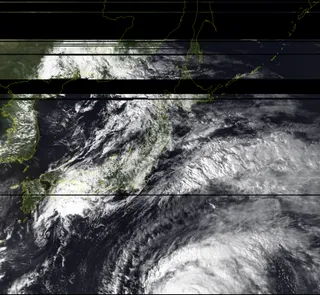
By the way, the thick cloud covering the area from Kyushu to Okinawa is from Typhoon No. 30.
Here’s the comparison with previous passes. The longest vertical stretch means the signal strength stayed above the Reed-Solomon demodulation threshold for the longest time. There’s only a single line of data loss in the middle, and for the first time I got the entire Japanese archipelago with no gaps.
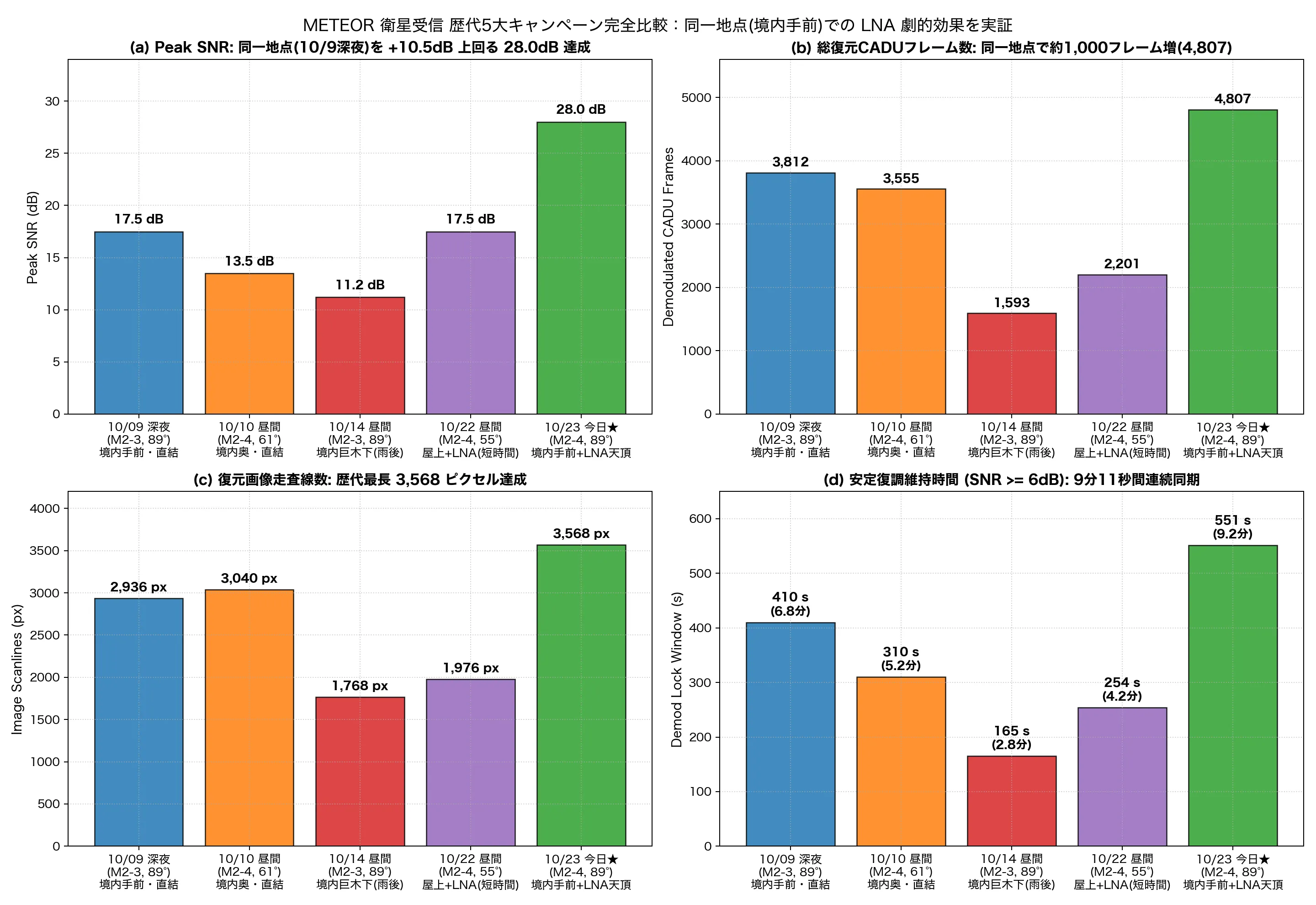
The various metrics are below. Compared to my previous best, that’s +10.5dB in Peak SNR, +1000 in recovered CADU frames, +600px in recovered image scan lines, and +141 seconds of demodulation lock time.
An unqualified huge success!
…except that the antenna I built for the 1.5GHz band still couldn’t pick up any signal from the geostationary satellite even with the LNA connected. At this point it’s certain that the antenna itself is the problem, so I’ll have to investigate…
Testing with the Random Wire Antenna at Home
I chose a wideband LNA because it can do a bit of everything, so I tried it on other bands too.
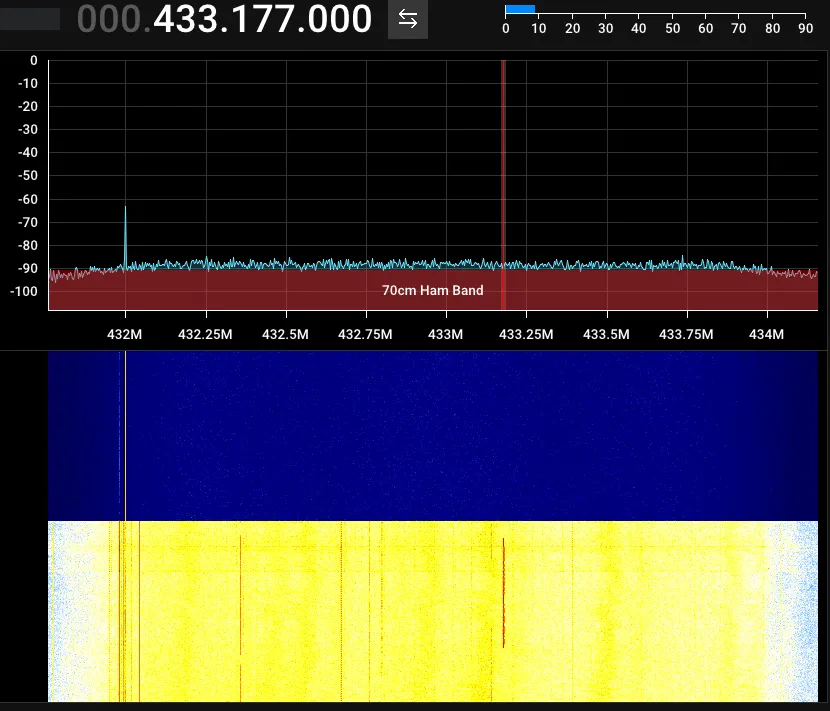
The most dramatic was the 433MHz band. A 20m random wire surrounded by buildings has no business receiving anything there, and it had indeed been a complete wasteland until now, but with the LNA in the chain, reception became possible. It feels like the LNA is brute-forcing its way through the massive attenuation from the mismatch.
It also seems to be genuinely useful on shortwave, and I’m currently verifying the effect by receiving FT8.
Bonus
While I was out in the plaza waving my antenna around, a stranger came up and talked to me. He’d done something similar when he was young and said it brought back a lot of memories. As we dug deeper into the conversation, I got the distinct feeling that this was no ordinary person. The philosophical talk kept getting more and more animated, and we ended up chatting for over two hours.
He gave me his business card, and when I checked it after getting home, it turned out he’s a (former) professor of philosophy/ethics with a monstrous résumé, a true top-tier figure. And what’s more, his field seems to overlap deeply with the areas I’m interested in.
The Time Has Come to Face Kitaro Nishida
Reading Impressions and Key Takeaways: Hayao Kawai’s The Structure of the Unconscious
It was such an insane event that it completely blew away the LNA’s first real-world deployment. Even a Genshin Impact world quest would give you a slightly more careful setup than that.
This world is responding to me!!!
More articles
- NOAA-15, 18 and 19 Are Out of Service, and the 137 MHz Analog Weather Satellites Are Gone• #RadioElon Musk is a cancer on humanity.

- Receiving METEOR M2-4 Weather Satellite Images with an RTL-SDR and a Homemade Yagi Antenna• #RadioI took on satellite reception with a homemade antenna that cost 300 yen (about $2).
- Building a Homemade Preselector to Improve RTL-SDR Reception• #RadioI've finally started doing some actual radio-engineering electronics projects.
- Getting Started with SDR Using an RTL-SDR Blog V4 and a Random Wire Antenna• #RadioA record of trying shortwave listening with a stealthy random wire antenna dangling off my balcony, from setting up the RTL-SDR Blog V4 to the before-and-after sensitivity gains of a homemade 9:1 unun.


Notes on games, radio and technology, translated from the Japanese blog.