NOAA-15, 18 and 19 Are Out of Service, and the 137 MHz Analog Weather Satellites Are Gone

Table of Contents
TL;DR
- NOAA ended all 137 MHz analog weather satellite operations in August 2025. For good.
- As of now, the only satellites still raining Earth photos down on 137 MHz are Russia’s Meteor-M series.
Introduction
Receiving satellite images from METEOR M2 was so much fun!!
Receiving METEOR M2-4 Weather Satellite Images with an RTL-SDR and a Homemade Yagi Antenna
I was still riding the high of pulling full-color photos of Earth straight from space with a homemade tape-measure Yagi antenna when Professor Gemini (my AI “teacher”) dropped some ominous news on me. Apparently, “the era of receiving satellite images with a cheap antenna is about to end.”
The long-beloved American NOAA weather satellites are all getting old, and the Russian Meteor satellites could die at any moment, it said.
Well then, I’d better enjoy this hobby while I still can!
…So I decided to launch an interception operation against the American weather satellite NOAA-19, which was going to pass over Tokyo on a gorgeous pass with a maximum elevation of 62 degrees.
Operation Failed
October 7, 2026, 21:45. I was standing on the emergency staircase landing on the top floor of my apartment building, clutching my homemade 3-element Yagi antenna, a MacBook, and an RTL-SDR V4.
The target: NOAA-19. Frequency: 137.100 MHz. Peak of the pass: 21:53. Trusting the AR app on my iPhone, I kept holding the antenna up toward the high western sky.
Unlike with Meteor, this one is analog (APT), so if I caught it, I’d hear a rhythmic, heartbeat-monitor-like “beep, beep, beep” straight through my earphones… or so I thought.
I heard nothing.
On the waterfall display, the 137.100 MHz line was completely flat. The noise floor didn’t budge an inch.
Right next door, around 136.8 MHz, I was picking up telemetry data (VDL2) from aircraft overhead loud and clear. So the antenna and the SDR were working perfectly.
I stood there in the night breeze, panicking. But no matter how I waved the antenna around, not a single wisp of radio wave fell from the sky.
Dejected, I went back inside and dug through the SDR community on Reddit, where I found the following comments:
“Doge shut them all off.”
“All of them are dead, do meteor instead.”
Huh????
NOAA’s 137 MHz Transmissions Were Completely Shut Down in “August 2025”
After some digging, I found out that the 137 MHz analog image transmissions (APT) from the American NOAA satellites (NOAA-15, NOAA-18 and NOAA-19) were permanently shut down on all three of them as of August 2025.
I get the feeling there’s not much information about this in Japanese, so to keep other people from repeating my tragedy, I’m posting the results of Professor Gemini’s Deep Research below.
POES Program Retirement Timeline
NOAA’s fifth-generation polar-orbiting satellites (the POES series) had delighted amateur radio operators and educational institutions around the world for 47 years, ever since the launch of TIROS-N in 1978. They all closed the book on their history in rapid succession in the summer of 2025.
| Satellite | COSPAR ID | Launch date | 137 MHz frequency | Transmission stopped (UTC) | Engineering trigger for retirement |
|---|---|---|---|---|---|
| NOAA-18 | 2005-018A | May 20, 2005 | 137.9125 MHz | June 6, 2025, 17:40 | Data loss caused by reduced output of the S-band transmitter (STX-4) |
| NOAA-19 | 2009-005A | February 6, 2009 | 137.100 MHz | August 13, 2025, 16:55 | Emergency retirement after damage to a cell in Battery 1A |
| NOAA-15 | 1998-030A | May 13, 1998 | 137.620 MHz | August 19, 2025, 15:26 | Final shutdown after completion of end-of-life engineering tests |
First, on June 16, 2025, ground data distribution to weather forecasting agencies was officially discontinued. After that, the three satellites that had survived until the very end were shut down one after another.
On August 19, 2025 at 15:26:07 UTC, with the shutdown of NOAA-15’s transmitter (VTX-2), NOAA’s analog weather radio signals vanished from the face of the Earth entirely.
Why Did They Have to “Turn the Power Off”?
You might be thinking, “Even if the satellites are old, they could just keep broadcasting and we hobbyists could keep using them. Why go out of their way to send commands to shut them down?” I thought so too, so I asked Professor Gemini.
It turns out there’s a pretty serious reason behind this in modern space environment protection, called “passivation.”
In fact, NOAA-16, a sister craft of the POES satellites, suddenly exploded in orbit after retirement in 2015, and NOAA-17 did the same in 2021. Each one turned into a disaster that scattered hundreds of pieces of uncontrollable space debris across orbit. The cause was thermal runaway in aging batteries left in orbit for years, plus a faulty overcharge protection circuit, which ruptured the storage cells.
To prevent that sort of thing, in accordance with the US government’s Orbital Debris Mitigation Standard Practices (ODMSP), the NOAA control team carried out the following irreversible passivation measures on each satellite.
- Vent and expel all remaining propellant from the attitude control thrusters
- Fully discharge the batteries
- Physically and irreversibly disconnect the solar panels and charging circuits
To make sure the batteries wouldn’t explode, they literally burned out the circuits themselves. The power line to the transmitter was also left completely open, so the chance of these satellites ever transmitting on 137 MHz again is, physically, zero.
The Move to the Next Generation (JPSS) and the “X-band” Wall
“Then why not just receive the new successor NOAA satellites?” you might ask. The current mainstay satellites are the state-of-the-art JPSS series (NOAA-20, NOAA-21 and so on).
But here too, a giant wall stands in the way of hobbyists. The new satellites have completely abandoned 137 MHz (the VHF band).
| Item | Previous generation (POES: NOAA-15, 18, 19) | Current generation (JPSS: NOAA-20, NOAA-21) |
|---|---|---|
| Direct broadcast method | APT (Automatic Picture Transmission, analog) | HRD (High Rate Data) |
| Center frequency | 137.100 to 137.9125 MHz (VHF band) | 7812.0 MHz (X-band / microwave) |
| Modulation | Analog FM with an AM subcarrier | Digital QPSK (CCSDS compliant) |
| Data rate | 2 lines / second | 15 Mbps to 25 Mbps |
| Ground equipment needed | A dollar-store tape measure + a few-thousand-yen SDR dongle (about $20-30) | A 1.5 to 2 m class auto-tracking parabolic dish |
The data volume from the sensors on the new satellites (VIIRS and others) is enormous, with transmission speeds reaching 25 Mbps. There is physically no way to fit that into the 137 MHz band, whose bandwidth is only a few dozen kHz. So they jumped straight to gigahertz-range microwaves (X-band: about 7.8 GHz).
At this point, you can no longer just hold a handheld antenna up to the sky from your balcony and expect to receive anything. You need a motor-driven giant parabolic dish and an expensive downconverter, and the hurdle for consumer-level reception has gone up literally astronomically.
Which Weather Satellites Are Still Alive on 137 MHz?
The last remaining route for receiving images directly with a homemade antenna is the Meteor-M series, operated by the Russian space agency Roscosmos.
- Active satellites: Meteor-M N2-3 (launched 2023) and Meteor-M N2-4 (launched 2024)
- Frequency:
137.100 MHzor137.900 MHz - Format: LRPT (digital QPSK / 72 kbps)
It uses digital modulation instead of the old analog APT, but your existing 137 MHz antenna works as-is, and with a modern SDR program like SatDump you can get full-color, high-resolution Earth photos that leave NOAA’s far behind.
(Note: the European weather satellite series “MetOp” also flies in polar orbit, but a design flaw was discovered right after the first satellite’s launch, in which its own infrared sensor (HIRS) and its 137 MHz transmit antenna caused electromagnetic interference with each other. As a result, the 137 MHz transmitters were permanently switched off on every unit, so you can’t receive them.)
At the moment, there are effectively only two low-Earth-orbit satellites in the world still dropping Earth photos on 137 MHz: Russia’s Meteor-M N2-3 and N2-4.
Twilight of History
This interception operation ended in a swing and a miss, with my antenna pointed at a grave marker in space. The worst.
While America, in pursuit of cost efficiency and the next generation, cut off consumer VHF radio waves, only the Russian satellites are still generously pouring out digital signals on 137 MHz. This is exactly why America is on the decline!
Never forgive Elon Musk, war criminal of humanity and world-class scumbag.
(Some people in the English-speaking world were saying that, but apparently these satellites were well past their design life and shutting them down was technically reasonable. On the other hand, it also seems to be true that pressure was being put on NOAA (the US National Oceanic and Atmospheric Administration), so the truth is hard to say. Personally, I have come to absolutely hate Elon Musk.)
More articles
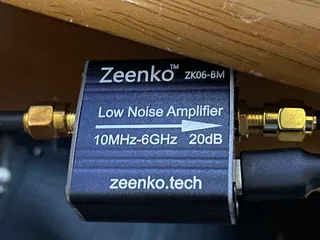
- I Bought a Cheap Wideband LNA from AliExpress, the Zeenko ZK06-BM• #RadioI used the Zeenko ZK06-BM to intercept METEOR-M2 4 and got the best satellite image I've ever received.
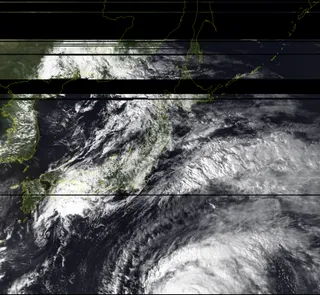
- Receiving METEOR M2-4 Weather Satellite Images with an RTL-SDR and a Homemade Yagi Antenna• #RadioI took on satellite reception with a homemade antenna that cost 300 yen (about $2).
- Building a Homemade Preselector to Improve RTL-SDR Reception• #RadioI've finally started doing some actual radio-engineering electronics projects.
- Getting Started with SDR Using an RTL-SDR Blog V4 and a Random Wire Antenna• #RadioA record of trying shortwave listening with a stealthy random wire antenna dangling off my balcony, from setting up the RTL-SDR Blog V4 to the before-and-after sensitivity gains of a homemade 9:1 unun.

Notes on games, radio and technology, translated from the Japanese blog.