The Time Has Come to Face Kitaro Nishida

Table of Contents
Recently, I watched the 100 Minutes on a Masterpiece episode on Kitaro Nishida’s An Inquiry into the Good.

And lo and behold, what did they introduce in it but the diagram from Hayao Kawai’s The Structure of Unconsciousness!
Reading Impressions and Key Takeaways: Hayao Kawai’s The Structure of the Unconscious
To put it super roughly, what Nishida calls “the Good” is apparently for each individual to discover what lies in what Hayao Kawai (= Jung) calls the “collective unconscious.”
What’s more, Nishida was supposedly fond of the Ensō diagram. That very same one Joseph Campbell loved!

So when I looked into it further, it turned out that D.T. Suzuki, who had a Zen influence on Campbell, was Kitaro Nishida’s close friend.
And the person who contributed the foreword to D.T. Suzuki’s major work An Introduction to Zen Buddhism was none other than Jung himself.
This is a big deal. Through Kitaro Nishida, my separate interests have all linked together into one.
The Navel of the World
Around the beginning of The Hero with a Thousand Faces, I remember there was a line to the effect of: “churches and the like are the navel of the world, but every human being is itself the navel of the world (and ought to discover themselves as such).” I didn’t really understand what that meant at the time, but through Nishida’s phrase “the eternal now,” I feel like I’ve finally started to get it.
According to Kitaro Nishida:
When one speaks of the eternal now, nunc aeternum, it may immediately be thought of as mystical, and mystics indeed thought by this of the “eternal being,” that is, God. But by my determination of the eternal now, I mean simply that the present determines the present itself. Passing time and eternity touch one another in the present; nay, there is no eternity apart from this present wherein the present determines itself. It is precisely where the present is conceived as determining itself that the true meaning of eternity lies.
That’s the idea. Reading this, what came to mind first was T.S. Eliot’s Four Quartets.
Time present and time past
Are both perhaps present in time future,
And time future contained in time past.
If all time is eternally present
All time is unredeemable.
At the still point of the turning world. Neither flesh nor fleshless;
Neither from nor towards; at the still point, there the dance is,
But neither arrest nor movement.
In Four Quartets, there was also supposed to be a line along the lines of “the end of the world (the destination of the pilgrimage) is here and now (England).”
The similarity of these ideas is startling. Even though Nishida says that “the eternal now is not the God spoken of by mystics,” when you think of “the eternal now” = “the still point of the turning world” = “the destination of the pilgrimage” = “the axis mundi” = “the navel of the world,” so many things click into place.
In other words, Campbell’s statement that “every human being is the center of the world” is a message telling us to awaken to the realization that the “sacred center”—which used to be sought in specific places like churches—actually lies within the “eternal now (= the center of the world)” inside every single one of us. Wasn’t it a call to pivot from the Western mindset that places a transcendent God “outside” to an Eastern (Nishida / D.T. Suzuki-style) mindset that finds truth “within”?
…To take this any further, it seems I’ll need to study Kitaro Nishida in earnest.
The Map
Once again, I made a diagram of the key figures and the relationships of influence in this area that captivates me.

I used to wonder what possible use there could be in knowing the exact birth and death years of famous people, but it turns out they’re necessary in moments like this so you don’t invert cause and effect…
The True Map
With just this diagram, though, the sheer shock of “Everything has been tied together by Kitaro Nishida!” might not quite come across. So, I have prepared the true map—the one where I’ve lost my mind.

As expected, this probably makes zero sense, so let me explain.
Actually, this wasn’t my first time taking on Kitaro Nishida. My first attempt goes back to high school.
I had stepped away from Touhou for a while, but during our high school class trip, a friend I wasn’t particularly close to (who had apparently seen me playing Patchucon from behind during computer class) struck up a conversation with me. We hit it off talking about Touhou, and my passion reignited. After getting home, I played Touhou Chireiden ~ Subterranean Animism for the first time in ages, and was blown away by the Extra stage theme, “Last Remote.”
Now, the destination of that class trip was Kyoto. And naturally, as a Touhou nerd, you secretly weave temples and shrines that might have some connection into your group’s itinerary.
Among those attempts was Kyoto’s “Philosopher’s Path” (Tetsugaku no Michi).

What tied these elements together was the following description on the Touhou Reference Wiki (Touhou Motoneta Wiki):
- The Philosopher’s Path
- A small path in Kyoto stretching from Kumano Nyakuoji Shrine to Ginkaku-ji.
- The symbol of Kumano Shrine is the Yatagarasu (three-legged crow).
- Named after the fact that philosopher Kitaro Nishida used to walk it. Nishida philosophy is centered on theories formulated about the unconscious and the body that make our consciousness possible.
- A small path in Kyoto stretching from Kumano Nyakuoji Shrine to Ginkaku-ji.

Talk about an absurd stretch. But at least at the time, I agreed with this description. The Subterranean Animism Extra stage is taking place right on the Philosopher’s Path! I feel like some unhinged screed I wrote ages ago on this subject is still lingering somewhere on my computer.
And so, wondering what on earth Koishi Komeiji could possibly have to do with Kitaro Nishida’s thought, I tackled An Inquiry into the Good and promptly crashed and burned. That was my first encounter with Kitaro Nishida.
Let’s shave off even more sanity. In my mind, there is an understanding that Koishi Komeiji, Kaban-chan, and Shamiko are essentially the same being.
Kitaro Nishida says that “the real world is an absolute contradictory self-identity.” What does this mean? As far as I know, it means that “different things are united as one while remaining different.” Realizing this for the particulars of “animals and humans” is Kaban-chan; attempting to realize this for the particulars of “Light and Darkness” is Shamiko.
When it comes to Koishi-chan and Shamiko, you’ll surely agree that they are similar in the ability-based aspect of intruding into the unconscious realm. As for Koishi-chan and Kaban-chan, their appearance is similar.
In other words, they are “The Hero with Three Faces.” Imbuing some kind of meaning into this trinity has been my homework for roughly the past five years. And as you can tell by looking at the diagram above, Kitaro Nishida appears to have exerted quite a significant influence on them.
Hence why I feel: the time has finally come to face Kitaro Nishida.
According to Gemini
Since I haven’t been able to research anything myself yet, for now I’m pasting the content that Gemini’s Deep Research compiled on Kitaro Nishida and Joseph Campbell. I’ll verify the factual accuracy of the contents later. At the very least, it doesn’t look like it’s telling blatant lies regarding Joseph Campbell.
Kitaro Nishida and Joseph Campbell: A Dialogue Between Thinkers Who Never Met
Introduction: A Dialogue Between Thinkers Who Never Met
In the intellectual history of the 20th century, there stand two giants who each opened up the horizons of knowledge in the East and the West through their own distinct methods: the Japanese philosopher Kitaro Nishida (1870–1945) and the American mythologist Joseph Campbell (1904–1987). This report aims to elucidate the profound and astonishing intellectual resonance and indirect connections that exist between these two thinkers, who shared no historical points of contact such as direct correspondence or meetings. In Campbell’s extant correspondence and papers, no direct references to Kitaro Nishida are found, and there is no concrete evidence that either read the other’s works.
Yet despite the lack of confirmed direct interaction, why do their thoughts resonate so powerfully on themes such as “the transformation of the self,” “the primacy of experience,” and “the relationship between the individual and the universal”? This report takes that question as its starting point of inquiry. In unraveling this riddle, this study establishes as a central perspective the existence of a key figure who bridges the two: the Zen Buddhist scholar D.T. Suzuki (Daisetz Teitaro Suzuki, 1870–1966), who was Nishida’s closest lifelong friend and an immense influence on Campbell. By placing Suzuki on the analytical table as an “intellectual bridge,” we can illuminate the process by which the Zen experience underlying Nishida’s philosophy was transformed through this extraordinary mediator and flowed into the fertile soil of Campbell’s mythology.
This report adopts a three-part structure. Part I overviews Kitaro Nishida’s philosophical system, tracing the trajectory of his thought from “pure experience” to the “logic of place” (basho) and culminating in “absolute contradictory self-identity.” Part II explicates Joseph Campbell’s mythology, focusing on its core concepts: the “Hero’s Journey (monomyth),” the “four functions of myth,” and his relationship with Eastern thought. Then, in Part III, after analyzing the role of D.T. Suzuki as a bridge, we conduct a comparative analysis of both thinkers, examining in detail their intersections and divergences in radical empiricism, the structure of self-transformation, and their approaches to universality. In doing so, we will reveal how these two thinkers who never met were nonetheless “looking at the same moon from different mountain peaks.”
[Table 1: Comparative Chronology] The Lives and Major Works of Kitaro Nishida and Joseph Campbell
This chronology visually presents the historical context of their intellectual development and the possibility of indirect influence by juxtaposing the active periods and publication dates of major works by Kitaro Nishida and Joseph Campbell alongside the Western activities of D.T. Suzuki, who mediated between them intellectually. Comparing the year of Nishida’s death (1945) with the publication of Campbell’s magnum opus The Hero with a Thousand Faces (1949), one clearly sees that Campbell’s thought entered its mature phase after Nishida’s philosophy had already completed its system. This chronological arrangement suggests the plausibility of this report’s central hypothesis: that Suzuki, Nishida’s intellectual ally, introduced the Zen experience underlying Nishida’s philosophy to the Western world, thereby influencing the formation of Campbell’s thought.
| Decade | Kitaro Nishida (1870–1945) | D.T. Suzuki (1870–1966) | Joseph Campbell (1904–1987) |
|---|---|---|---|
| 1870s | 1870: Born in Ishikawa Prefecture. | 1870: Born in Ishikawa Prefecture. | |
| 1890s | 1891–1894: Studies in the elective course at Tokyo Imperial University. Begins Zen practice. | 1893: Attends the World’s Parliament of Religions in Chicago. | |
| 1900s | 1897–1909: Travels to the United States; engages in translating and introducing Eastern thought into English under Paul Carus. | 1904: Born in New York. | |
| 1910s | 1910: Appointed assistant professor at Kyoto Imperial University. 1911: Publishes An Inquiry into the Good. | ||
| 1920s | 1926: Publishes the paper “Place” (Basho), developing the “logic of place.” | 1924: Meets Jiddu Krishnamurti aboard ship to Europe, deepening interest in Eastern thought. 1927–1929: Studies in Europe; influenced by Jung, Joyce, Mann, and others. | |
| 1930s | Deepens reflections on his late philosophy of “absolute contradictory self-identity.” | 1934: Publishes Outlines of Mahayana Buddhism (in English). 1936: Lectures at British and American universities. 1938: Publishes Zen and Japanese Culture (in English). | 1934: Appointed professor at Sarah Lawrence College (until 1972). |
| 1940s | 1945: Passes away in Kamakura. | 1949: Publishes The Hero with a Thousand Faces. | |
| 1950s | From 1951: Lectures at Columbia University and elsewhere. Influences Alan Watts, John Cage, and others. | 1950s: Participates in the Eranos Conferences hosted by the Jungians. 1959: Publishes The Masks of God, Vol. 1: Primitive Mythology. | |
| 1960s | 1966: Passes away at St. Luke’s International Hospital. | 1960s: Continues publishing The Masks of God series. | |
| 1970s | 1972: Retires from Sarah Lawrence College. | ||
| 1980s | 1987: Passes away in Hawaii. 1988: Dialogue with Bill Moyers, The Power of Myth, broadcast and published. |
Part I: The Philosophy of Kitaro Nishida — The Abyss of Experience and the Logic of “Nothingness”
Chapter 1: The Horizon of Pure Experience
At its starting point, Kitaro Nishida’s philosophical system sets down the original concept of “pure experience.” This refers to direct, concrete experience itself, prior to the bifurcation of subject (the “I”) and object (the world), unmixed with any intellectual operations such as judgment or reflection. In An Inquiry into the Good, Nishida declared that “the moment of seeing a color or hearing a sound, before one has even thought that this is the activity of an external object or that one is sensing it, and before one has even added the judgment of what this color or sound is” constitutes “experience in its purest state”—that is, the most genuine experience, and the sole reality.
This proposition of “pure experience” was not merely a description of some particular state of consciousness. It was the declaration of a fundamental shift in perspective regarding the foundational questions of philosophy. While many commentaries cite immersion in beautiful music or an athlete’s state of deep concentration to explain pure experience as a psychological “flow state,” Nishida’s own intent was far more radical. As indicated by his words, “I would like to explain all things on the basis of pure experience as the sole reality,” this was an attempt aimed at reconstructing ontology, transcending the domain of psychology. Whereas modern Western philosophy since Descartes posited two substances at the foundation of the world—the “thinking thing” (res cogitans, the subject) and “extended thing” (res extensa, the object)—Nishida questioned this dualistic premise itself. According to him, both subject and object are nothing more than posthumously differentiated, abstract entities derived from the more primordial “event of experiencing.” The inverted insight that “it is not that there is an individual and then experience; rather, there is experience and then the individual” was the beacon of a grand metaphysical project: shifting philosophy’s foundation from static “being” to dynamic “experiencing.”
Lying deep at the source of this original thought was the experience of Zen practice that Nishida maintained from his youth throughout his life. The states of “the oneness of mind and object” (shinkyō ichinyo), where subject and object unite, and “the oneness of all things” (banbutsu ittai), where the self and all creation are felt as one, served as the primal experiences of his philosophy. Zen’s “non-reliance on words and letters” (furyū monji)—that is, the emphasis on direct awakening free from distinctions of language and logic—resonates profoundly with Nishida’s discovery of true reality in experience prior to intellectual judgment. That Nishida’s philosophy is acclaimed as “the first original philosophy of modern Japan” is due precisely to this unprecedented undertaking: attempting to systematize this Zen experience with the logical rigor of Western philosophy.
Chapter 2: The Discovery of “Place”
In the middle period of his philosophical career, Nishida further deepened his early thought on “pure experience” and carved out a new conceptual horizon to ground it logically. This was the “logic of place” (basho no ronri). This logic takes its departure from the simple yet primordial intuition that “one cannot help but think that whatever exists must exist in something.” For any individual thing or phenomenon to exist as such, there must be a “place” wherein it exists. Nishida’s inquiry shifted from individual entities (the what) to the place that makes being possible (the wherein).
The conclusion reached by Nishida’s reflection was that this ultimate “place” cannot be defined as any particular “being” (yu), but must be “Absolute Nothingness” (zettai mu). The “nothingness” spoken of here is fundamentally different from “nothing” in Western philosophy—that is, the mere absence or void of being. Nishida’s “Absolute Nothingness” is a concept harboring affirmative, creative potential, closer rather to the “Dao” (Tao) of Laozi and Zhuangzi or the “Emptiness” (śūnyatā) of Buddhism. It is a rich, dynamic field of possibilities (echoing Plato’s chōra) that enfolds all entities within itself and allows each to be established as an individual thing. Nishida himself likened this “place” to an enormous furoshiki (wrapping cloth) on which everything can be laid out, or to a mirror that reflects all things while remaining colorless and transparent in itself.
Borrowing the form of logic, this “place” is defined as “the predicate plane that becomes the subject and does not become the subject.” For example, in the judgment “That sunset is red,” “sunset” is the subject (S) as an individual thing, and “red” is the predicate (P) as a universal quality. In conventional logic, S and P are separate entities linked by the judgment. But Nishida considered that this judgment is established because the particular “sunset” determines itself in the “place” of the universal “redness in general.” In short, the universal (place) enfolds the individual thing (subject) within itself, allowing it to be.
This “logic of place” does not merely envision a static “container” or “stage.” As Nishida’s thought deepened, “place” took on an increasingly dynamic character, reconceived as an “environment” interacting with individual things. A mutually determining relationship emerges wherein individual things influence the environment, and the environment conditions individual things. This dynamism eventually reaches the self-referential movement wherein “place determines place itself.” This signifies that rather than the place merely accommodating things, the place itself undergoes transformation, generating new particulars in a creative process. Consequently, Nishida’s “place” must be understood not merely as a static logical foundation, but as a vital, dynamic “field” in which processes of self-transformation—such as individual “self-awareness” (jikaku) and historical creation—unfold.
Chapter 3: Absolute Contradictory Self-Identity and the Formation of the Self
The core concept at which Nishida’s philosophy ultimately arrived is “absolute contradictory self-identity” (zettai mujunteki jikodōitsu). What this difficult term points to is the profound realization that the real world in which we live contains contradiction at its very foundation. Nishida maintained that logically incompatible opposites—life and death, the one and the many, the universal and the particular, the self and the world—dynamically form the real world precisely by negating each other, mediating each other, and mutually determining one another.
This logic stands apart from Hegelian dialectics, which overcomes opposition (thesis and antithesis) by synthesizing them at a higher level (synthesis). In Nishida’s dialectic, contradiction is not something to be resolved; rather, it is the primordial mode of reality itself. In the place of Absolute “Nothingness,” opposing terms remain in opposition while serving as moments of the self-identity of the one. For instance, the individual thing (the particular) can be an individual thing by negating the universal “place,” yet at the same time it can exist only within that “place.” Conversely, the universal “place” can manifest its working only by determining itself in the individual thing. In this way, the state in which absolutely contradictory terms mutually depend on one another to exist is the very visage of reality.
This logic of “absolute contradictory self-identity” becomes the key to elucidating the formation of the human “self”—that is, the structure of “self-awareness” (jikaku). According to Nishida, the true self is not a fixed, substantial ego. It is the unceasing process of self-formation itself. The true self arrives at a more primordial self only through self-negation—that is, by transcending ordinary ego-consciousness. As Nishida noted, “That self-awareness wherein the self knows itself is a self-contradiction,” self-awareness is a contradictory movement in which the self objectifies itself (departing from the self) while simultaneously becoming one with that objectified self (returning to the self). This process of self-transformation is nothing less than an unceasing creative process in which the particular reflects the universal (place) within itself, and the universal determines itself in the particular.
Part II: The Mythology of Joseph Campbell — The Archetypal Journey and the Exploration of the Psyche
Chapter 1: The Hero with a Thousand Faces
In his comprehensive comparative study of myths, legends, and folktales from around the globe, American mythologist Joseph Campbell discovered that these narratives, transcending culture, era, and geography, share an astonishingly common basic structure. He named this universal narrative pattern the “monomyth” (single myth), or more widely known, “The Hero’s Journey.”
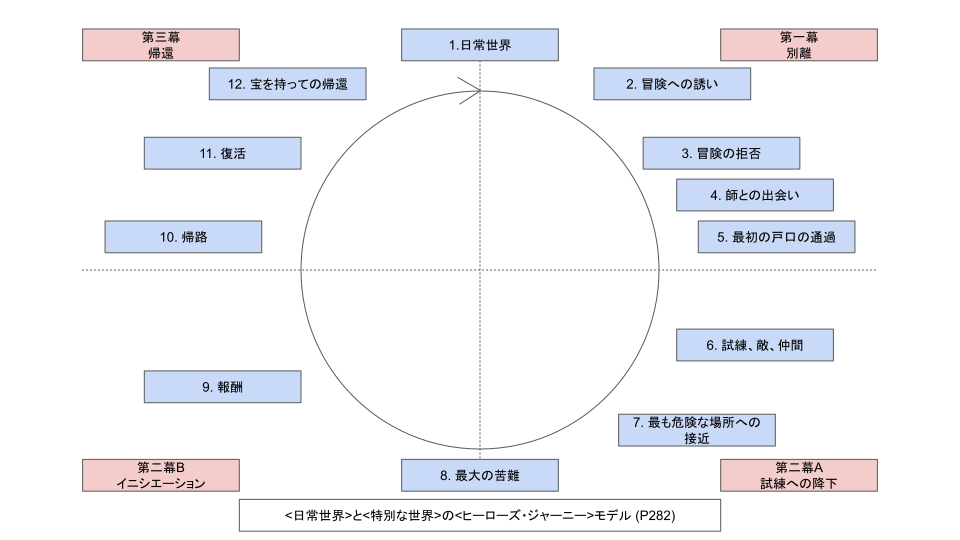
The structure of the “Hero’s Journey” presented by Campbell in his magnum opus The Hero with a Thousand Faces (1949) is broadly composed of three major stages: “Separation,” “Initiation,” and “Return.” This journey begins when the protagonist, living in the ordinary world, receives “The Call to Adventure.” While the protagonist may initially refuse this call, they eventually resolve to depart through encounters such as “Meeting with the Mentor,” and step into an extraordinary world by “Crossing the First Threshold.” In the unknown world, the protagonist encounters various “Tests, Allies, and Enemies,” undergoing personal growth. At the journey’s climax, deep within the most dangerous place, they face “The Ordeal,” experiencing death and rebirth. Having overcome this trial, the hero obtains the ultimate treasure, “The Reward,” and finally accomplishes “The Return” to their homeland in a transformed state. Campbell argued that this circular structure is the underlying backbone running through hero tales across all times and places.
The “Hero’s Journey” is not merely a typology of narratives. For Campbell, it was a universal metaphor symbolizing the process of personal internal growth, self-discovery, and psychological integration. The dragons and monsters the hero confronts on the journey are often embodiments of their own inner fears, repressed desires, and immaturity—their “shadow.” The journey’s progression illustrates a psychological path for integrating the realms of consciousness and the unconscious, leading to a more mature and integrated personality. As George Lucas openly acknowledged when building the story of the film Star Wars, this model continues to exert immense influence across modern storytelling, psychotherapy, and personal development.
Chapter 2: The Power of Myth
Campbell was deeply troubled that in modern society, dominated by science and technology, people had become alienated from myth and tended to lose sight of the meaning of life and the joy of living. For him, mythology was not an academic exercise confined to a scholar’s study, but an intensely practical endeavor to revive the lost power of myth in modern times, enabling people to reclaim the richness of “the experience of being alive.” In his late masterpiece, The Power of Myth, he presented four vital functions that myth can still fulfill today:
- The Mystical/Metaphysical Function: Myth awakens a sense of awe before the fathomless mystery of the universe surrounding us. It serves as a window opening us to an experience of touching the foundation of existence that transcends words and reason.
- The Cosmological Function: Myth presents a comprehensive image of what the world is like. While science explains “how,” myth presents through symbolic narrative the overall picture of the cosmos and humankind’s place within it.
- The Sociological Function: Myth validates and maintains a particular social order. It establishes ethical norms and rites of passage within that society, providing models for how an individual should conduct themselves within the community.
- The Psychological/Pedagogical Function: Myth serves as a guide showing human beings how to live meaningfully through each stage of life, from birth to maturity, old age, and death. The stories of heroes provide a handbook for overcoming difficulties in the journey of our own lives.
Campbell placed great weight on these functions, especially the fourth, psychological function. He considered myth to be a timeless treasury of wisdom for guiding the individual’s inner journey and realizing a way of life that resonates with one’s innermost being.
Chapter 3: Resonance with Eastern Thought
Joseph Campbell’s wide-ranging system of thought was deeply influenced not only by Western classics but also by profound Eastern spiritual traditions. In understanding this intellectual background, the presence of two thinkers is of particular importance.
First is the Swiss psychologist Carl Gustav Jung. Campbell’s comparative mythology is deeply rooted in Jung’s analytical psychology, especially the concepts of the “archetype” and the “collective unconscious.” That myths from completely disparate cultures across the globe exhibit common figures and motifs—such as the hero, the wise elder, the Great Mother, and the trickster—stems, Campbell believed, from the fact that humankind possesses at the deepest layer of the psyche an unconscious realm shared as a species (the collective unconscious), where these universal archetypes lie latent. The Hero’s Journey was interpreted as a process of descending into this realm of the collective unconscious, confronting archetypal forces, and integrating them into one’s conscious self.
Second is the Japanese Zen Buddhist scholar D.T. Suzuki. While on the ship returning from a trip to Europe in 1924, Campbell met Jiddu Krishnamurti of the Theosophical Society and deepened his interest in Indian thought; however, what decisively oriented his understanding of the East was D.T. Suzuki. Like Alan Watts and other American intellectuals of the era, Campbell attended the lectures Suzuki gave at Columbia University and avidly read his writings. The Zen that Suzuki introduced to the West emphasized its aspect as a “philosophy of experience”—not dependent on specific dogmas or scriptures, but elevating “intuitive experience” beyond logic and discrimination to the supreme place. This stance resonated powerfully with Campbell’s thought, which valued the direct, transformative experience brought about by myth. In a lecture, Campbell quoted Suzuki’s words to contrast the Western “belief in God” with the Eastern “experience of identity with God,” explicitly arguing for the superiority of the latter. Through Suzuki, Campbell discovered in Eastern thought the concrete practice of the “lived wisdom” that his own mythology sought.
Behind the fact that Campbell’s thought went beyond mere academic scholarship to exert a powerful influence on how many people live their lives lies his presentation of these universal mythic patterns as guidelines for modern individuals living their “personal” lives. His celebrated motto, “Follow your bliss,” epitomizes this practical dimension. Myths are not to be worshipped as absolute truths external to the individual; rather, they are reinterpreted as “tools” and “maps” to draw out the individual’s inner potential and aid in self-actualization. This approach held an extraordinary affinity with the American cultural soil that prizes individualism and self-fulfillment, becoming a major factor in the widespread acceptance of his thought. Campbell’s achievement can be evaluated as having created, through universal mythic structures, a “practical spiritual technology” for post-modern individuals to find meaning in their own lives.
Part III: Indirect Pathways and Intellectual Intersections
[Table 2: Conceptual Parallels] Comparison of Key Concepts in Nishida’s Philosophy and Campbell’s Mythology
The table below compares the core concepts of Kitaro Nishida’s and Joseph Campbell’s thought systems along four common themes—“Primordial Experience,” “The Path of Self-Transformation,” “The Ground of Universality,” and “The Integration of Opposites”—clarifying their structural similarities (convergence) and philosophical differences (divergence). This table functions as a roadmap for grasping the overall picture of the detailed comparative analysis developed in this chapter. It shows how the thoughts of both thinkers, expressed at first glance in completely different vocabularies, share a common awareness of problems at a deep level, and yet sought to answer those questions in markedly different ways.
| Theme | Kitaro Nishida’s Concept | Joseph Campbell’s Concept | Convergence | Divergence |
|---|---|---|---|---|
| Primordial Experience | Pure Experience | Mythic Experience / Experience of Being Alive | Absolute emphasis on the direct, experiential dimension where subject and object are undifferentiated. | Methodology: Seeks to reach the ground of reality through rigorous philosophical introspection (Zen contemplation), versus seeking to restore the wholeness of life through participation in narrative (re-experiencing symbols). |
| The Path of Self-Transformation | Self-Awareness (Jikaku) | Hero’s Journey | A model of self-transformation as a step-by-step process of transcending the limits of the ordinary ego to arrive at a deeper self. | Teleology: Aims for an ontological awakening that realizes “Absolute Nothingness” as the ground of the self, versus emphasizing psychosocial integration and return, bringing back the wisdom gained through trials to the community. |
| The Ground of Universality | Place of Absolute Nothingness (Basho of Absolute Nothingness) | Monomyth / Archetypes | The search for a universal structure and ground underlying all human existence beyond individual entities and narratives. | Nature: Universality as a metaphysical “field” of Nothingness that enables all existence, versus universality as narrative “forms” rooted in the shared psychological structure of humankind (the collective unconscious). |
| The Integration of Opposites | Absolute Contradictory Self-Identity | Trials and Reward / Integration of the Shadow | The recognition that contradiction and opposition (good and evil, life and death, conscious/unconscious) are the keys to transformation and growth. | Logic: A logic of “place” where contradictory terms are unified while remaining contradictions (simultaneous co-presence), versus growth within narrative time where conflicts are overcome and opposing terms are integrated. |
Chapter 1: D.T. Suzuki as a Bridge
In elucidating the intellectual resonance between Kitaro Nishida and Joseph Campbell, the presence of D.T. Suzuki is indispensable. He functioned not merely as an intermediary, but as a “transformer” and “translator” of ideas.
Nishida and Suzuki were inseparable close friends since their days at the Fourth Higher Middle School in Ishikawa Prefecture, maintaining deep intellectual exchange throughout their lives. Both threw themselves deeply into Zen practice, but their ways of expressing that experience were contrasting. While Nishida struggled to systematize his Zen experience using the conceptual apparatus of Western philosophy as a thoroughly universal “logic,” Suzuki undertook the role of directly introducing the spirit and culture of Zen itself to the Western world in accessible and powerful English.
The “ZEN” that Suzuki conveyed to the West was not confined to the sectarian dogmas of Japan. He presented Zen as a universal “philosophy of experience” capable of entering into dialogue with Western mysticism, psychology, and even existentialism. What he emphasized was not faith in dogma, but the paramount importance of direct experience (satori) that transcends discriminating intellect—an approach that exerted a major influence on Western intellectuals of the time who were skeptical of established religious authorities.
Joseph Campbell was likewise among those deeply captivated by Suzuki’s “ZEN.” Alongside figures such as Alan Watts, he was deeply moved by the lectures Suzuki delivered at Columbia University and read his works intently. In particular, the stance of placing absolute primacy on “experience” presented by Suzuki is considered to have decisively reinforced Campbell’s perspective in viewing myth not as mere ancient stories, but as a “psychological reality” that we living today can experience internally.
Here emerges the indirect intellectual pathway leading from Nishida to Campbell. This pathway was not a simple transmission of information. It was a dynamic process wherein a single intellectual source was reinterpreted and transformed across different cultural contexts. It is hard to imagine that Nishida’s extremely abstruse and abstract philosophy crossed the Atlantic as-is to influence Campbell directly. Rather, the core element of the “Zen experience of undivided subject and object” at the root of Nishida’s philosophy was first “translated” by that preeminent translator, Suzuki, into a “psychological and experiential” discourse intelligible to Westerners. Then Campbell, who already possessed the receptive ground of Jungian psychology, absorbed and integrated this “interpreted Zen” into his own mythological system. In this sense, one can say that Campbell, without knowing Nishida’s philosophy, was in contact with a rich stream deriving from the headwaters of that same thought.
Chapter 2: The Primacy of Experience — “Pure Experience” and “Lived Myth”
When comparing the thought of Nishida and Campbell, the most prominent commonality is that both placed absolute primacy on direct, concrete “experience” over abstract theories and dogmas.
The “pure experience” that Nishida took as the starting point of his philosophy viewed vivid direct experience, prior to the division of subject and object, knower and known, as true reality. For him, the world is given first as experience, while concepts such as subject and object were merely secondary byproducts born from subsequently reflecting upon and analyzing that primordial experience. From this perspective, true “knowing” is not the objective analysis and possession of an object as knowledge. Rather, true cognition is established precisely when the distinction between object and self vanishes and they become one—in the relationship that Nishida termed “love is knowing, knowing is love.”
On the other hand, Campbell likewise viewed myth not as a mere object of study or relic of the past, but as a living force for enriching “the experience of being alive” and imparting meaning to life. For him, the value of myth lay not in whether its tales were historical facts, but in the fact that reliving these symbolic narratives brings about a profound inner transformation within ourselves. Reading myth is to participate psychologically in the hero’s journey, experiencing the trials, conflicts, death, and rebirth they confront as metaphors for our own lives.
In this manner, both fundamentally questioned the nature of knowledge within their respective fields. Nishida in philosophy and Campbell in mythology attempted to transform knowledge from something objectively “possessed” into something subjectively “participated in.” Just as Nishida sought to attain the “pure experience” of the unity of subject and object through Zen contemplation, Campbell sought through participation in myth to awaken a “mythic experience” in which the self and the archetype unite. What both aimed for, one could say, was the reintegration of the self and the world—fragmented by intellect and discrimination—at the dimension of primordial experience.
Chapter 3: The Topology of Self-Transformation — “Place” and the “Hero’s Journey”
The thought of both Nishida and Campbell takes human “self-transformation” as its central theme. And remarkably, while their modes of expression differ between philosophy and mythology, the models of self-transformation they presented exhibit striking parallels in their structure (topology).
Campbell’s “Hero’s Journey” depicts the structure of the narrative space (journey) in which self-transformation unfolds. It is a process with distinct phases: departure from the everyday, descent into the depths and trials, reaching the foundation and undergoing transformation, and returning once again to the ordinary world.
- Departure from the Everyday: The journey begins with the “Call to Adventure” and “Crossing the Threshold.” This corresponds to the first step away from the state of stable, ordinary ego-consciousness (what Nishida calls “reflective consciousness”) toward the more primordial and unknown realm of the self.
- Descent into the Depths and Trials: The stage where the hero battles monsters in an unknown world and confronts varied trials parallels the process in which the self confronts inner contradiction (Nishida’s “absolute contradiction”) and deepens toward a profounder dimension through the mediation of self-negation.
- Reaching the Ground and Transformation: The climax of the journey, where the hero overcomes “The Ordeal,” experiences death and rebirth, and secures “The Reward,” corresponds to the moment when the self touches the ground of its existence and is reformed as a self possessing new wholeness.
- Return to the World: The process where the transformed hero returns to the ordinary world bearing the gained wisdom corresponds to the self, having attained primordial awakening, once again becoming a creative “working agent” within historical and social reality.
On the other hand, Nishida’s “logic of place” elucidates the structure of the logical space (topos) for self-transformation to occur. In his philosophy, the deepening of the self—the process of “self-awareness” (jikaku)—unfolds in stages from the surface to the depths of consciousness. It is a path leading from the “place of being” that cognizes objects, to the “place of for-itself nothingness” that grasps the acts of consciousness themselves, and ultimately to the “place of Absolute Nothingness” that is the foundation transcending consciousness itself. By touching this “place of Absolute Nothingness,” the self is liberated from the shackles of the ordinary ego, attains true freedom, and becomes capable of acting upon the world as a creative self.
If Nishida’s “place” presents the structure of the logical, vertical deepening of self-transformation, Campbell’s “Hero’s Journey” presents the structure of the narrative, horizontal unfolding of self-transformation. While employing different vocabularies and approaches, both resonate deeply in charting the universal topology of self-transformation: the death of the ordinary self and the rebirth of a more primordial self.
Chapter 4: The Question of Universality — “Absolute Nothingness” and the “Monomyth”
Both Nishida and Campbell were thinkers who explored a universal dimension underlying human existence that transcends individual cultures and personal experiences. Yet the nature of the “universality” each conceived was fundamentally different, reflecting their divergent intellectual backgrounds. Clarifying this difference is critically important for accurately situating their intellectual relationship.
The universality Campbell sought was the narrative “Form” found commonly across world mythologies—namely, the “monomyth” and “archetypes.” From myths of diverse cultures, he empirically extracted the shared “skeleton” of the Hero’s Journey and archetypal figures like the wise elder and the Great Mother, presenting these patterns. The ground of this universality was sought in Jung’s theory of the collective unconscious: that in the layer of the unconscious shared by humanity on a psychological level, these archetypal “forms” exist a priori, finding expression across the world as diverse myths. Campbell’s approach possessed a structuralist character, discerning “one story” running through diversity.
In contrast, the universality Nishida sought was a “Field” possessing no particular form, yet making possible the existence of all forms (particulars)—namely, the “place of Absolute Nothingness.” His inquiry was the more primordial question: not “what common forms exist?” but “in what kind of place is it possible for formed things (particulars) to exist at all?” Nishida’s “place” is in itself “Nothingness,” possessing no specific properties. Yet precisely because it is nothingness, it can encompass all opposing attributes (being and non-being, the one and the many) within itself and establish all particulars. This universality is not a common quality appearing within particulars, but so to speak a “universality of form” or “universality of foundational ground” for particulars to appear within.
This contrast can be likened to the contrast between Platonic Theory of Ideas (philosophy of forms) in Western philosophy and Emptiness (philosophy of dependent origination) in Eastern thought, particularly Buddhism. By way of Jungian psychology, Campbell unconsciously approached a psychological variation of Platonic Ideas in the form of archetypes. Nishida, on the other hand, explicitly set Buddhist emptiness as his philosophical foundation, attempting to overcome Western ontology (formal theory). Therefore, while both sought universality, Campbell located its source in the “universality of content (a shared narrative),” whereas Nishida located it in the “universality of form (a shared foundational ground).” Without recognizing this fundamental divergence, no true comparison of their thought is possible.
Conclusion: Looking at the Same Moon from Different Mountain Peaks
As this report has argued in detail, between the Japanese philosopher Kitaro Nishida and the American mythologist Joseph Campbell, there were no historical points of contact such as correspondence or direct meetings. Yet their ideas exhibit an astonishing thematic convergence, as though two individuals gazing upon the same moon from distant mountain peaks.
If we are to summarize this relationship, rather than a direct “influence,” it is most appropriately grasped as an “intellectual convergence”—originating from a shared intellectual source, traversing different routes, and heading toward the same human challenges. The mediator who enabled this convergence was none other than D.T. Suzuki, Nishida’s close friend who exerted a profound influence on Campbell. It is virtually certain that the core of Zen experience at the foundation of Nishida’s philosophy—namely, direct experience prior to the division of subject and object, and the inquiry into self-transformation—underwent transformation through that rare “translator of knowledge,” Suzuki, into Western psychological and mythological discourse, flowing into the intellectual soil of Campbell.
Confronting the persistent dualistic challenges of modernity—logic and experience, the universal and the particular, the self and the world—the thought of both presented unique paths of integration, each shouldering the intellectual traditions of East and West. Arming himself with the Eastern logic of “Nothingness,” Nishida attempted to break through the ontological limits of Western philosophy from within. Campbell, on the other hand, surveyed the shared heritage of humankind across the world’s myths, sketching a map to reclaim the wholeness of the soul that modern humanity had lost amidst scientific rationalism.
Their dialogue without encounter continues to offer rich and powerful implications for those of us living in the contemporary world. In a modern era where globalization progresses even as cultural fractures and the individual’s loss of internal meaning grow acute, their efforts to fundamentally question what the self is and what a meaningful life entails only grow in importance. The ground of self and world that Nishida demonstrated in the “place of Absolute Nothingness,” and the archetype of self-transformation that Campbell illuminated in the “Hero’s Journey,” will serve as timeless guides for living our own lives deeply.
While this report has analyzed their relationship focused specifically on the single point of “D.T. Suzuki,” this exploration opens possibilities for further research. For example, comparing the concept of the “self” in Jungian psychology with that in Kyoto School thought, or analyzing the structure of “experience” between Husserlian phenomenology and Campbell’s mythology—many uncharted territories remain. Kitaro Nishida and Joseph Campbell: the dialogue without encounter between these two great thinkers will surely remain an inexhaustible, rich vein yielding new insights for generations to come.
More articles
- Kemonomyth: Kemono Friends and the Monomyth (Japanese Translation & Transcript)• #Kemono FriendsFull Japanese translation and transcript of the legendary Kemono Friends video essay 'Kemonomyth'.

- On the 2channel Ghost Story 'Resort Baito'• #Hero's JourneyAn analysis of the 2channel ghost story 'Resort Baito' based on the Hero's Journey and internet archaeology.

- Titanic: Inner and Outer Problems• #Hero's JourneyIn The Writer's Journey, there is a section titled "A Hero's Journey Analysis of Titanic." As the name suggests, it analyzes Titanic using the Hero's Journey framework.

- The Demon Girl Next Door Commentary: A More Detailed Analysis Through Season 2 Episode 6 Using the Hero's Journey• #The Demon Girl Next DoorHaving read about halfway through The Writer's Journey, I'm going to do a more detailed analysis of the first half of The Demon Girl Next Door Season 2.

Notes on games, radio and technology, translated from the Japanese blog.