On the 2channel Ghost Story 'Resort Baito'

Table of Contents
A test run analyzing a classic Sharekowa (Japanese internet creepypasta) masterpiece using the framework of the Hero’s Journey.
Not sure if I’ll keep this series going, but the memorable first installment is “Resort Baito” (Resort Part-Time Job). It’s the story of three young men who go to work a live-in part-time job at a Japanese inn (ryokan), go through a horrifying paranormal experience, and get rescued by a highly capable Buddhist monk.
Personally, with developments like:
- Getting possessed by a malicious local entity
- A Buddhist monk coming to the rescue
- Confining themselves to a room for a whole night to survive
it felt like the textbook, cookie-cutter Sharekowa formula, so I wasn’t really a fan of it.
Origins
However, it occurred to me that maybe “Resort Baito” was actually the originator of this very cliché. So I started digging, but I couldn’t pinpoint exactly where it first appeared or what year it was published.
In the first place, people generally assume it originated on 2channel, but is that really true? While it has been widely copied and pasted across the web, I’ve never once seen a version that still retains the characteristic 2channel metadata—the poster handle, date, and user ID. Of course, it’s possible that those parts were stripped away in the process of copypasting. But for other ghost stories originating from 2ch, that post metadata usually survives somewhere. It feels unnatural.
While my investigation ended up incomplete, here is a summary of the trail I’ve uncovered so far.
Fushigi.net
For instance, this aggregator blog lists a publication date of 2011/04/29. However, the comment section only has comments from February 2017 onward. Even checking the Wayback Machine, there are no snapshots from before 2017/04/24.

Kowabana
On a user-submitted story site called Kowabana, this tale is posted with a timestamp of 2011/07/16.
Notice the end of the URL path here. The final integer seems to be a serial number for stories submitted there, meaning this piece was the second story ever posted to the platform. The poster is the site’s official administrative account, so they likely posted it as a test run using a ghost story that was already popular at the time.
Scary Story Submissions: Horror Teller
As of right now, the strongest contender is “Scary Story Submissions: Horror Teller” (Kowai Hanashi Toukou: Horror Teller).
Back then, Sharekowa wasn’t the only place online where scary stories were published. On the Wayback Machine, we can verify that this story had already been posted by 2009/10/04. A scary story aggregator blog also keeps a record of it with the proper source credited. Citing your sources is always essential when quoting.
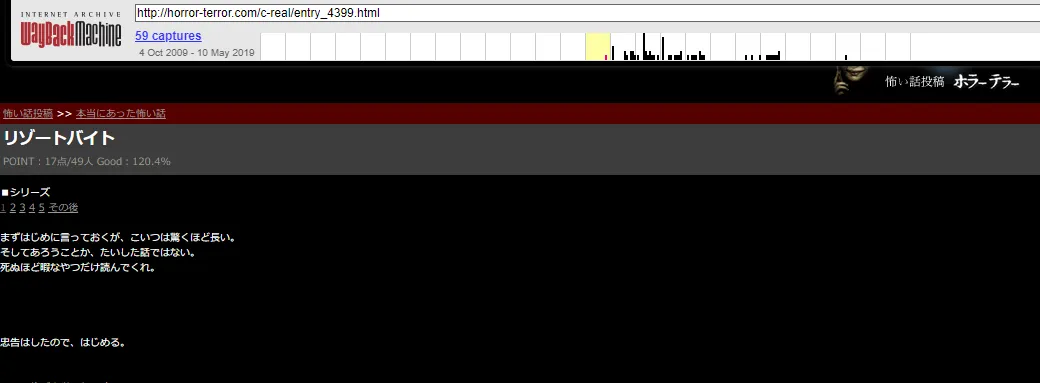
In fact, among the scary stories now considered classic Sharekowa masterpieces, a surprisingly large number seem to have actually debuted on Horror Teller:
- Resort Baito (Resort Part-Time Job)
- Pandora [Kinkou]
- Chika no Maruana (The Round Hole Underground)
- Kankandara
- Real
And so on. None of these actually originated on Sharekowa—they all began on Horror Teller. I was astonished by this myself.
…
Now that finding the original source has cleared things up, let’s return to the main topic.
Just in case, I made a copy of the Wayback Machine record while keeping the author’s original comments intact. My analysis will be based on this copy.
The Hero’s Journey: An Overview
Put very simply, the Hero’s Journey is a set of guidelines that says, “Here is a great way to build a story.”
For more details, please see this article.
The Hero’s Journey consists of 12 stages.

| # | Stage | Summary |
|---|---|---|
| 1 | The Ordinary World | Shows the heroes’ everyday life. Establishes the stakes. |
| 2 | Call to Adventure | Hints at problems with the status quo and raises the adventure’s stakes. |
| 3 | Refusal of the Call | Demonstrates the danger of the adventure to the reader. |
| 4 | Meeting with the Mentor | Prepares for the adventure. Offers advice and bestows magical gifts. |
| 5 | Crossing the First Threshold | The adventure actually begins. Passes the point of no return from the ordinary world. |
| 6 | Tests, Allies, Enemies | Learns the rules of the Special World. |
| 7 | Approach to the Inmost Cave | Prepares and plans to enter the deepest cave. |
| 8 | The Ordeal | Confronts the greatest fear. Death and rebirth of the hero. Transcendence of ego. Initiation. |
| 9 | Reward | Claims the sought-after elixir, the missing person, knowledge, etc. |
| 10 | The Road Back | Attempts to return to the ordinary world. May be pursued by the reward’s owner. |
| 11 | Resurrection | A reenactment of death and rebirth. Must be purified and reborn as a new being before returning. |
| 12 | Return with the Elixir | Brings the reward back to the ordinary world to serve the community. |
However, because these are strictly guidelines, not every single stage needs to be present, nor do they have to appear in this exact order.
The Ordinary World
This happened back when I was a junior in college. With summer vacation just around the corner, five of us college buddies planned a trip to the ocean.
“I” (the narrator) is a third-year college student. He ends up taking two friends with him to work a resort part-time job over summer vacation.
Call to Adventure
B: “Nah, I don’t really know. But lately, hasn’t the okami been taking meals up to the second floor a lot?”
About a week after they start working, B notices the suspicious behavior of the okami (proprietress). A few days later, “I” also witnesses it, and the three of them agree to investigate what she’s actually doing—and what is hidden up on the second floor.
Refusal of the Call
At that point, we still had nearly a month left on our job. The three of us talked it over: should we just pretend we didn’t see anything or not?
Should they really dig into this? The three of them struggle with the dilemma.
The other two friends were scheduled to join us next week anyway, so I figured that as long as nothing went wrong, we’d all have a great time.
This single sentence seems to concentrate the very essence of the [Refusal of the Call] stage. If they refrain from plunging into the extraordinary world, their outwardly peaceful ordinary life can continue. But without embarking on the adventure, they cannot satisfy their curiosity.
Meeting with the Mentor
Anyway, just as B had said, about five minutes after the okami vanished up there, she came back down, and the food on the tray was completely gone.
While there is no explicit mentor in this scene, if we had to name one, it would be B. B was the first to point out the okami’s behavior, and he was the one who knew the most about it.
Crossing the First Threshold
A: “Isn’t it locked or something?”
Brushing aside A’s worries, I turned the doorknob, and it opened effortlessly.
They literally open the door to the staircase leading to the second floor, carrying out the [Crossing the Threshold] into the extraordinary world.
The horrifying ordeal begins.
Tests, Allies, and Enemies
B: “No, seriously. Can’t you smell it? If you open the door wider, you’ll know.”
The three of them are assaulted by one frightening, sickening experience after another. From here up to [The Ordeal], you could perhaps view the narrative as collapsing into a single consolidated stage.
Approach to the Inmost Cave
In the end, we decided I would go up alone, but on the condition that if any emergency happened, they absolutely wouldn’t run away (leaving me behind) and would alert me right away. But if nothing happened, they weren’t supposed to suddenly yell or make noise.
Before climbing the stairs to the second floor, they reorganize their squad.
The Ordeal
Around the frame of the door at the end of the second-floor hallway, what looked like sheets of plywood were nailed shut with countless nails, and on top of that, a massive number of talismans (ofuda) were plastered all over it. On top of that, some kind of thin rope was wrapped around the hammered nails, crisscrossing like a spiderweb.
They close in on the root of horror in this story.
“I,” our hero, ends up in a state where his own memories diverge from his actual actions. You can feel the unmistakable motif of death and rebirth here.
The Reward
B: “It was there. It was watching the whole time from below.”
Then, after a brief silence, he looked down and said:
B: “It’s watching right now, too.”
As the “reward”—if you can call it that—for this sequence of terrifying experiences, B acquires a [New Perception].
The Road Back
You’re probably thinking, “You nearly died yesterday and now you’re feeling sentimental?!”
But honestly, when you’re saying goodbye to someone who took really good care of you, all that other stuff just melts away in the moment.
Realizing they can’t possibly keep working in a place like this, the three of them cut their jobs short and leave the inn.
With this, the three have departed the extraordinary world of the inn. However, they are still trailing the defilement (kegare) of that extraordinary world, which must be purified before they can return to the ordinary world.
Resurrection
Monk: “You must not open this door. Everyone will remain in the main hall. Until tomorrow morning, no one will come here.
Furthermore, you must not speak to whatever is on the other side of the wall. You must not utter a single word inside this sanctuary (ondou). You must not reveal your whereabouts.
I ask of you, please observe these rules without fail.”
Under the care of a Buddhist monk who understands the situation, the three receive an exorcism. It is a reenactment of [The Ordeal]. A literal [Magic Flight]. The three are forced to confront the terror once more.
Personally, I really love the part where they communicate in silence by writing notes on chewing gum wrappers. We could perhaps view this as the [Approach to the Inmost Cave] stage within the localized Hero’s Journey of the “sanctuary exorcism.”
Return with the Elixir
He said they couldn’t save the okami. With an indescribable expression—looking like he might cry, or perhaps enraged—he told us that. When we asked if she died, he said no, that wasn’t it.
The three learn the local legend behind this supernatural horror from the monk.
In this story, [Reward and Punishment] are clearly laid out. The reward the three men obtained was their survival, while the okami who triggered this horror was left beyond saving.
Just as in The Wizard of Oz, the three diverted the death hurtling toward them onto another victim.
Conclusion
So as it turns out, “Resort Baito” is a story that fits the Hero’s Journey template remarkably well.
Perhaps this is one of the reasons it continues to be passed down as a legendary 2channel ghost story to this day.
References
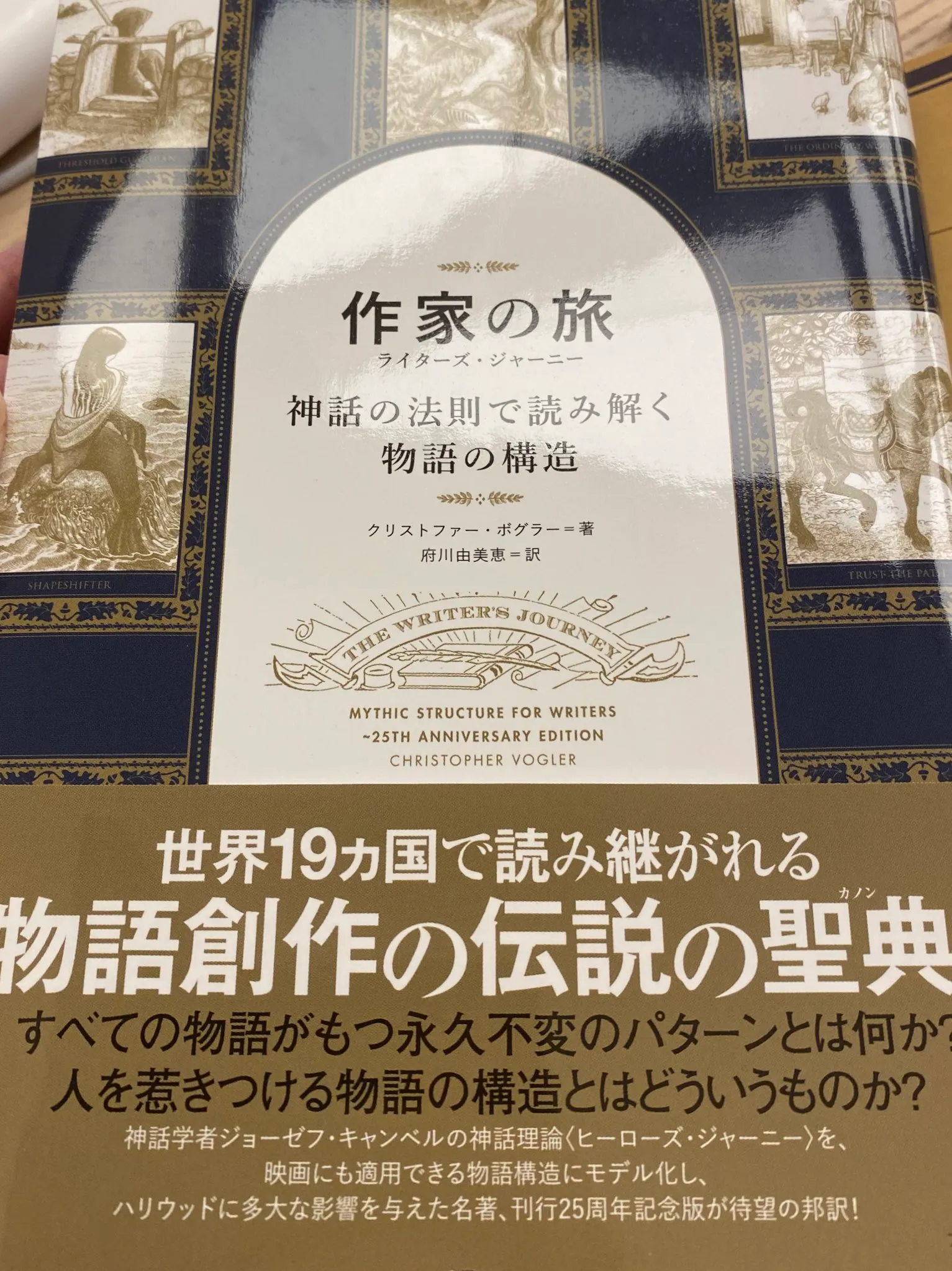
The Writer’s Journey: Mythic Structure for Writers
By Christopher Vogler, translated into Japanese by Yumie Fukawa
Film Art Inc., 2022
More articles
- The Time Has Come to Face Kitaro Nishida• #Hero's JourneyWhen I looked into Kitaro Nishida, I found that his thought seems to have quite a close connection with Joseph Campbell's ideas.
- Kemonomyth: Kemono Friends and the Monomyth (Japanese Translation & Transcript)• #Kemono FriendsFull Japanese translation and transcript of the legendary Kemono Friends video essay 'Kemonomyth'.

- Copy of the Original Japanese Ghost Story 'Resort Baito'• #SharekowaAn archive of the original 2009 Japanese text of the iconic web ghost story 'Resort Baito'.
- Titanic: Inner and Outer Problems• #Hero's JourneyIn The Writer's Journey, there is a section titled "A Hero's Journey Analysis of Titanic." As the name suggests, it analyzes Titanic using the Hero's Journey framework.
Notes on games, radio and technology, translated from the Japanese blog.