A 10-Year Challenge: I Can Finally Kind of Play the Acoustic Guitar

Table of Contents
Lately, I’ve been practicing the acoustic guitar. When I say “lately,” it’s actually been going on for about a year now, which is an abnormal level of obsession for someone like me who usually gets easily fired up and just as easily bored.
Having reached the solid milestone of one full year, I decided to write this article to summarize my journey so far and my goals moving forward.
How It Started
It was ten years ago that I first bought an acoustic guitar. I can’t even remember why I started anymore, but I remember buying a 10,000 yen (about $70) acoustic guitar at Shimamura Music (a major Japanese musical instrument chain) as a gift to myself.
However, I couldn’t barre the F chord, the finger pain was grueling, and I gave up in less than a month. The guitar was stashed away in my closet, and when I moved later on, I handed it off to a friend.
Then, around the summer of last year, I suddenly felt the urge to give guitar another try. While there were several catalysts, the biggest reason was discovering the main theme of Genshin Impact.

What a breathtakingly beautiful piece of music. It had been such a long time since a song drew me in completely on its own merits, without needing any contextual baggage like “because it’s the theme for XYZ.” I felt an overwhelming desire to connect with this piece musically.
Connecting with it musically could have meant DTM or piano, but why did I settle on acoustic guitar? Because I was captivated by Venti in Genshin Impact.

(Actually, I don’t even have him yet, though.)
What he plays is a lyre, but there’s just something so wonderful about the sound of an instrument where you pluck strings with your fingers. And then it hit me: couldn’t I do basically the same thing on an acoustic guitar?
So I bought that acoustic guitar back from my friend and started practicing.
Below is an overview of what I did and the insights I gained.
Finding TABs
Fortunately, since the Genshin Impact main theme is so famous, good-quality TAB scores were easy to find.
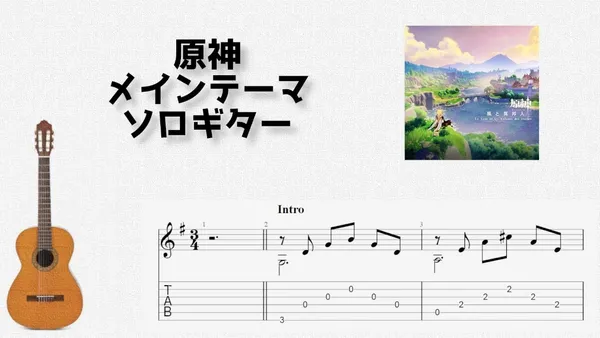
This arrangement was just right: reasonably faithful to the original track while keeping the difficulty low. There aren’t many huge position shifts, nor are there many spots demanding barre chords that usually crush a beginner’s spirits.
Incidentally, among videos sharing TAB for the Genshin main theme, this one was also very appealing:

Purely for listening, this one is actually my favorite, but it clearly looked too difficult, so I passed.
Transcribing TABs by Hand
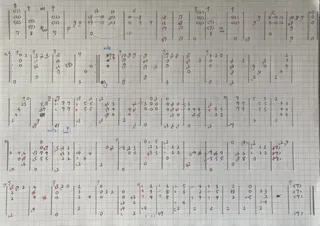
I considered just downloading the TAB or typing it out, but when practicing an instrument, I really wanted sheet music I could write on by hand. So, I transcribed the TAB onto paper by hand.
I tried using an A4 5 mm grid notepad in landscape orientation, and it turned out to be just right.
Like this. While I can technically read standard musical notation, I find MIDI far more intuitive for playing things back in my head, so I set one grid square to represent an eighth note, with the horizontal axis reflecting timing. Note length information is lost with this notation, but I just play that by feel.
By the way, transcribing the TAB onto paper by hand turned out to be an unexpectedly important step. It allowed me to clearly grasp which sections repeat, and by compressing repeated parts using repeat signs as much as possible, my notes didn’t end up scattered all over the place when I added annotations later.
Setting Up the Instrument
And so, time to finally play… or so I thought, but it was still hard. The exact same wall from ten years ago was right there. Unless I clamped down on the strings with crazy force, they would buzz, and forcing them down sent sharp pains shooting through my fingers. My spirit nearly broke: “Am I going to fail again…?”
When I looked into it, I found information stating that when buying a guitar or after leaving it unmaintained for a long time, “action setup” (adjusting string height) is critically important. Action refers to the gap between the strings and the frets.
When I measured it, the action at the 12th fret was over 4 mm. Apparently acoustic guitars are generally set with higher action than electric guitars, but even so, this was absurdly high.
So I cranked the truss rod screw back and forth until I set the height so that plucking the open strings somewhat hard just barely avoided buzzing against the frets. The action at the 12th fret ended up at 2.3 mm for the 6th string and 1.8 mm for the 1st string.
In addition, I replaced the strings for the first time in ten years. Learning that lighter string gauges (thicknesses) require less force to fret, I picked Elixir’s Extra Light gauge, which had great reviews.

↑ Don’t worry, this isn’t an affiliate link.
Once I made these adjustments, it became shockingly easier to play! Especially around the 1st and 2nd frets, I barely had to use any force at all—just a light touch on the string produced a crystal clear note.
Strictly speaking, lowering the action too much or using thinner strings apparently alters the tone, but as a beginner, I decided that sheer playability was far more important than tone.
I had a casual mindset of “Well, it’s just a cheap guitar I bought 10 years ago; if it breaks, I’ll buy another,” so it was fine for me, but adjusting a truss rod seems to be a task requiring specialized skills, so I don’t really recommend doing it yourself. If you’re willing to accept the risk of destroying your instrument, there are plenty of adjustment guides you can Google and refer to.
Apparently many instrument shops will do this for free as post-purchase maintenance, so if that’s an option for you, taking advantage of it is definitely the way to go.
Grooming Your Nails
Just as important as setting up the instrument was grooming my nails. That said, what you do is pretty simple: keep your left-hand nails (the fretting hand) as short as possible, and for your right hand (the plucking hand), maintain about 1.5 mm of the white part. There’s no need to grow them so long that they interfere with daily life.
It’s that simple, but your left-hand nails in particular are worth checking regularly. Whenever I felt like, “Wait, why does this feel harder to play than before?”, it was almost always because my left-hand nails had grown out.
Practice Relentlessly Until the Finger Pain Goes Away
After that, all that’s left is relentless practice.
Looking back, the reason I could stick with practicing without getting bored was my choice of song. Not only is the track itself great, but the difficulty was just right, and above all, logging in every day to claim daily login rewards meant I inevitably heard this song, which reminded me, “Oh right, I need to practice.”
On average, I probably only touched the guitar for about 20 minutes a day, but even so, after about two weeks, my body started adapting to playing the guitar. Specifically, my left hand’s grip got stronger, my fingers stretched open much easier than before, and most importantly, fretting strings stopped hurting nearly as much.
It took about a month for the finger pain to disappear completely. At first (even after adjusting the action and strings), playing for about 10 minutes was painful, but now I don’t feel any pain even after practicing for 30 minutes.
I suspect finger pain is the number one reason people quit guitar. While there’s some truth to the meathead solution of “just endure it until the pain goes away,” you’re making music to enjoy yourself, so you’d prefer to avoid suffering if possible.
To reduce finger pain, here are the tips that helped me the most in the very beginning:
Only Press Down When You Pluck
At first, you inevitably don’t really know which string is producing which note, so you tend to clamp down hard on every single string your fingers touch. But doing that burns through your fingers’ stamina in no time.
The key is not to apply unnecessary force to strings you aren’t actually sounding, and at the exact moment a note is played, press down only the required string with the right amount of force. Picture resting your fingers lightly on the strings until the note sounds, and then squeezing down snugly right in sync with the pluck (picking).
Doing this conserves your fingers’ stamina and lets you practice much longer.
Reinforce Fingertips with Liquid Bandage or Superglue
This feels a bit like cheating, but if you really want to practice and the pain makes it impossible, applying liquid bandage or superglue to your fingertips was also effective.
However, relying on this constantly might interfere with the natural process of calluses forming on your fingers. It’s wiser to treat this purely as an emergency workaround for when you think “I desperately want to practice, but the pain is killing my concentration!”, rather than depending on it too much. Personally, I only used it a few times and then just waited for my fingers to adapt naturally.
Understanding the Guitar Learning Curve
I forget where I saw this, but apparently the guitar learning curve has a notoriously brutal shape for beginners.

If a typical hobby’s learning curve looks like this…

A guitar’s learning curve looks like this, where for quite a while after starting practice, there’s a prolonged, painful plateau where virtually zero results appear.
I can painfully vouch for this from my own experience. With a piano, for example, if you hit a key, at least a note sounds. But with a guitar, unless you press down in the right spot, with enough force, and without touching adjacent strings, you won’t even get a clean chord in the first place. In the beginning, the simple act of “making a sound” is remarkably difficult.
When zero results are accompanied by physical suffering in the form of finger pain, it’s no wonder people want to throw in the towel.
Ten years ago, the reason I quit guitar almost immediately was that I lacked a clear, burning goal like “I want to play this specific song!” Without enough passion, I just followed instructional material online and ground through boring basic exercises that I had zero interest in. As a result, I couldn’t cross this “valley of agony,” ending up in defeat.
That’s exactly why persevering without giving up until you cross that “valley of agony”—and to make that possible, starting with “a song you truly love” at “a difficulty level that is realistic for you right now”—is so profoundly important.
Branching Out into New Scores
Once I could play the Genshin Impact main theme mostly from memory, I started tackling the next songs.
Dawn Winery Theme
For my second song, I naturally chose the Dawn Winery Theme, once again from Genshin Impact.
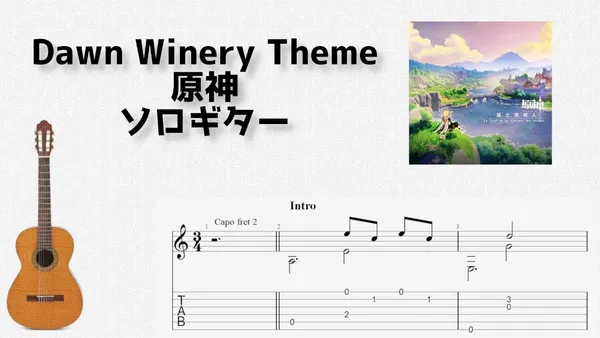
Another track from Genshin. This piece doesn’t have overly complex fingering either, but its major feature is the heavy use of the thumb-fretting technique on the 6th string (the thickest string).
This is an essential technique that also helps simplify barre chords, which normally crush a beginner’s spirit. Naturally strengthening this through learning the song was a huge takeaway.
Les murmures des flots
Around January this year, I finally cleared the Fontaine chapter in Genshin Impact, and encountered an insanely good piece of music in the process.
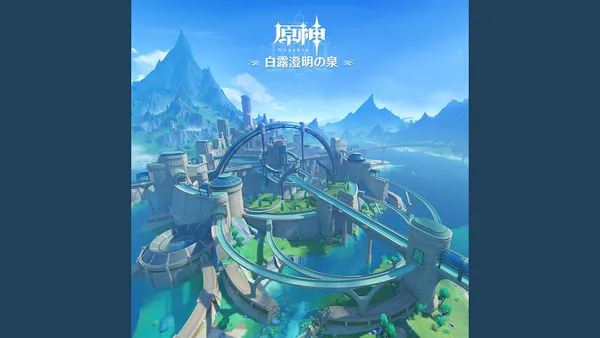
Fontaine’s music generally has a strong classical music feel, but this piece in particular has such a gorgeous melody that if someone told you “this is a hidden masterpiece of classical guitar repertoire,” you’d completely believe them.
So I went looking for tabs.
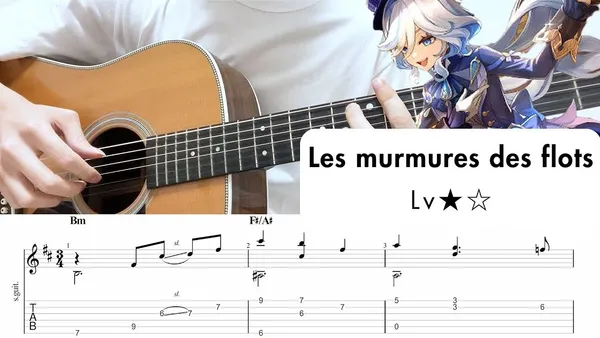
This video is fantastic: not only does it include TAB, but in the latter half, it also slowly walks through the fingering.
I’m currently practicing this piece.
Future Prospects
My ultimate goal right now is to master Agustín Barrios’s La Catedral: I. Preludio Saudade.

The reason being: this very piece was the original experience that made me fall deeply in love with the sound of the acoustic guitar in the first place.
The Side Story of Ace Combat 04 and Agustín Barrios
The difficulty jumps up considerably, so my attitude is more like, “I’d love to try it someday after building up my skills with Genshin tracks…”, but if I could play this, I would be realizing a small dream twenty years in the making. Pretty thrilling, honestly.
Previously, in my post “What Ace Combat 04 Taught Me About the Important Things in Life,” I wrote about the realization that “no matter what you’re doing, you are constantly growing.”
Important Life Lessons I Learned from ACE COMBAT 04
The fact that my second attempt at guitar has been largely a success might be a prime example of that very truth. That game really teaches you so many things.
In Closing
I came away feeling that the guitar is a magnificent instrument. There really aren’t many other instruments that can handle melody, chords, and (if you get creative) percussion all by themselves on a single instrument.
And as repetitive playing solidifies muscle memory (?), the sensation of a beautiful piece becoming truly your own is strangely addictive.
I feel like there are quotes like “Happiness is the feeling that power increases” or “Happiness is not the result of success, but exists in the process of pursuing it,” and I truly felt that this is spot on.
If you feel vaguely bored with your daily routine, why not pick up an instrument?
Musings
When all is said and done, the acoustic guitar became the first instrument I ever practiced enthusiastically of my own free will. I had played other instruments before, but rather than doing so out of my own desire, it felt heavily like something forced upon me as formal music lessons, and in the end, I never understood the concept of “enjoying playing.”
Looking back, what was the point of those lessons anyway? You were handed assignment pieces you didn’t even like or have ever heard of, and if you played them flawlessly, you got a flower stamp (the Japanese equivalent of a gold star) and moved on to the next assignment piece. On top of that, you were made to grind through method books and basic drills that, frankly, had zero musical appeal or interest whatsoever…
It might be the most efficient method for building technical skill, but if you ask whether I was able to enjoy music through that experience, I really don’t think so. In fact, I feel like it made me actively hate music.
- Blaming the instrument when I can’t play well
- Not obsessing over a single song, and instead diving into whatever pieces I actually like
- Never doing practice etudes
Thanks to completely ignoring that classical-lesson approach in every single way, I can finally—quite literally—enjoy the sound of making music myself.
Of course, if you’re aiming to become a professional musician, practicing that way from early childhood is probably one of the legitimate paths, and the fact that I love music now and have some skills and knowledge is partly thanks to that, so I can’t write it off as entirely bad. Still, it leaves me feeling conflicted.
In the end, what truly matters when it comes to music (and really, any activity) is whether you can enjoy it of your own volition. If it’s fun, you’ll naturally stick with it, and as a result, you’ll get better.
There’s a saying that “hard work cannot beat obsession,” which apparently traces back to Confucius: “They who know it are not equal to those who love it; they who love it are not equal to those who find joy in it.”
If you’re reading this, chances are you’re either thinking about picking up guitar or you’ve just started.
I hope we can both keep enjoying it together! If this post helps you along the way, nothing would make me happier.
Bonus
After all that talk, here’s the level I’m actually at right now. Recording yourself really highlights all the rough edges…

More articles
- Tackling Fontaine's Masterpiece 'Le Souvenir avec le crepuscule' on Acoustic Guitar• #MusicA declaration of intent: I'm going to learn to play the Hydro Archon's theme that plays at dusk in the Court of Fontaine on acoustic guitar.
- Recent Earworms (from Genshin Impact)• #MusicOn the music that won't stop playing in my head.

- Impressions of Genshin Impact Ver. 7.1 Snezhnaya, Up Through Act IV "A Rekviem for the Underworld"• #Genshin ImpactAfter two years, I've finally caught up with the current release.
- Thoughts on Genshin Impact's Nod-Krai Storyline• #Genshin ImpactI finished Nod-Krai.
Notes on games, radio and technology, translated from the Japanese blog.