Important Life Lessons I Learned from ACE COMBAT 04
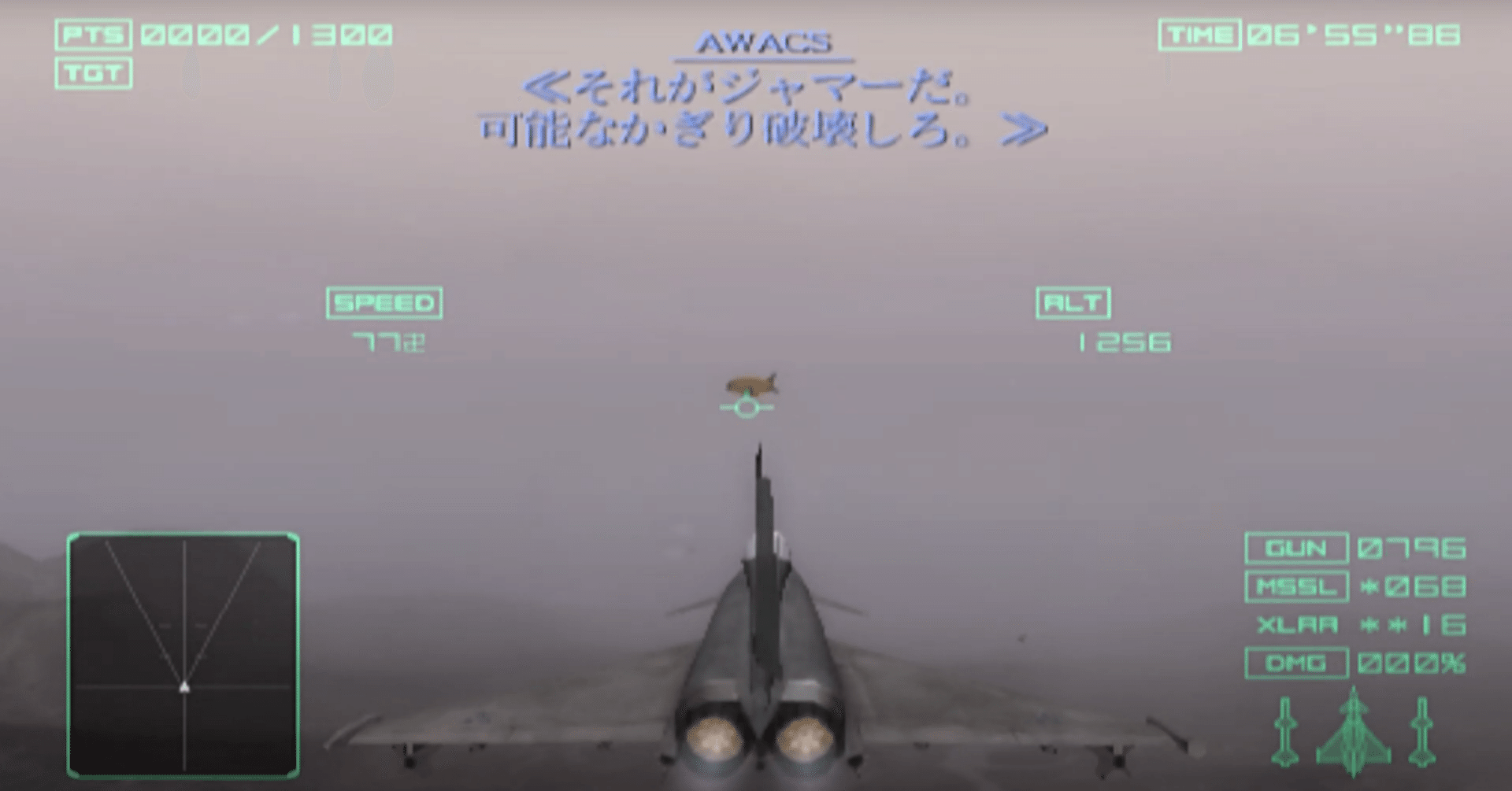
Table of Contents
Introduction
The other day, I went to the “Learning Important Life Lessons from Games” Exhibition.
It got me thinking about what kind of things I had learned from what kinds of games, so in this post I’d like to reflect on that in an essay format.
The exhibition itself was wonderful, and I’d love to write an impressions post about it sometime. My personal favorite was “Aim to Be a Kung Fu Master.” Reaching the goal on my very last life gave me an unreal rush of brain juice (pure dopamine).
ACE COMBAT 04
Ace Combat 04: Shattered Skies is, needless to say, a masterpiece flight shooting game from the PS2 era.
My first encounter with this game was back when I was in elementary school. I remember my father buying it for me at Toys “R” Us. More than 15 years have passed since then, but it remains my all-time favorite game. And I think I learned many “important life lessons” from it.
In the survey results at the “Learning from Games” exhibition, when asked what important lessons people took away, “learning that difficulties can be overcome” garnered the most votes. What I learned from 04 falls into this broad category as well.
So, what difficulties did I run into, and how did I learn that they could be overcome? Let me dig into my memory and look back on the experience. As far as I can recall, I ran into three roadblocks in this game that forced me to put the controller down.
The First Difficulty: M05: LIFELINE
Starting out (as far as my memory serves) on Easy mode with Novice controls, the first thing lying in wait for me was the fifth of the game’s 18 missions, “LIFELINE.”
What was the “important life lesson” I gained here? It was that to achieve your goal, you shouldn’t get trapped by a single method; you must consider other options.
This mission is the first score-attack mission in the game. You blast enemy installations and fighter aircraft left and right, and if you can hit the target score within the time limit, you pass; otherwise, you fail.
Up to that point, all you had to do was destroy the designated targets, but in this mission you have to formulate your own plan and carry it out. And that proved to be a massive hurdle. No matter how many times I tried, I couldn’t reach the required score.
Let me show you the map. The white triangle is the starting point. The targets are split across two locations: the petrochemical storage facilities on the western coast, and the offshore platforms to the east. To the south is the return line indicated by a dashed line; crossing it lets you repair damage and resupply weapons.
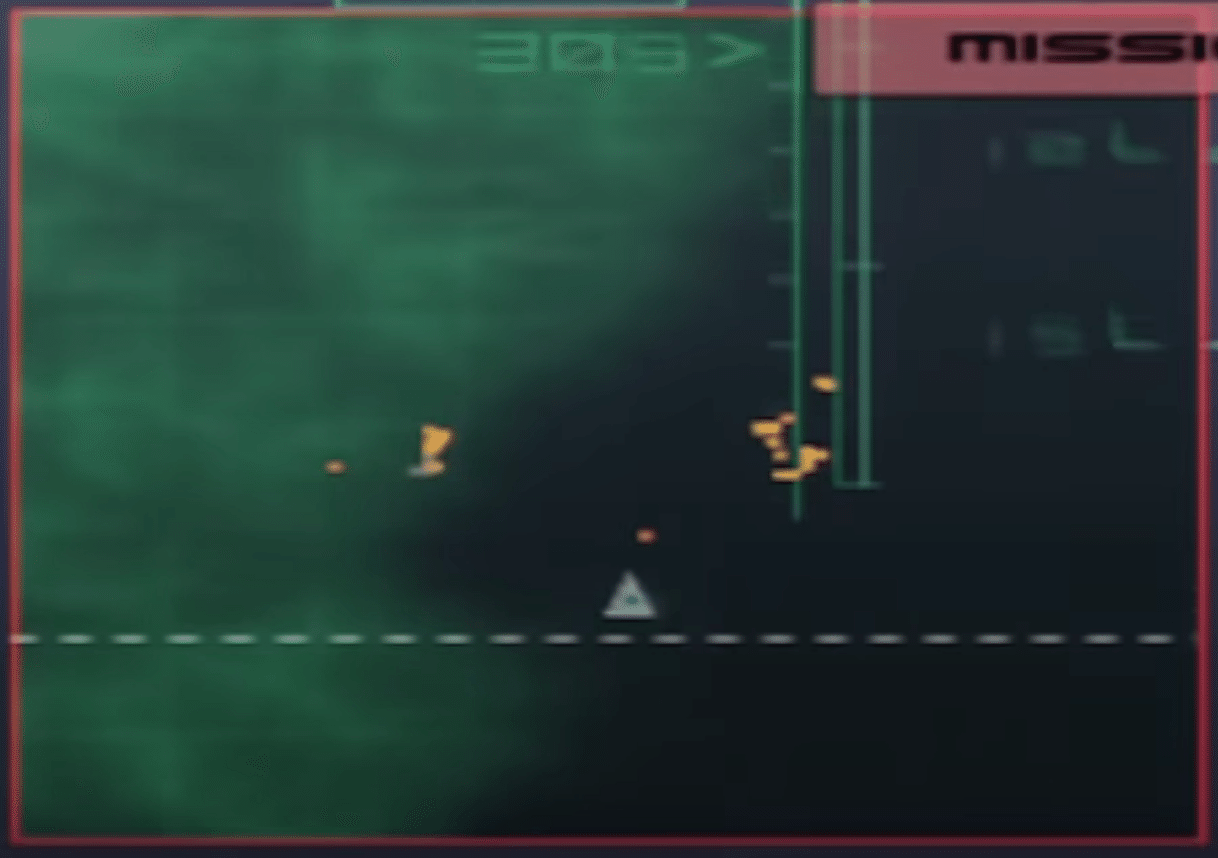
Since it’s the very first score-attack mission, the difficulty shouldn’t be that high. In fact, completely wiping out either one of the two bases is enough to reach the clear objective.
Even so, why couldn’t I clear it? To cut straight to the point: the reason was that “I was attacking the offshore platforms first.”
Attacking the offshore platforms is tricky. Giant cranes and towers surround the targets, so unless you’re careful about your approach angle, your missiles won’t hit. In some cases, you might slam right into a crane.
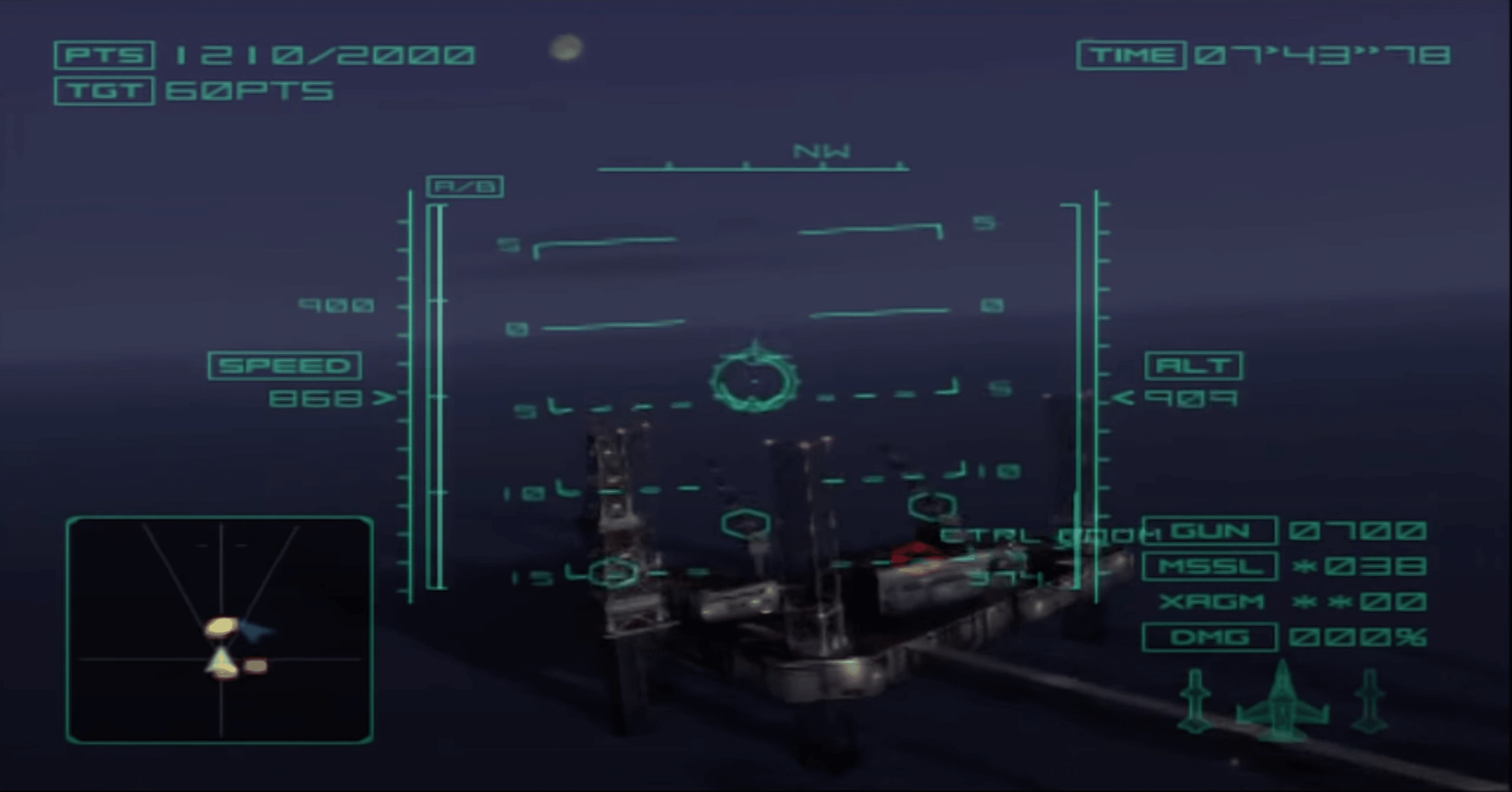
Failing to realize this, I kept making timid, inefficient attacks on the offshore platforms and running out of time. That was why I couldn’t clear the mission.
On the other hand, the storage facilities on the coast sit on flat terrain, making them easy to attack. They are also densely clustered, making them prime targets for napalm bombs—the newest air-to-ground special weapon available at that point. Once I attacked the coast, I hit the objective with ease.
I had been fixated on the inefficient method of the offshore platforms, completely blind to the fact that a much simpler way existed. In other words, I was just being an idiot.
…Or was I, really?
In the first place, why had I started attacking from offshore? Right in front of the starting point, slightly to the east, sits a 120-point TANKER. It doesn’t fight back and it’s a high-value target, so ignoring it is out of the question. Naturally, you attack this first.
You veer slightly right and destroy the TANKER with missiles or machine guns.
Do that, and 20 seconds later you find yourself in the following situation:
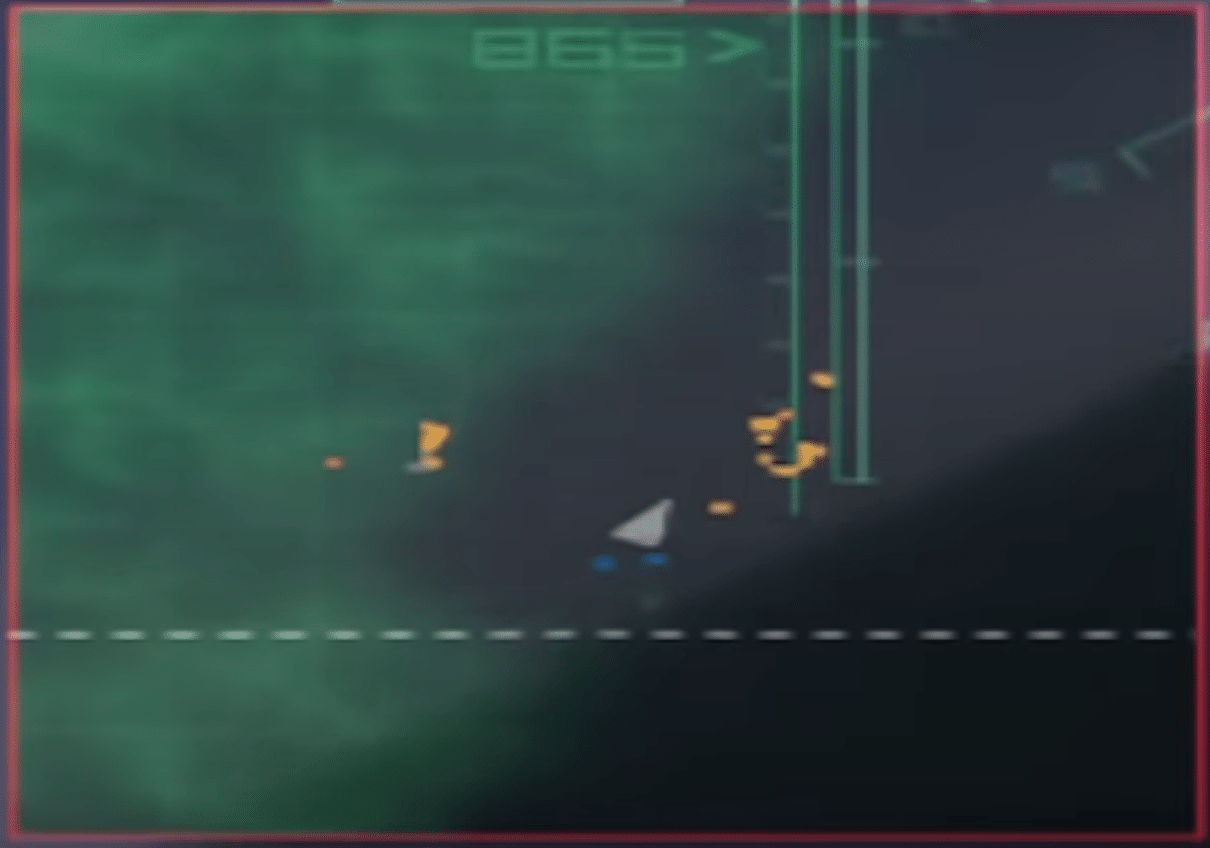
Now, pressed for time, which base would you head toward from here—east or west? Surely, most people would head east, which is closer and requires no change of direction. And so, they are forced into difficult ground attacks, crashing into cranes or getting a Game Over as the clock runs out—never realizing that an easier option existed.
I can’t help feeling this was a deliberate trap laid by the developers. A stroke of ingenious game design, if you will: didn’t they expect many players to face this exact difficulty just like I did, and resolve it the same way?
The placement of a single, tiny target gave this entire mission a whole new layer of difficulty and a valuable lesson.
If that’s the case, it’s pretty terrifying.
The Second Difficulty: M08: Shattered Skies
The series’ universally acknowledged masterpiece of a mission, “Shattered Skies” (titled “Pieces of the Sky” in Japanese). Here, too, I was destined to taste defeat.
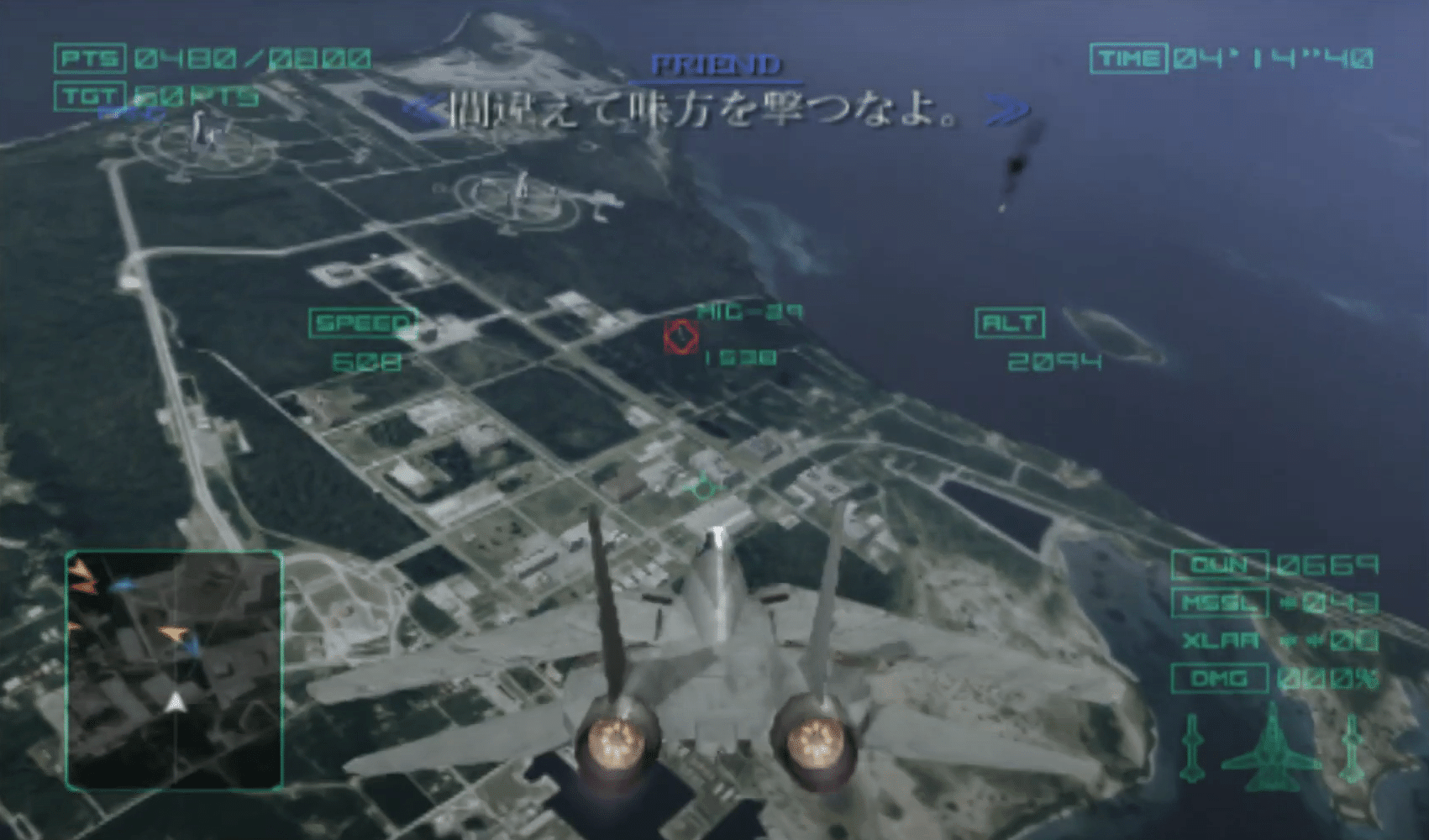
The lesson I learned here was that proximity does not necessarily equal ease of execution. It’s virtually the same as the previous section, but it was a bitter lesson taught by an entirely different game system.
If the previous section’s lesson was an issue at the strategic level, what I’m addressing in this section was one at the tactical level.
This mission is divided into multiple phases. In Phase 1, you’re required to score 800 points (shooting down roughly 13 enemy aircraft) within 7 minutes. In Phase 2, you have to intercept and shoot down bombers incoming from the west before they reach the rocket launch facility.
Where I got stuck was Phase 1. No matter how many times I tried, I couldn’t hit the target score.
What was the cause? Put simply, I was just terrible at dogfighting.
Trying to explain the mechanics with words alone is tough, so let me illustrate with some diagrams.
Now, in this game, a locator is displayed on-screen showing the direction of the enemy you’re currently targeting. If you follow it, in most cases you will eventually get the enemy directly in front of you.
In the diagrams below, my aircraft and its field of view (the lock-on cone) are shown in blue, the target in red, and the locator in green.
If the target is stationary, like this…
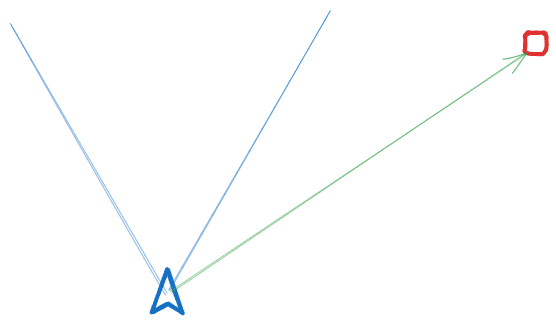
…you simply turn along with the locator.
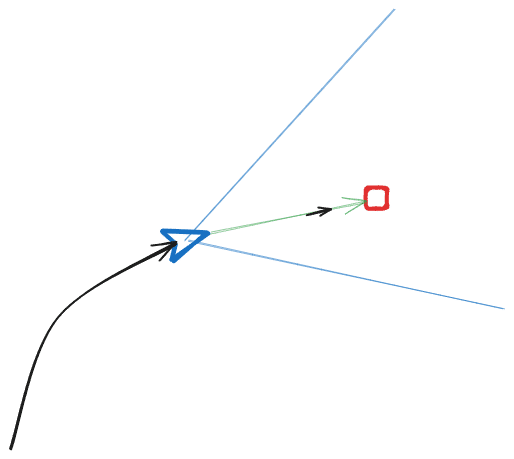
However, if the target takes evasive maneuvers…
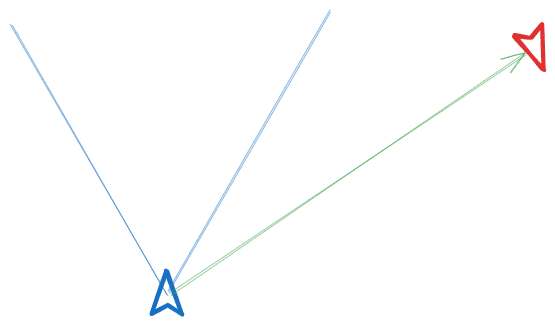
…even if you follow the locator, you won’t be able to get the enemy plane in your sights. In particular, if your turning performance is inferior to your opponent’s, you will never catch up.
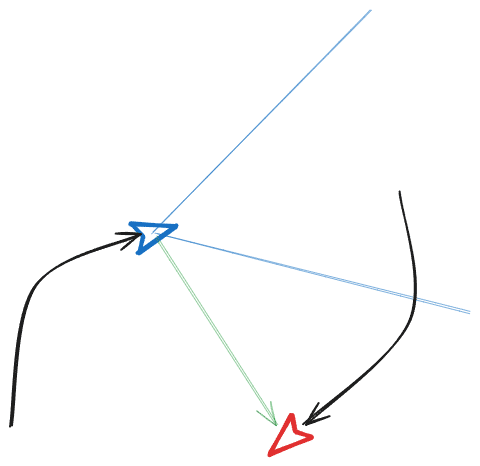
So what should you do? Don’t fixate on a single target; switch targets flexibly. Even if another target is further away, their relative positioning might be far more favorable.
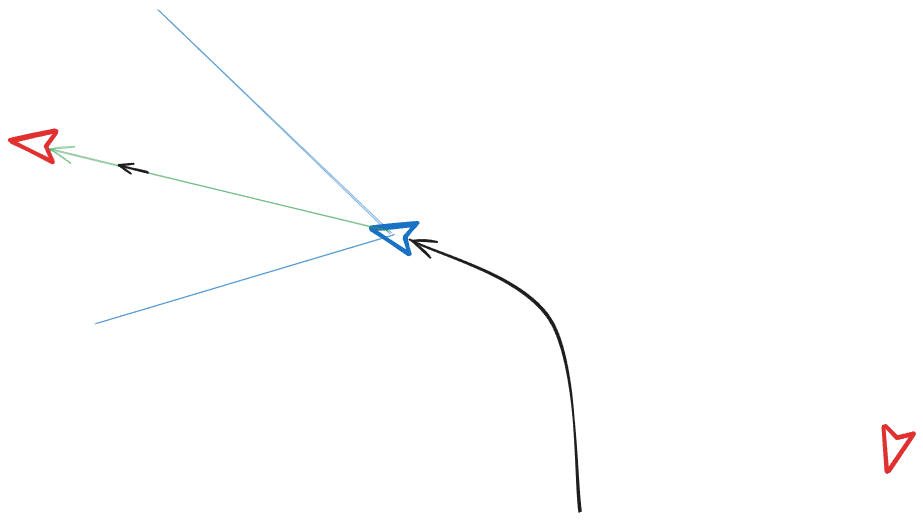
It’s the most basic of basics, but back then, it took me a long time to realize this.
I kept chasing an enemy I could never catch, wasting precious time. Obviously, under those conditions, there was no way I could reach the target score within the time limit.
Looking back now, it’s remarkably simple, but for an elementary school kid at the time, it was anything but easy. You have to check the radar, scan your surroundings, and predict the positions of both your aircraft and enemy aircraft in 3D space several seconds into the future to judge which target is best. I simply didn’t possess that kind of capability yet.
That said, the strategy of “if you can’t get them after chasing for 20 seconds, switch targets” proved plenty effective, and I managed to hit the target score somehow.
The Third, and Worst, Difficulty: M13: SAFE RETURN
On the 13th mission, I ran into the worst setback of my life up to that point.
SAFE RETURN is an extremely peculiar mission.
The player must destroy 13 stationary airships within 7 minutes. However, you cannot lock on, and the radar is unreliable. In dense fog, you have to visually spot the airships, align your aircraft directly in front of them, and take them down with unguided missiles or machine guns.
Just hearing the description, it might sound simple. But when you actually play it, it is an absurdly difficult mission.
For example, how many airships do you see in the image below?
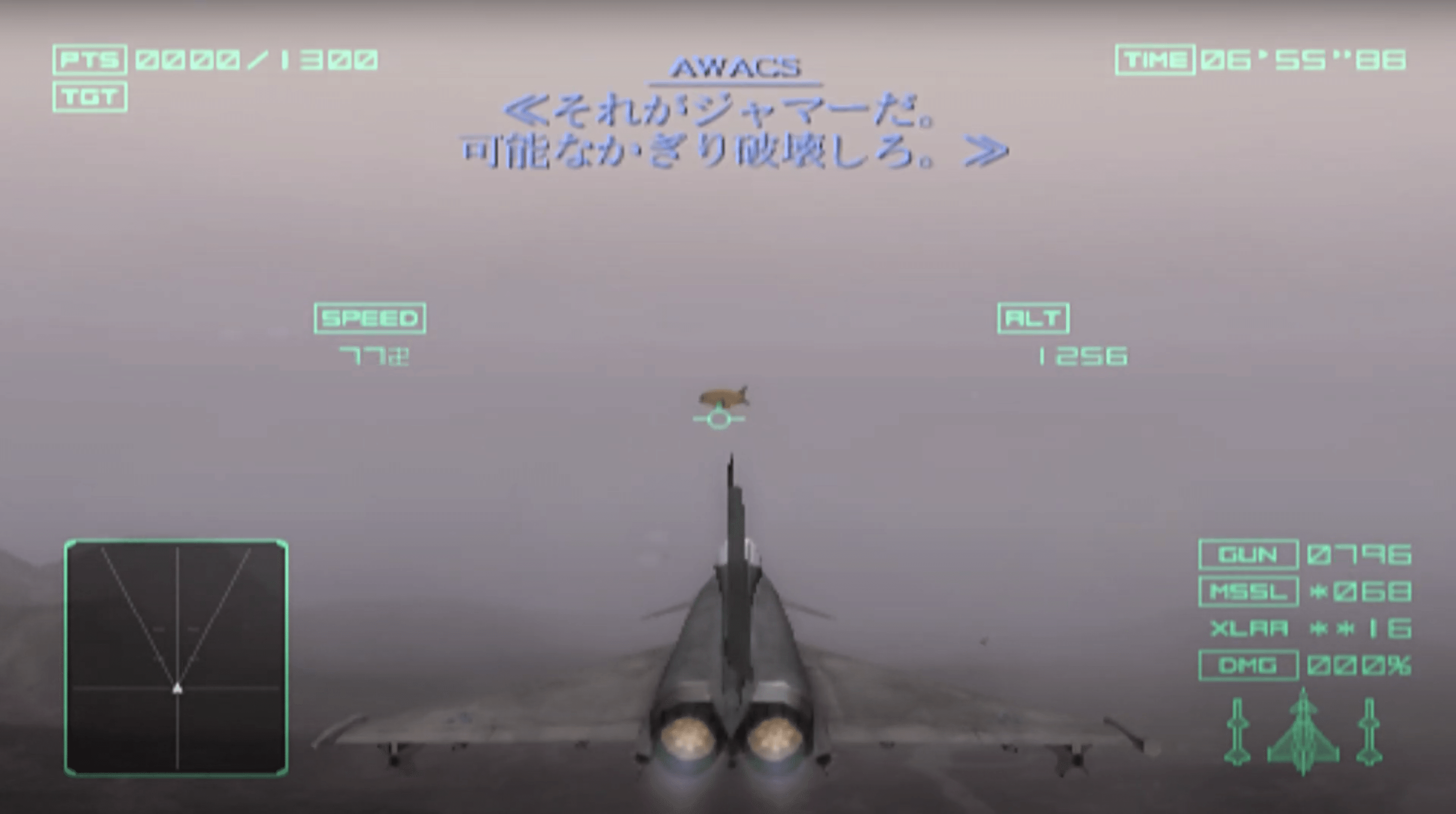
The answer: at least three.
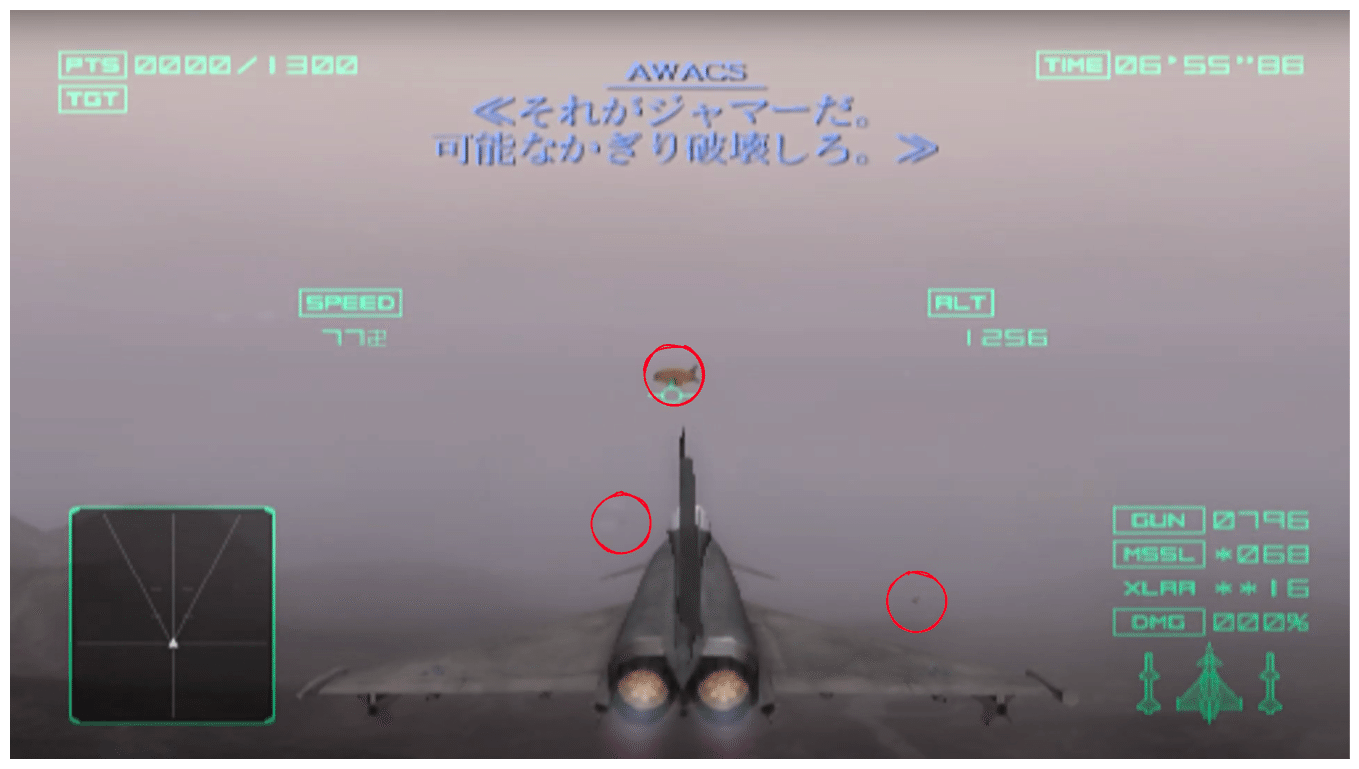
Can you imagine the agony of squinting at a CRT TV connected via composite RCA cables, searching for black dots the size of sesame seeds? Surely, countless boys and girls glued their faces to the CRT screen and got yelled at by their parents.
So, how did I eventually beat this mission?
Unfortunately, my past self couldn’t clear it. I gave up on the game and didn’t touch it for at least nearly half a year.
After some time had passed, I picked the game back up. I switched from Novice to Normal controls and decided to start over from scratch.
Mysteriously enough, every single mission felt easier than before. And this mission, too, I blew right through with zero trouble. Surely, it was thanks to physical growth. No special effort or clever tricks were needed whatsoever.
So, what was the important life lesson I gained from this experience? I gave it a lot of thought, and what resonates most is that no matter what you are doing, you are continuously growing.
When you hit a wall, you don’t necessarily have to overcome it right then and there. Even if you turn your eyes away from the problem for a while, if you’re young your body will keep growing, and even if you aren’t, your knowledge will. Even experiences that seem unrelated on the surface all become part of your flesh and blood, quietly helping you without you even realizing it. You can just wait for that to happen and then return to your original challenge.
It might sound a bit defeatist to call it a life lesson. But all the same, this lesson still holds a powerful presence inside me today.
Conclusion
Looking back like this, it seems that rather than learning “to win through hard work,” what I learned from this game was the importance of “winning with minimum effort.”
- Proximity does not necessarily equal ease of execution.
- To achieve your goal, you shouldn’t get trapped by a single method; you must consider other options.
- No matter what you are doing, you are continuously growing.
And these lessons also seem to resonate with the following quotation, which is currently my personal motto:
We shall not cease from exploration
And the end of all our exploring
Will be to arrive where we started
And know the place for the first time.
(T. S. Eliot, Four Quartets)
While I’ve focused here on difficulties and overcoming them, Ace Combat 04 has had a massive influence on me in countless other ways as well.
For example, 04 led me to play the rest of the series, and while playing 5, I tried transcribing video game music by ear for the first time. That got me into DTM (desktop music production), through which I learned music theory and discovered the joy of analyzing things I love from a theoretical framework. The desire I have today to understand narrative structures might never have developed if I hadn’t played 04.
On a more practical level, the spatial awareness I honed through dogfighting might have helped me with entrance-exam math, and listening to the English radio chatter over and over may have given my English listening skills a huge boost.
I started writing this post a little while ago, but with public debates flaring up lately over whether parents should “ban children from playing video games,” dropping it now ended up feeling quite well-timed.
Speaking from personal experience, I think banning video games is utterly ridiculous. Even if it looks like a detour on the surface, every single experience becomes fuel for overcoming future difficulties. And video games are a rare medium that presents you with a rich variety of challenges that you could never experience in everyday life.
If you love your child, let them play video games (a twist on the Japanese proverb: “if you love your child, send them on a journey to face hardships”).
More articles
- The Side Story of Ace Combat 04 and Agustín Barrios• #Ace Combat 04And the Bachian spirit inherited by Yellow 13
- Impressions of Genshin Impact Ver. 7.1 Snezhnaya, Up Through Act IV "A Rekviem for the Underworld"• #Genshin ImpactAfter two years, I've finally caught up with the current release.
- I Bought a Cheap Wideband LNA from AliExpress, the Zeenko ZK06-BM• #RadioI used the Zeenko ZK06-BM to intercept METEOR-M2 4 and got the best satellite image I've ever received.
- On the End of the World• #ScreedIt's Ragnarok.


Notes on games, radio and technology, translated from the Japanese blog.