Exploratory Data Analysis of Idol Growth and Body Proportions in THE IDOLM@STER

Table of Contents
TL;DR
In this article, I used character data from THE IDOLM@STER series to analyze physical measurements of idols, including height, weight, BMI, Rohrer Index, and three sizes.
Dividing the idols into four age brackets reveals that lower-grade elementary school girls (lower JS) emphasize a plump, squishy “puni-kei” fullness; upper-grade elementary school girls (upper JS) lean toward relatively realistic childlike proportions; middle school girls (JC) are characterized by skinniness; and high school girls (JK) and above emphasize tall, slender, model-like figures.
In particular, among 13- to 15-year-old middle school (JC) idols, an abnormal phenomenon emerged where the waist alone becomes exceptionally thin compared to all other measurements.
Introduction
The article above was so interesting that I decided to try it myself. I hadn’t done much data science work lately, and part of my motivation was simply wanting to see how easy EDA would be when paired with an LLM. There is no particular end goal here. We’re just going to explore the data casually.
For my data source, I used im@sparql. It’s an insanely impressive database—I doubt there is any other resource out there with such a massive amount of detailed 2D character information accurately assembled and so easily accessible.
First, we run a SPARQL query.
PREFIX schema: <http://schema.org/>PREFIX rdf: <http://www.w3.org/1999/02/22-rdf-syntax-ns#>PREFIX imas: <https://sparql.crssnky.xyz/imasrdf/URIs/imas-schema.ttl#>PREFIX imasrdf: <https://sparql.crssnky.xyz/imasrdf/RDFs/detail/>PREFIX foaf: <http://xmlns.com/foaf/0.1/>PREFIX math: <http://www.w3.org/2005/xpath-functions/math#>PREFIX xsd: <http://www.w3.org/2001/XMLSchema#>PREFIX rdfs: <http://www.w3.org/2000/01/rdf-schema#>
SELECT ?name ?height ?weight ?age ?gender ?bust ?waist ?hip ?brandWHERE { ?s schema:name|schema:alternateName ?name; schema:height ?height; schema:weight ?weight; foaf:age ?age; schema:gender ?gender; imas:Bust ?bust; imas:Waist ?waist; imas:Hip ?hip; imas:Brand ?brand. FILTER(LANG(?name) = 'ja')}ORDER BY ?brandIn the original article, BMI and Rohrer Index were calculated directly in the query, but I decided to calculate them later with Pandas.
After filtering out non-female idols and anomalies like “Lots of apples” (Riamu Yumemi’s weight profile), I plotted the data with Plotly.
(For the subsequent work I relied entirely on Perplexity, and it kept up with me while barely spitting out any errors. Truly amazing.)
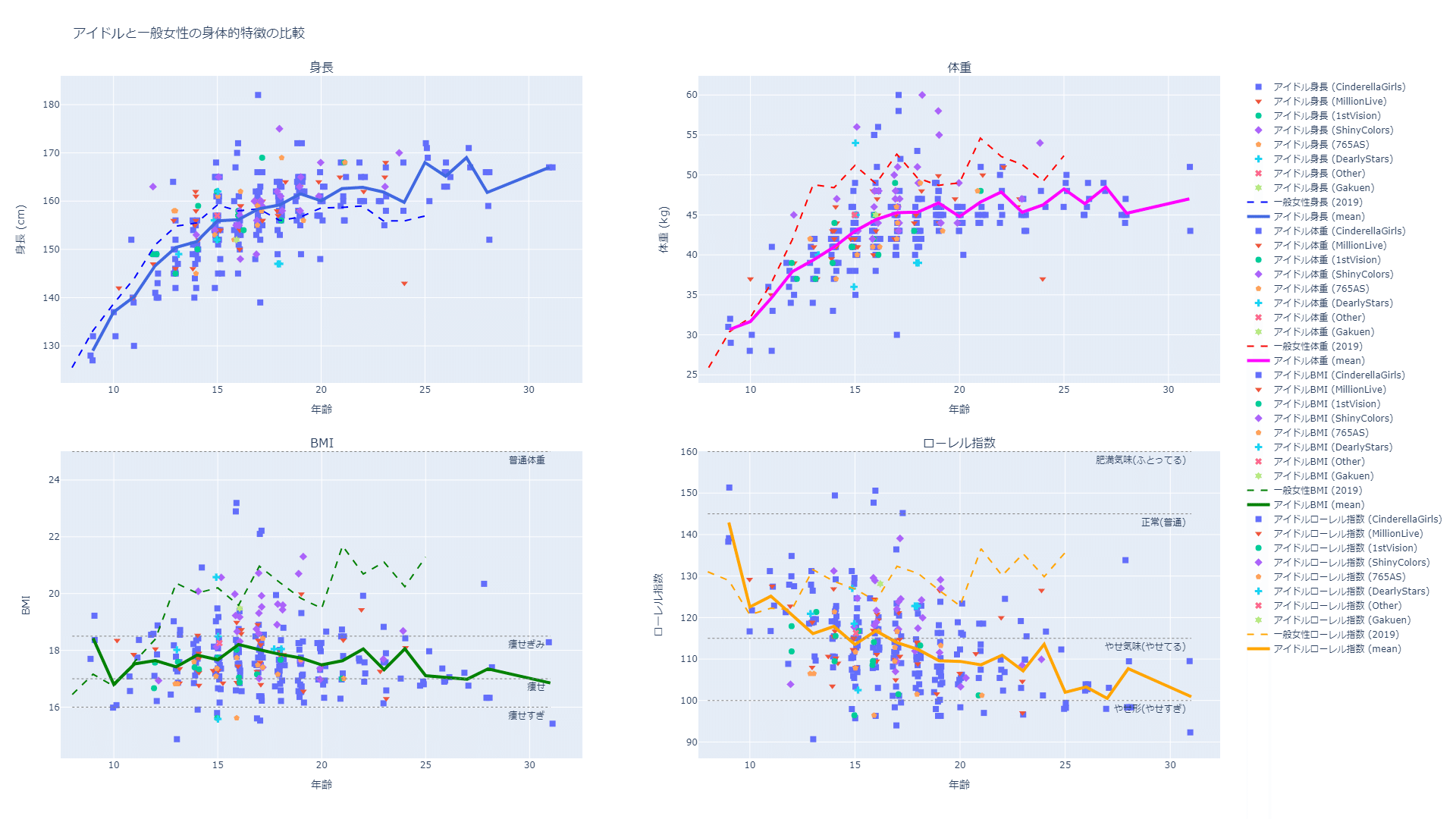
It’s easier to view if you expand it. The same applies below.
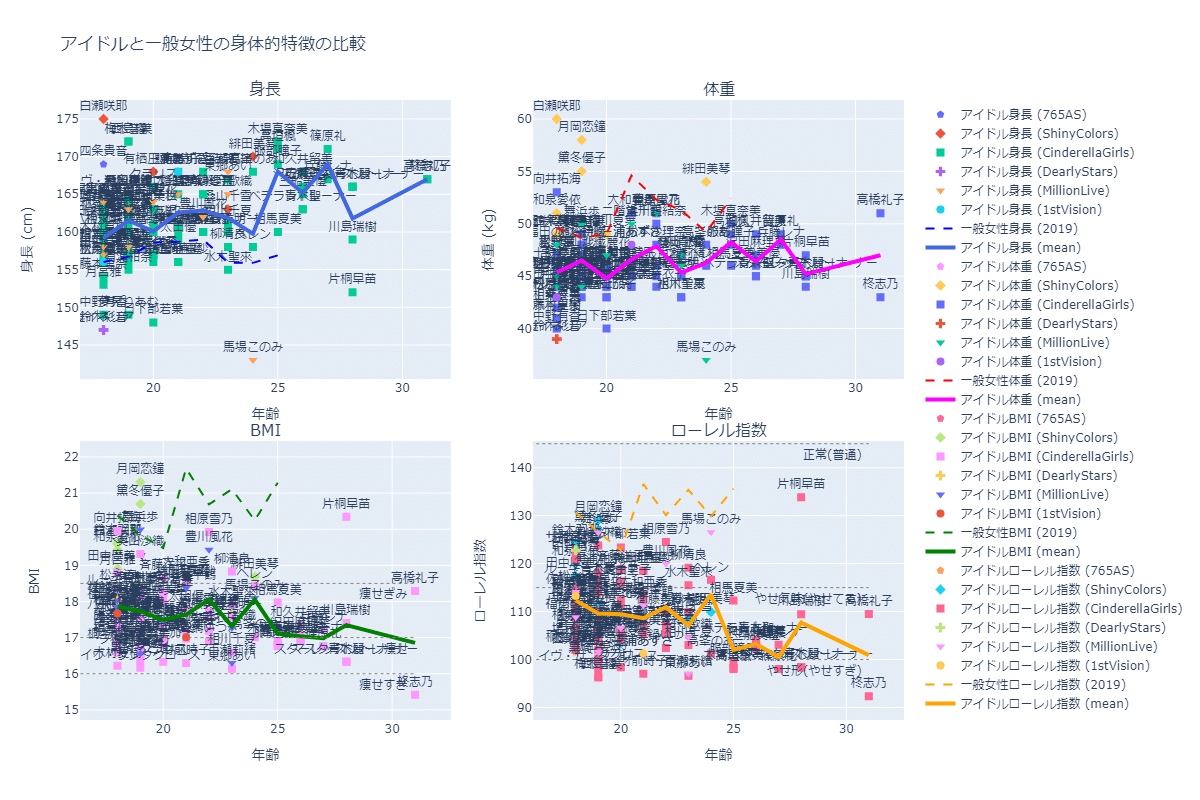
Height
Age is plotted on the horizontal axis and height on the vertical axis. Each point represents an individual idol. Note that random jitter has been added along the horizontal axis when plotting to prevent points from overlapping.
The solid line represents the idols’ average height, while the dashed line represents 2019 data from the Ministry of Health, Labour and Welfare’s Part 2: Health and Sanitation, Chapter 1: Health, “Average Height and Weight by Sex, Year, and Age”.
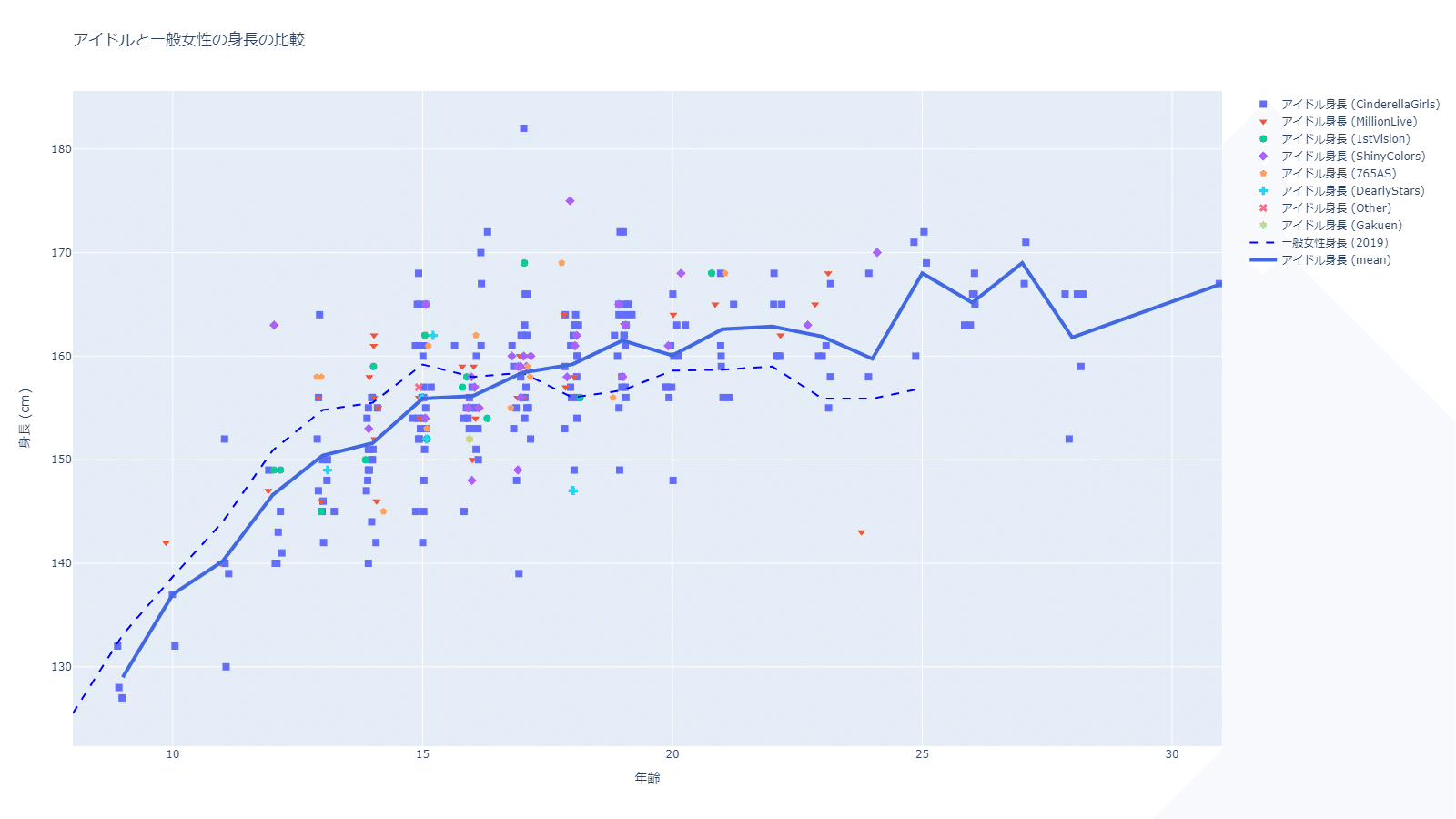
Interestingly, with age 17 as the boundary, younger girls tend to be on the shorter side compared to average, while more adult idols tend to be taller.
Weight
Plotted similarly to height, except that the vertical axis represents weight.
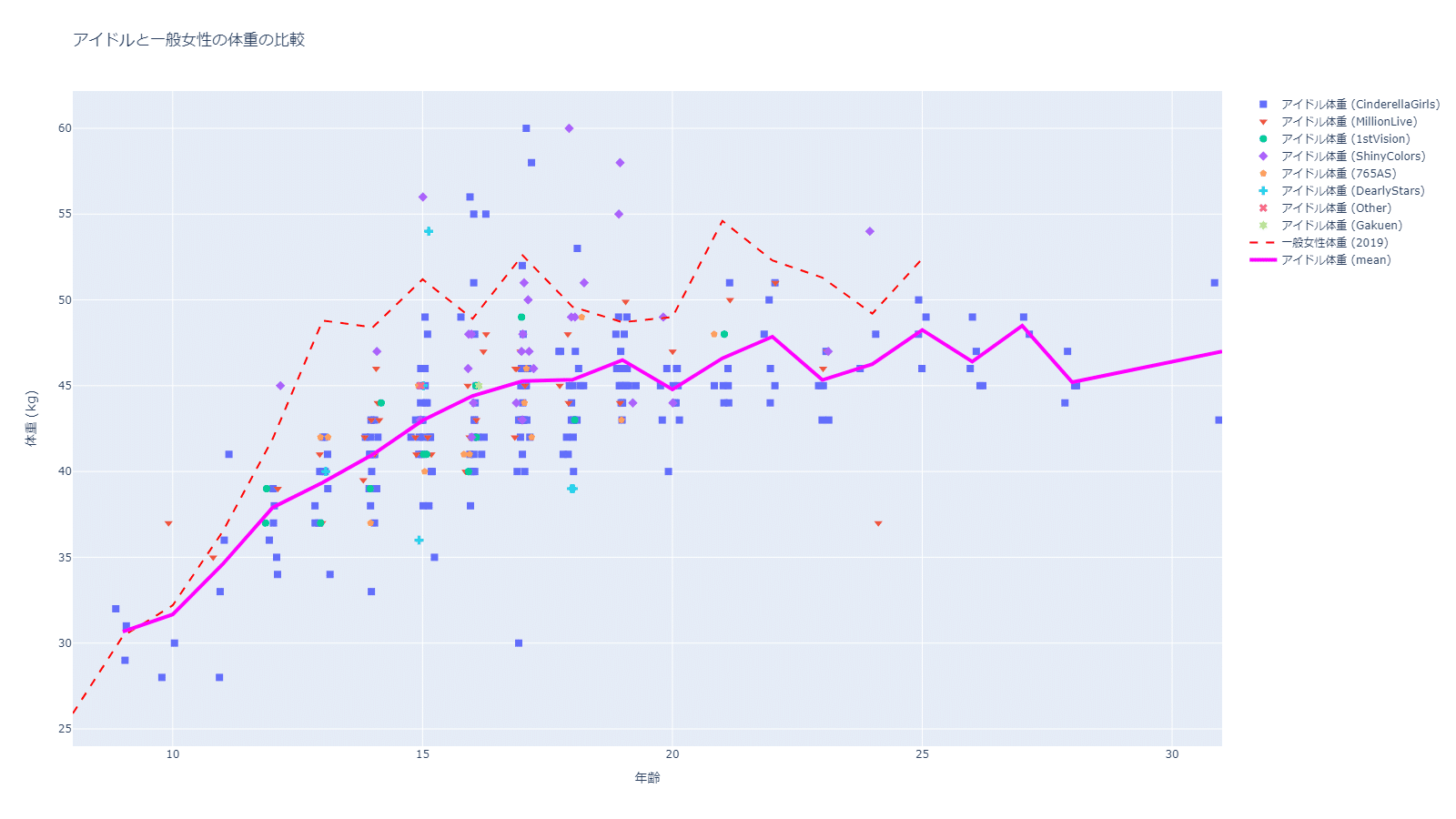
As expected of idols, except for the 9-year-olds, practically every idol has a significantly lower weight than average.
When height doesn’t deviate much from average yet weight is so low, you start to worry about their health. Let’s look at the next graph.
BMI and Rohrer Index
As indicators for assessing physique by combining height and weight, the Body Mass Index (BMI) and the Rohrer Index are widely used methods in Japan.
BMI is calculated by dividing weight (kg) by height (m) squared, and serves as an international indicator of obesity.
The Rohrer Index is an index formerly used in Japan to assess obesity in school-age children.
In recent years, BMI has increasingly been used for evaluating childhood obesity as well, and the Rohrer Index is reportedly not used very often nowadays.
BMI (Body Mass Index)
- Formula: Weight (kg) ÷ Height (m)²
- An international indicator widely used to determine obesity in adults
- A BMI of 25 or above is classified as obese, while 22 is considered the optimal weight with the lowest disease incidence
Rohrer Index
- Formula: Weight (kg) ÷ Height (m)³ × 10
- Mainly used to evaluate obesity in school-age children and students (up to around age 18)
- 130 is considered standard, though definitive criteria are not rigidly fixed
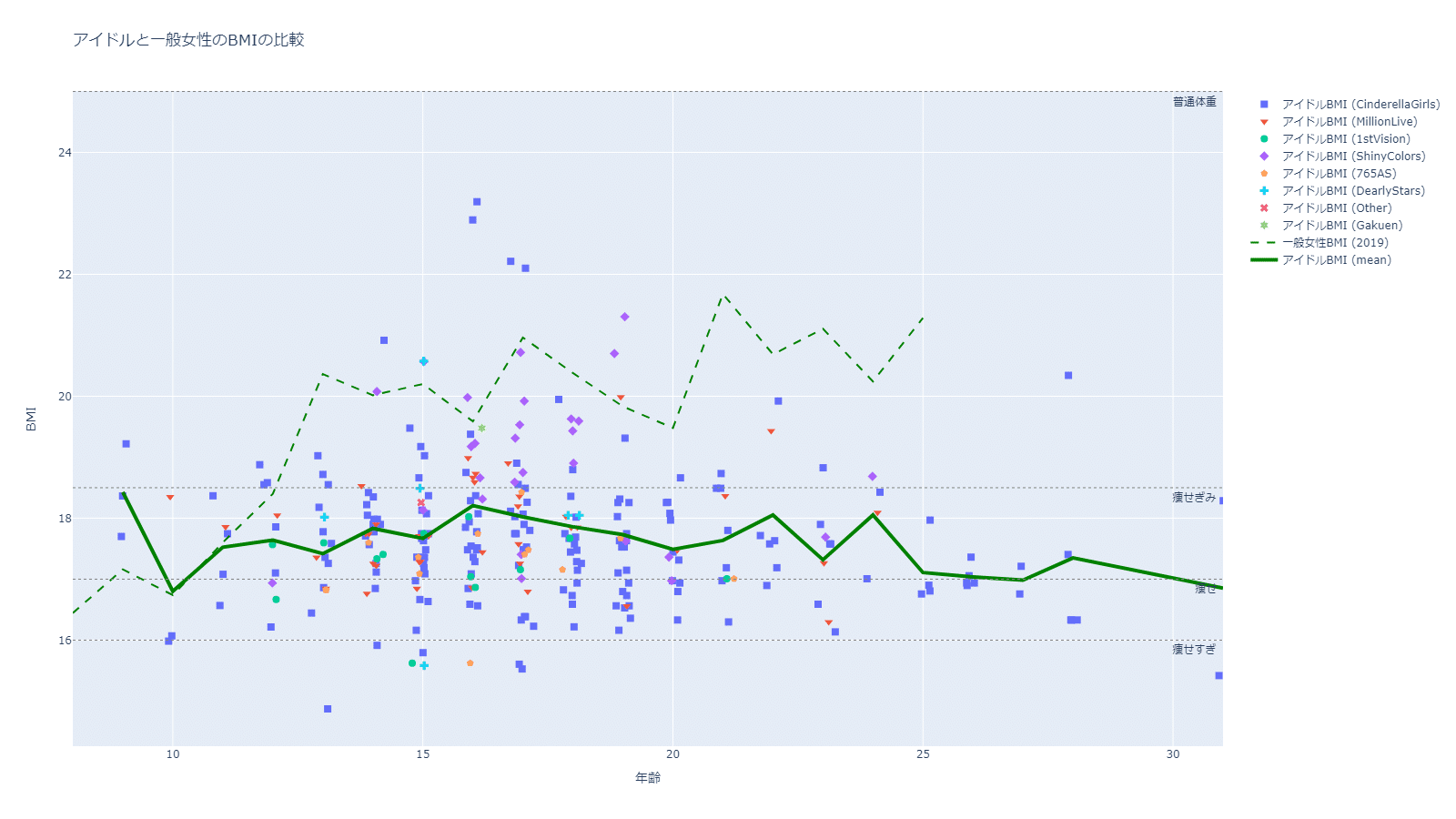
The BMI plot is shown below, alongside WHO standards.
You can see that many idols have a BMI at or below “underweight.”
Furthermore, while the average BMI of general women gradually rises throughout their teenage years, the average BMI of idols never exceeds the 18.5 “underweight” line, remaining flat.
The Rohrer Index plot is shown below, alongside Japan Medical Association standards.
Here too, while the general female average hovers around 130, the idols’ average diverges increasingly starting from age 12.
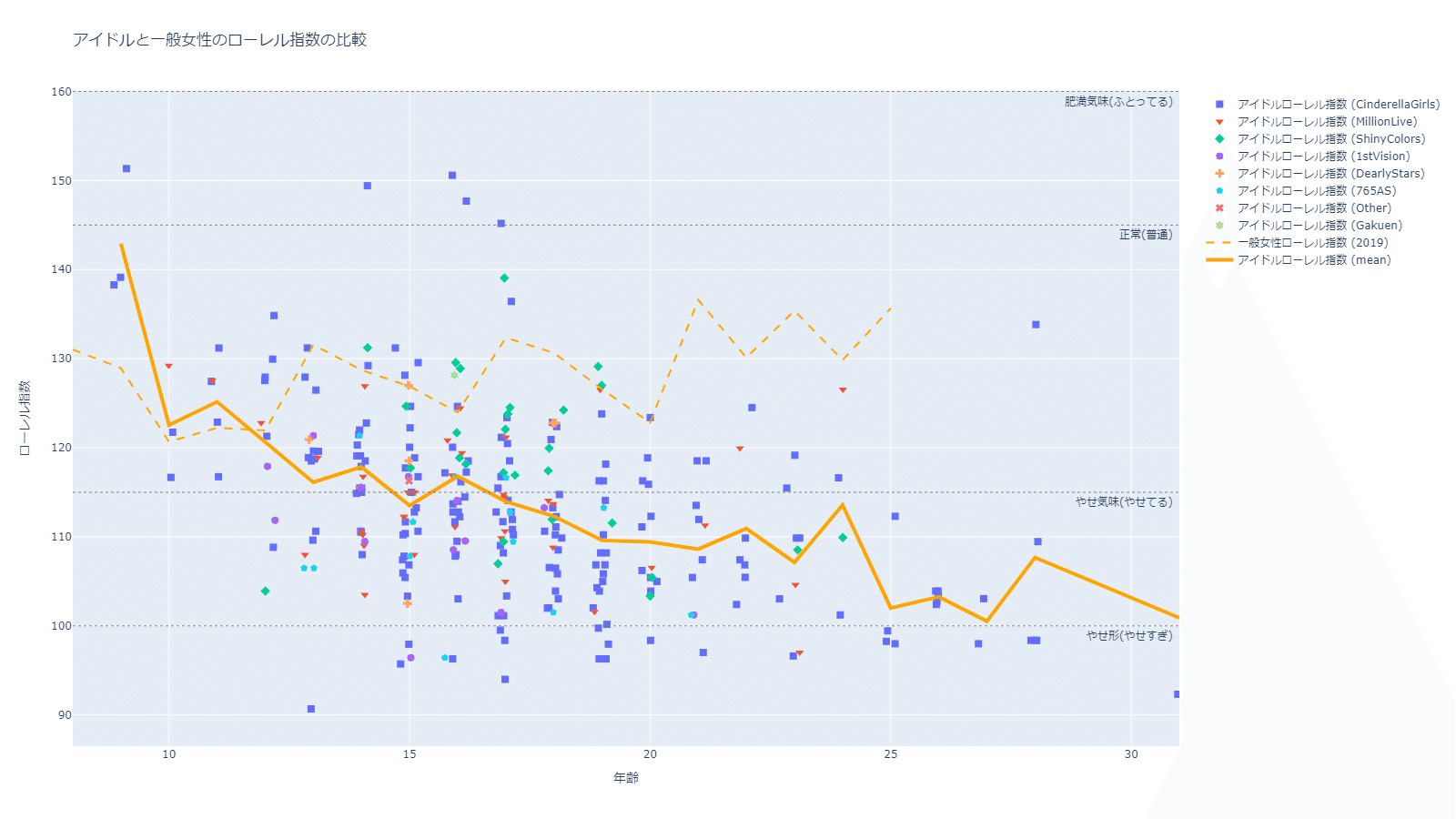
Summary of Physical Measurements
So far, we’ve looked at four graphs. Putting them all together reveals the following:
- Compared to the average, idol height is shorter before age 17 and taller afterward.
- Idol weight is consistently lower than average, with the gap peaking around age 13.
- Up to age 12, idol physique aligns fairly well with the average, but from age 13 onward, it becomes extremely skinny compared to average.
Let’s add some thoughts and analysis.
Making a bold assumption: if they were created as idols, there must be a demand from fans for them.
In that case, this data doesn’t just reflect the body types of idols; it can be said to mirror the idol archetype demanded by fans.
And depending on age, idols seem to fall into several distinct categories.
Things are starting to sound a bit dangerous, but for the sake of clarity, if we forcefully apply labels, it looks like this:
Age 9 (and Under): Lower Elementary (JS)
- Both height and weight are lower than average, but looking at them combined, they have good fleshiness.
- It’s a term you don’t hear as much lately, but you could perhaps call them “puni-kei lolis” (plump, squishy little girls).
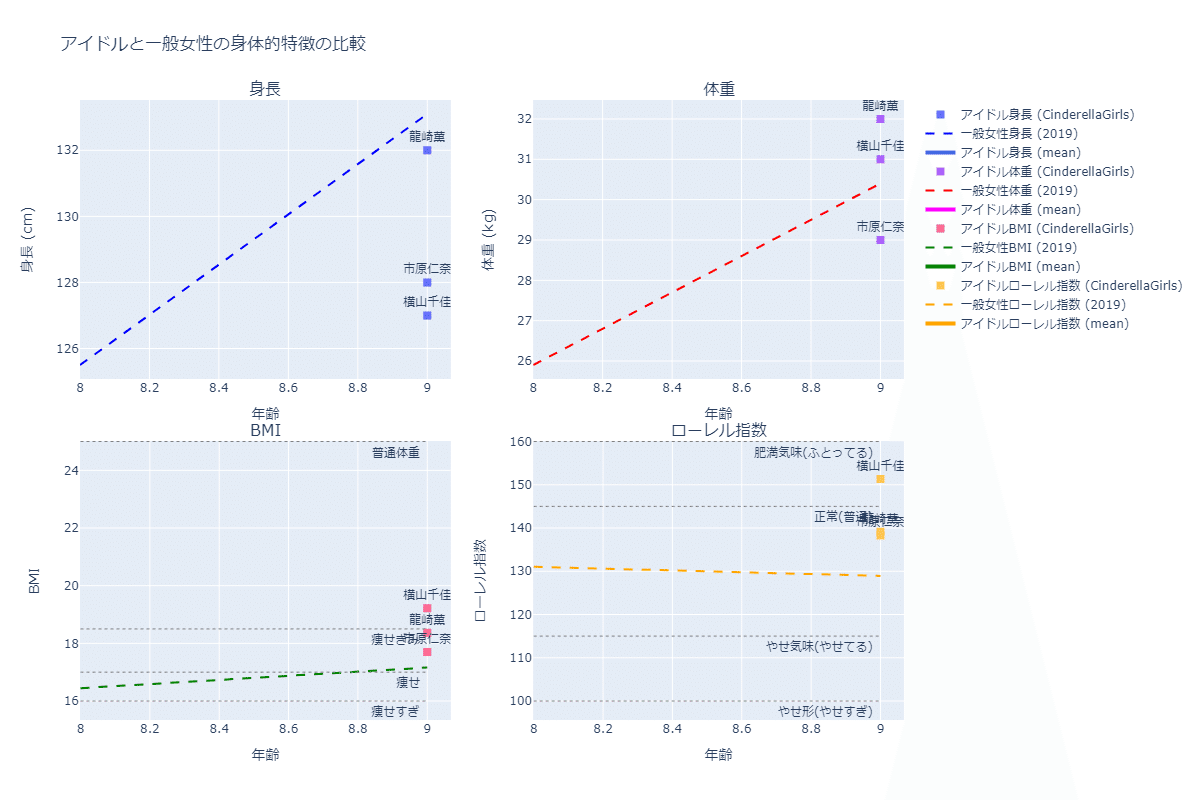
With only three examples, talking about a “representative case” is pretty much meaningless, but in terms of seeming the most popular, Nina Ichihara would probably be it.
Ages 10 to 12: Upper Elementary (JS)
- Physique doesn’t deviate much from the average.
- There is an expectation for them to have the realistic body shape of girls that age.
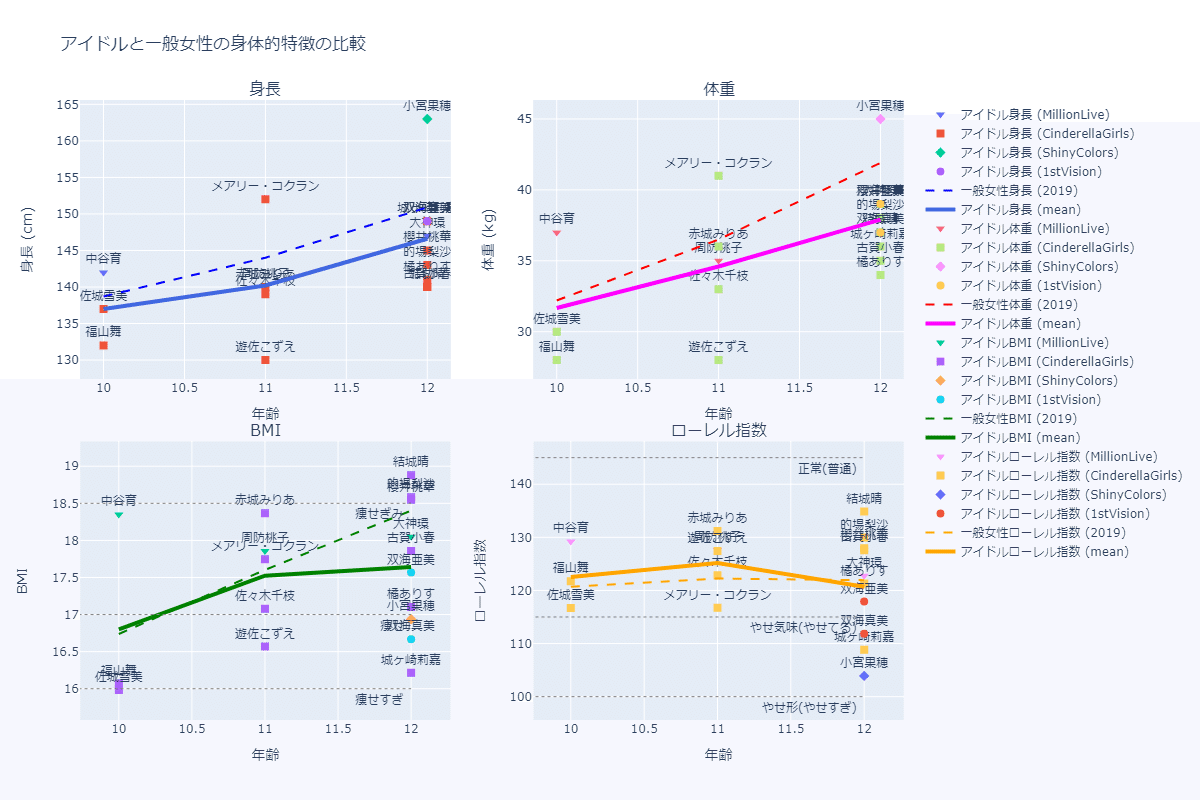
Representative examples include Miria Akagi and Arisu Tachibana. How to put it—it’s a lineup that’s practically lolicon flypaper (lolicon hoi-hoi).
Ages 13 to 17
- They tend to be both shorter and lighter than average.
- In other words, there is an expectation for them to be more petite.
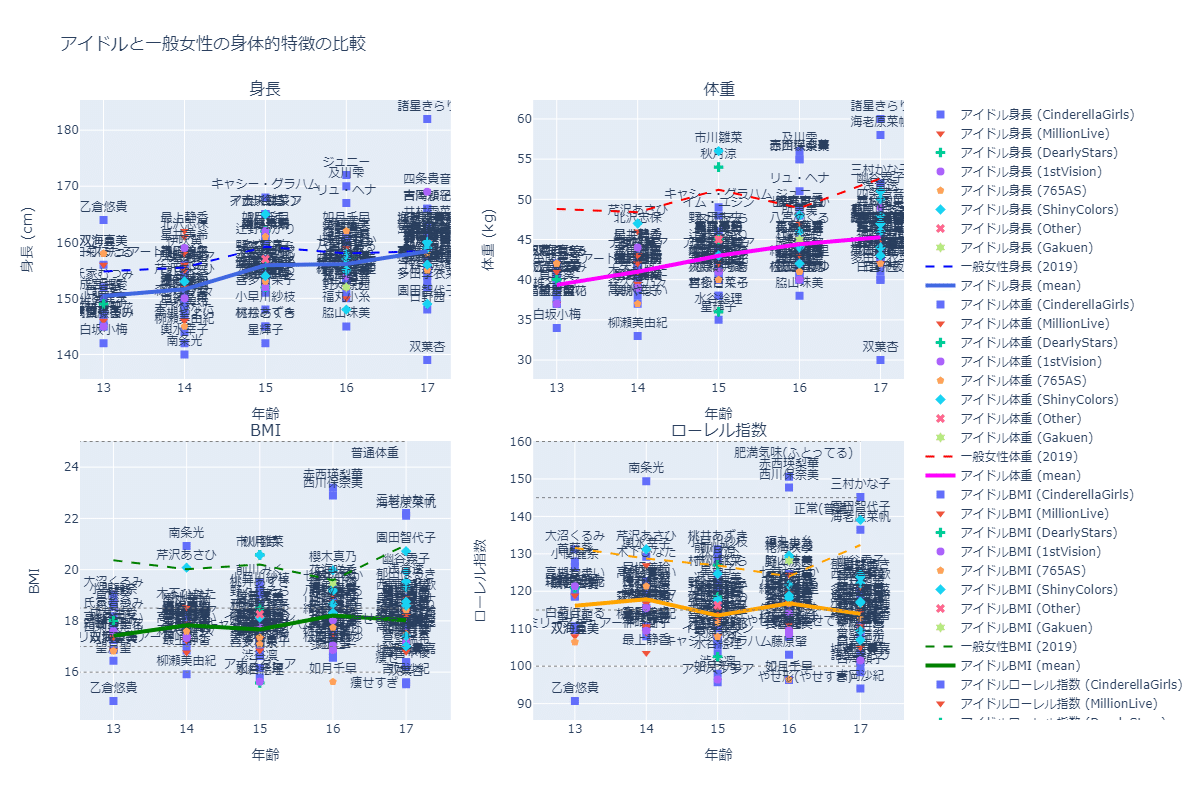
Lumping this many people together into a single attribute bracket feels pretty crude. It might be better to break it down further. Based on the analysis of three sizes discussed later, the following classification seems to work best:
Ages 13 to 15: Middle School (JC) Idols
- Extremely short and underweight compared to average, tending toward a toned, slender physique.
- In other words, there is a strong expectation for them to be especially petite and delicate.
A representative example is Yayoi Takatsuki.
Yayoi Takatsuki | THE IDOLM@STER MILLION LIVE! THEATER DAYS (Mirishita) | Bandai Namco Entertainment Official Site
Ages 16 to 17: High School (JK) Idols
- Their three sizes are comparable to adults, yet their height isn’t particularly tall.
- In other words, idols who are petite yet have great figures are in demand.
A representative example would be someone like Mayu Sakuma?
Mayu Sakuma | [Official] THE IDOLM@STER OFFICIAL WEB -Idol Directory- (Imas)
Age 18 and Above: Outstanding Figures
- The tendency to demand lower weight than average remains unchanged, but their height is taller than average.
- Taller and lighter—in other words, an outstanding, model-like figure is expected.
If I had to give a representative example, it would probably be someone like Ritsuko Akiyama [sic: Akizuki].
Ritsuko Akizuki | THE IDOLM@STER MILLION LIVE! THEATER DAYS (Mirishita) | Bandai Namco Entertainment Official Site
The Anomaly Occurring in Idols’ Waists
Here is where things get interesting.
First, take a look at the heatmap below.
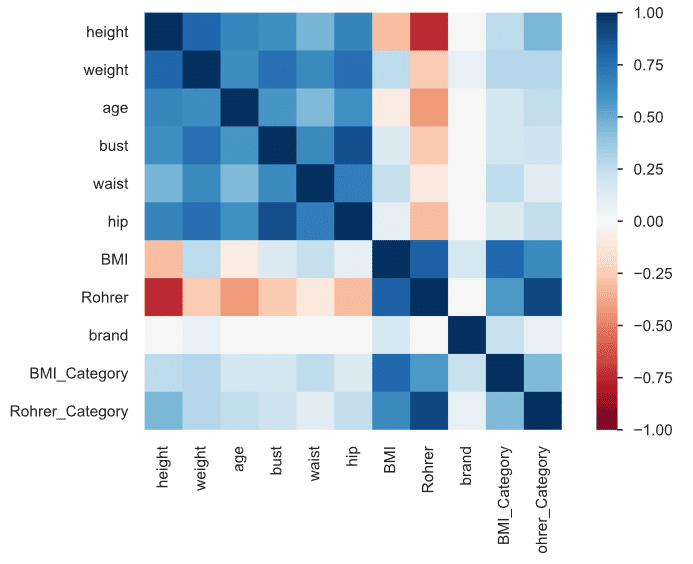
The closer to blue, the stronger the positive correlation between two values; the closer to red, the greater the negative correlation. Naturally, the correlation coefficient between identical variables is 1, so the diagonal is solid blue.
The first thing that catches your eye is the correlation between brand and weight. Correlations also appear with BMI and BMI categories, which are directly related to weight. As pointed out in the aforementioned article, this stems from the fact that 765 Allstars (AS) members are simply too light.
The next point of interest is the correlation among the three sizes. According to the graph on the following page, the three sizes supposedly develop at roughly the same rate:
Jissen Women’s University Faculty of Human Life Sciences, Department of Environmental Sciences
By “at roughly the same rate,” I mean that there is generally an approximately linear relationship between each of the three sizes. In other words, the average of one measurement can be closely approximated by multiplying another measurement by some coefficient. If that were the case, all of these correlation coefficients should be nearly 1.
And yet, while the correlation between hips and bust is strong, the waist shows a notably weaker correlation. Compared to other metrics—height, weight, or age—the waist’s correlation coefficients appear lower across the board than those of hips or bust.
Let’s investigate what’s going on here.
The figure below plots hips on the horizontal axis and bust size on the vertical axis for each idol. To show differences by age, colors are grouped into three-year intervals.
Additionally, the black stars mark the average value for each age. The lowest star represents age 9, tracing year by year where the average for idols of that age lies. You can think of it as depicting how an “average idol” changes as she grows up.
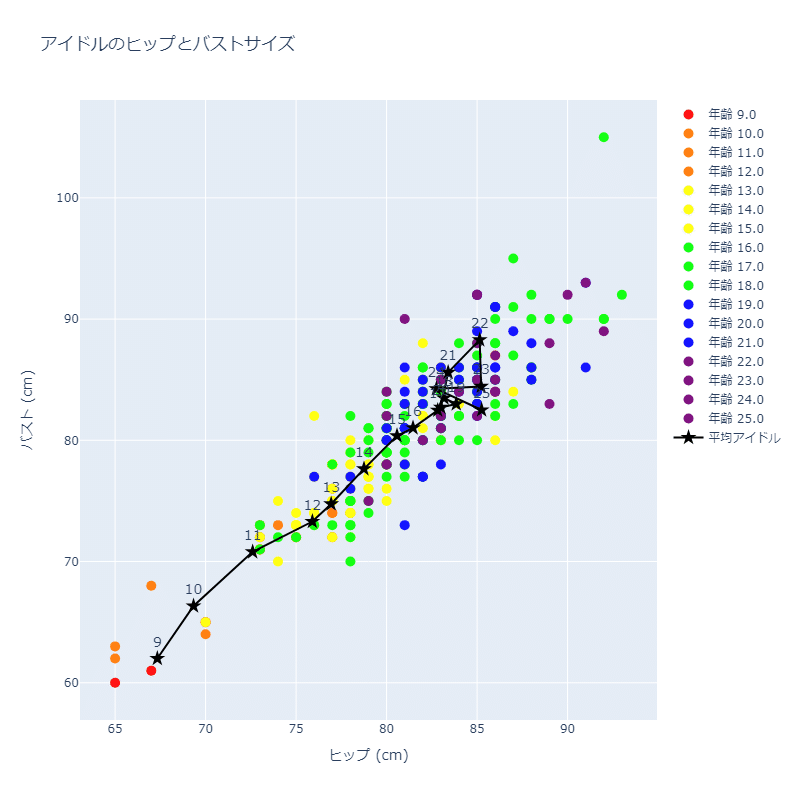
You can see that it forms a clean, straight line up to around age 17. Given the high correlation coefficient, this is only natural.
Looking at this chart (assuming no major differences in child growth rates based on birth cohort), the increase in bust and hips progresses at a steady pace from at least age 9 and halts around age 17.
Considering that breast development occurs during puberty (secondary sex characteristics), this is entirely plausible. On average, you could say their growth mirrors reality quite well.
Next, let’s examine the relationship between waist and bust. Surely this chart will produce a clean straight line as well.
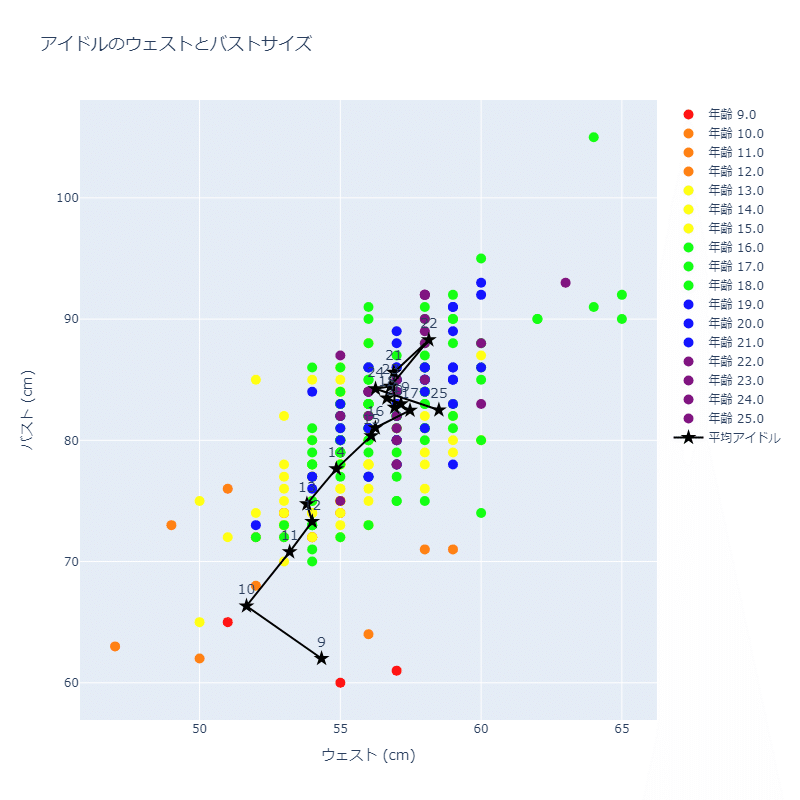
Lo and behold, no clean line appeared.
Looking closely at the averages by age, two peculiar points stand out.
First, going from age 9 to 10, even though the average bust size increases, the average waist size decreases substantially. Perhaps this reflects the aforementioned demand for “puni-kei lolis.” Still, with only three 9-year-old idols, the sample size is admittedly too small to say anything definitive.
Second, when moving from age 12 to 13, a similar regression in waist size occurs, albeit to a lesser extent. This one cannot be explained away by small sample sizes: there are 10 idols at age 12 and 16 idols at age 13.
Let’s look at another graph to see what’s happening. This time, keeping bust size on the vertical axis, we place the difference from standard weight on the horizontal axis instead of waist.
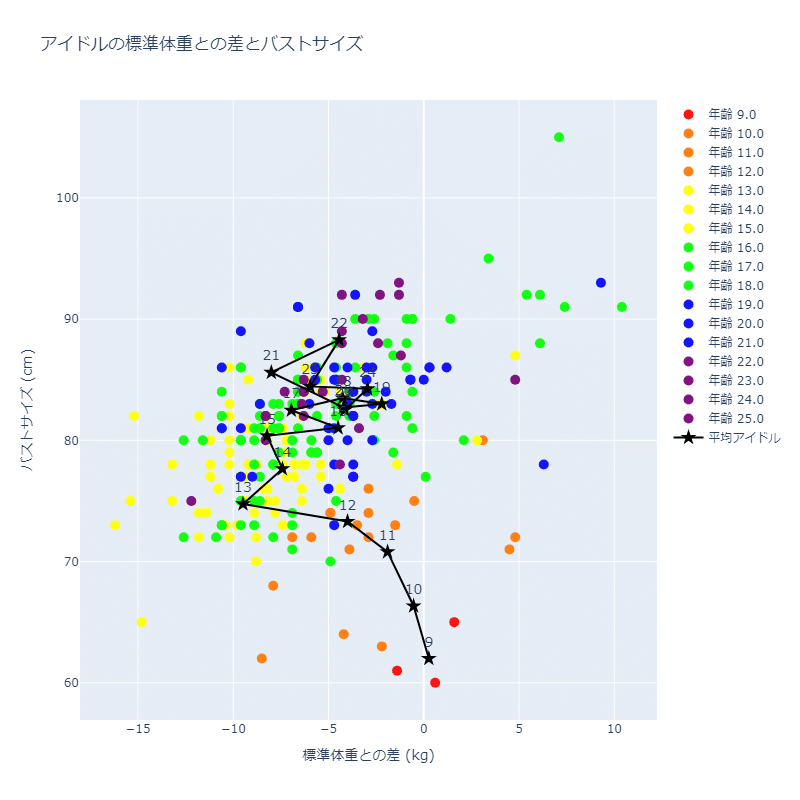
You can see that at the jump from age 12 to 13, the divergence from standard weight widens dramatically. And this divergence narrows when jumping from age 15 to 16, remaining largely unchanged afterward.
The fact that this anomaly emerges between ages 13 and 15 is quite fascinating, as this age range corresponds exactly to Japanese middle school. In other words, this anomaly is occurring specifically for middle school (JC) idols.
Let me introduce one more startling graph. What happens when we plot weight on the horizontal axis and waist on the vertical axis?
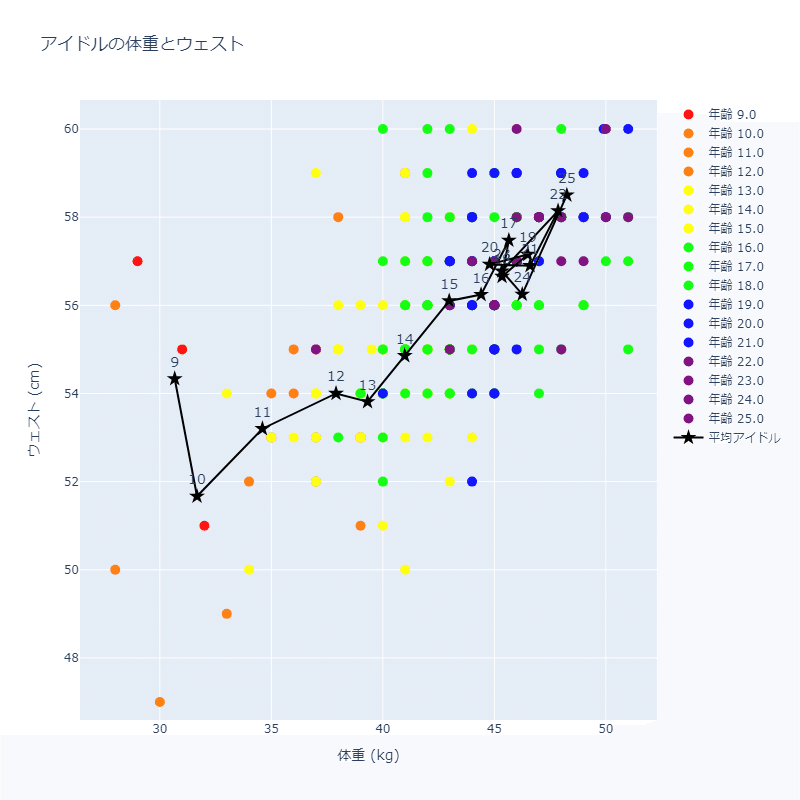
Unbelievably, from age 12 to 13, average weight increases, yet average waist size actually shrinks. While every other physical measurement increases monotonically, having only the waist decrease is impossible in real biology. This is clearly an anomaly.
Just to be thorough, let’s consider the possibility that this anomaly is driven by outliers.
The lower age limit for the featherweight 765 Allstars (AS) members is indeed 13. However, their sample size isn’t that large, so they alone shouldn’t have enough leverage to drag down the entire overall average.
Also, the fact that Yuuki Otokura—who has the lowest BMI among all idols—is 13 years old might have some slight effect, but that still doesn’t explain ages 14 and 15.
Ultimately, rather than an outlier effect, it appears that something anomalous is genuinely happening across the waist distribution of middle school (JC) idols as a whole.
When idols become middle schoolers (JC), their waists alone become drastically cinched while leaving the rest of their bodies untouched.
Trajectories of Height and Weight
Finally, let’s look at the graph below. This chart vividly illustrates the difference between general females and idols.
Plotting weight on the horizontal axis and height on the vertical axis, the black line tracks the idol average by age, while the gray line represents the general female average.
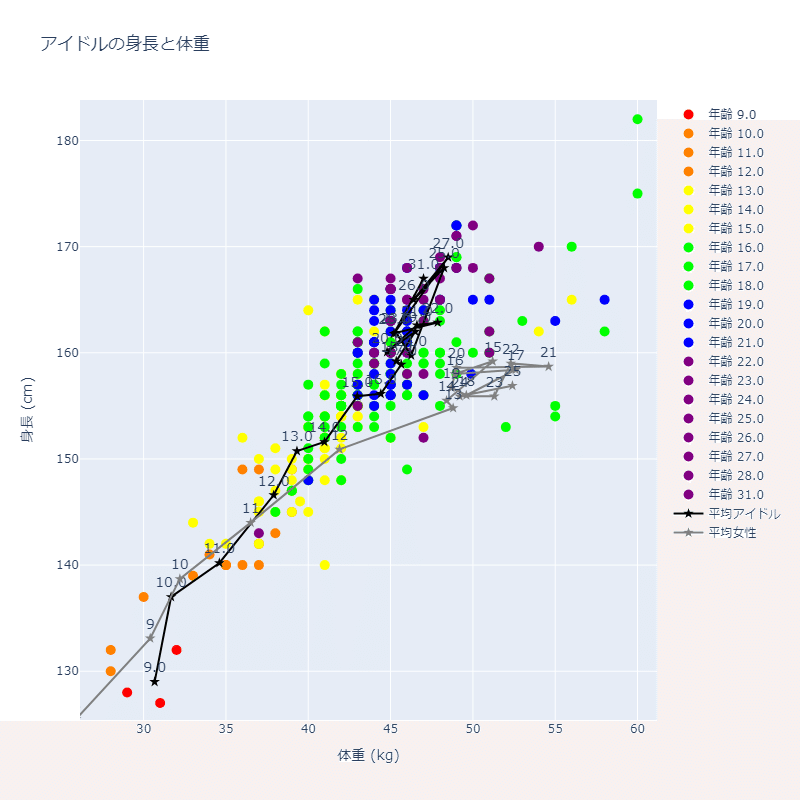
Comparing idols and general females across age groups, we can observe the following:
- Up to age 10, the idol average does not deviate substantially from general females.
- However, between ages 11 and 14, idols appear to gain height and weight at roughly half the pace of general females. An average 14-year-old idol has roughly the same height and weight as an average 12-year-old general female.
- As a result, while general females see little significant change in height and weight after around age 14, idols continue growing until age 17.
- Furthermore, after the point where a 14-year-old idol equals a 12-year-old general female, the divergence toward taller and lighter figures grows ever wider.
- This trend continues gently even past age 18.
Deepening the analysis, we might infer the following:
- The height and weight distribution of idols up to age 17 is much more evenly dispersed than that of general females.
- Considering that age functions as a “tag” for characters, it seems ages are assigned to maximize their utility as tags.
- Or perhaps we simply remember human growth rates as slower than they actually are, projecting that bias onto the idealized archetypes of idols.
- Up to age 14, even within lolicon preferences, realistically plausible body types are favored.
- That said, a 14-year-old idol has the proportions of a 12-year-old general female. You might be more of a lolicon than you think.
- On the other hand, from age 15 onward, unrealistically tall and slender figures become favored.
- When otaku self-deprecatingly call themselves lolicons, there certainly seems to be a dividing line around age 15. As in: 16 and older doesn’t count as lolicon territory.
- In terms of how characters are treated within works, those 15 and under emphasize adolescent imperfection, while those 16 and older tend to receive adult-equivalent treatment. This seems true not just for Imas, but across many franchises.
- In short, things change completely depending on whether they’re JC (middle school) or JK (high school).
- The fact that idols continue growing physically until age 17—even though general females stop around age 14—may stem from men misunderstanding female biological development based on their own experiences.
- After all, men’s physical growth lasts longer than women’s. And male growth tends to halt right around age 17.
Without having run formal statistical tests, I can’t say anything definitive, but the idea that expectations differ between middle school (JC) and high school (JK) idols intuitively makes sense.
In that case, the “ages 13 to 17” category from earlier can indeed be subdivided into JC and JK.
…And so, the classification from earlier has reached its final form. In the end, going full circle, it naturally settles into the standard school-bracket categorization: JS, JC, JK, or 18 and older.
Conclusion
For this project, I used idol data from THE IDOLM@STER because it is so cleanly organized. Thank you, im@sparql.
It seems to me that the results obtained from this investigation cannot be explained away simply by “because all the girls in Imas are idols.” Though I have no proof, I have a feeling that 2D characters in general exhibit a similar divergence between age and physique compared to reality.
The fact that the physique demanded of idols varies so starkly by age is especially fascinating. Those 14 and under are framed as “innocent young girls,” while those 15 and older are positioned as “alluring adult women,” projecting entirely different tastes.
What is the underlying reason why the dividing line falls around age 15? Is it really the strong cultural influence of the JC and JK labels? If so, had Japan’s educational system been structured differently, would this boundary have appeared somewhere else?
Or does the urge to place the boundary there stem from innate biological traits like puberty and secondary sexual characteristics? But then again, the educational system itself was designed around those innate traits to begin with…
The more I think about it, the less clear it becomes. But at the very least, this analysis was a whole lot of fun.
As a side note, this article is by no means intended as a political statement arguing that men’s ideals are “wrong.” They are idols, literally idolized entities. Or rather, they are fictional characters in the first place. Even if the idols we chase diverge from reality, there is zero reason to condemn that.
Rather, I hope this serves as a helpful reference when you create or daydream. Personally, I’m the type whose heart races just looking at the numbers on a character profile.
I don’t know if there’s any demand for it, but I’d like to make the interactive Plotly graphs publicly available at some point. And if anyone wants the Jupyter Notebook I used for the data analysis, I’d be happy to share it. Feel free to reach out!
More articles
- Impressions of Genshin Impact Ver. 7.1 Snezhnaya, Up Through Act IV "A Rekviem for the Underworld"• #Genshin ImpactAfter two years, I've finally caught up with the current release.

- I Bought a Cheap Wideband LNA from AliExpress, the Zeenko ZK06-BM• #RadioI used the Zeenko ZK06-BM to intercept METEOR-M2 4 and got the best satellite image I've ever received.

- On the End of the World• #ScreedIt's Ragnarok.

- Thoughts on Genshin Impact's Nod-Krai Storyline• #Genshin ImpactI finished Nod-Krai.

Notes on games, radio and technology, translated from the Japanese blog.