Getting Into Modular Synths with VCV Rack

Table of Contents
I was watching a bunch of DTM (desktop music) videos when a comment turned me on to a piece of software called “VCV Rack.” I figured it was some obscure DAW I’d never heard of, but no: VCV Rack isn’t a DAW at all. It’s modular synthesizer software.
So I tried it out, and it turned out to be incredibly fun. I’m completely hooked.
What Is a Modular Synth, Anyway?
In a typical synthesizer (the kind with a keyboard, or a soft synth inside your DAW), the parts are all neatly wired together internally ahead of time: the “oscillator” that makes the sound, the “filter” that changes the tone, the “amplifier” that shapes the volume. You just press the keys and a beautiful sound comes out.
A modular synth, on the other hand, splits all of these parts into modules, and they are basically completely disconnected. The player has to take a wire called a “patch cable” and plug it straight into the jacks on each module, building the “signal path” from scratch.
If you try to collect the real hardware for this, you end up with a wall-sized cabinet, or something that looks like a spaceship cockpit, and several million yen (tens of thousands of dollars) fly out of your wallet. It’s a terrifying hobby. A cool one, though.
And “VCV Rack” is a godlike piece of software that lets you experience a whole rack of those very modules on your PC, for free.
Modular Synths Are Factorio for Music
I had only ever used synths in Cubase to imitate acoustic instruments, so at first I thought, “Why would anyone go through all this trouble just to make a sound?” In a DAW you create a MIDI track, click some notes in with the mouse, and you’re done.
But after a few hours of poking at it, I realized what the fun is really about. This is not a “composition tool.” This is Factorio for music: a simulation game where you build a “factory that automatically generates music.”
- Place the heart that produces the tempo (the clock) and split its signal.
- Have the sequencer lay down a rhythm and send out pitch commands.
- Generate a random signal from another module and have it turn the filter knob automatically.
- Control the rate of change of that random signal with yet another LFO.
- …and after doing all that, send the final product to the audio output and sound comes out of the speakers.
Before I knew it, the screen was a plate of cable spaghetti. But once the system is built, it slips out of your hands, and the machine starts carving out unfamiliar grooves and complex electronic sounds all by itself. Sitting there, blissfully watching this “automated factory line” keep running, felt exactly like playing Factorio.
It’s probably closest to building space platforms in Space Age. Using logic circuits to keep chaos barely under control feels a lot like the joy of smoothing out the random distribution of asteroids to achieve stable interstellar logistics.


From the music side, if composing in Cubase is “architecture,” where you stack bricks one by one with precision, then a modular synth is closer to a “science experiment” or “gardening”: you only build an environment where sound can happen, then watch for unexpected chemical reactions.
From an aesthetic standpoint, this seems to carry an enormous advantage. In ordinary composition, you start from an orderly, predictable world and have to use knowledge and technique to create surprise. With a modular synth, you start from a chaotic world and have to create order.
I remember reading somewhere that “good music strikes a balance between predictability and surprise.” With a modular synth, you try to reach exactly that middle ground by an approach that is the polar opposite of conventional composition.
Everything Is a Wave
As I kept messing around with VCV Rack, I also went through a violent paradigm shift about the phenomenon of music itself.
In the DAW world, “notes (MIDI)” and “sound itself (audio)” are treated as completely different things. But in the modular synth world, there is only one word: “voltage.”
All that flows through the cables is a plain electrical wave (numbers going up and down). If the wave moves slowly, it becomes a “rhythm” that moves the volume or the filter. But if you crank the speed of that wave up to the extreme, the human ear starts to hear it as a tone with a pitch.
In other words, the progression of a song, its rhythm, and its pitch are all just waves in different frequency ranges.
The boundaries between the elements of music melted away, and I felt like I was kneading a kind of cosmic truth, “everything is vibration,” directly with my own hands through the cable wiring on the screen. This is addictive.
The History of Electronic Music Born from “Misuse”
As I messed with the modular synth, a question came to me. Sure, those squelchy, creepy sounds and the grinding, alien-like voices you hear in electronic music like techno and psytrance can be made on a modular synth. But who on earth came up with them, and how?
When I looked into it, I found that the history of electronic music is a history of “misusing equipment.”
Take the “Bwee! Squelch!” sound that’s all over 90s trance and acid house: gross and weird, yet somehow it lodges itself in your brain. From what I read, it all started in the 1980s with the TB-303, a machine Roland put out in earnest as a bass accompaniment unit for guitarists to practice with.
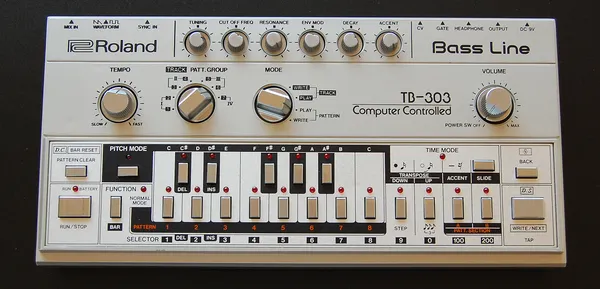
It was a flop as a bass machine, but some young people bought it used on the cheap and kept twisting the resonance knob at high speed, practically past its limit. The machine screamed, and that’s how the acid sound was born, apparently.
Ignoring the rules and common sense, and using equipment beyond its specs, produced a brand new sound nobody had ever heard… That’s incredibly rock ‘n’ roll, and yet it’s something that has happened over and over throughout the long history of Western music, which I find kind of fascinating.

How to Get Started with VCV Rack
For a piece of software that stimulates your curiosity this much, the barrier to entry is surprisingly low. Download it from the official site (free), create an account, and you can add hundreds of modules published by developers around the world and play with them. And because “everything is voltage,” you can patch any module to any other module however you like. Amazing.
At first you’ll surely be at a loss: “I’ve put modules on this pitch-black screen, so what do I connect first?” So I’ll write down a quick rundown (partly to check my own understanding).
The basic modules that come pre-installed (Fundamental) are all you need to begin with. Just line up the following six on the screen and connect them with cables, and you’ve got an automated music line.
- VCO (oscillator): The source of sound. It outputs waves.
- VCA (amplifier): The faucet for volume. Without it, the sound just gushes out nonstop.
- ADSR (envelope): Decides the “shape (over time)” in which the faucet opens and closes.
- SEQ-3 (sequencer): A machine that plays in a melody in time with the tempo.
- LFO (clock): The beating heart. It sets the tempo.
- AUDIO-8 (audio): The exit to the speakers. It delivers the final sound to your PC.
The LFO’s wave (the tempo) advances the sequencer; the sequencer sends the pitch to the VCO and a “play the sound!” signal (a gate) to the ADSR. Then the VCA faucet opens to match the shape of the ADSR, and sound comes out of the speakers.
Once you can build this basic system, an endless Factorio-style rabbit hole of factory expansion opens up: change the sequencer’s loop length to get odd time signatures, patch another LFO into the filter to modulate the tone automatically, and so on.
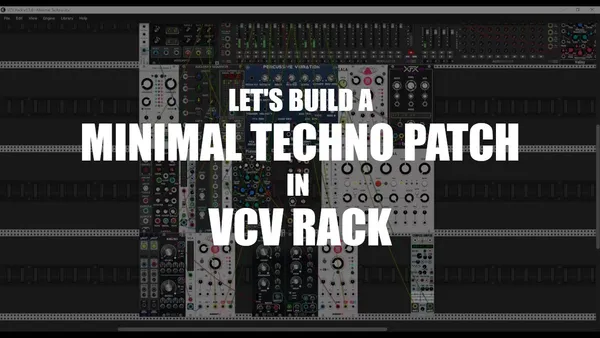
I recommend Omri Cohen’s YouTube videos. He has uploaded a ton of VCV Rack videos, covering everything from explanations of individual modules to how to actually use them, and even weird-but-works ways of using them. He’s got a lovely voice too, kind of like the Bob Ross of the VCV Rack world. The sound is so soothing that I keep passing out in my chair while watching, which is the one downside.
A Proper Partnership in Crime with the Machine
Until now, I thought that making music meant “how accurately can I enter the melody in my head into the computer and reproduce it.” That meant that when my songs came out monotonous, it was because I had too few musical drawers in my head, and I figured I needed to study music theory and composition techniques to make up for it.
But the modular synth taught me a completely different philosophy: “let the machine blurt out random phrases, and have a human scoop out the moments that feel beautiful.” A partnership in crime with the machine. Music theory still turns out to be useful in the end, but you get to put that knowledge to work in the opposite direction.
You tame a module that behaves like an unruly wild horse just enough, misuse it now and then, and dig fragments of order out of the chaos. In principle it should be extremely electronic and disembodied, yet I get the feeling that the fun of it is fundamentally connected to the feeling of wrestling with the friction of strings on an acoustic instrument and its unpredictable physical wobbles.
If the god of the Anemo element heard all this, he’d probably faint, but I’m sure he’d give the freedom of it a standing ovation.
More articles
- I Touched DJ Gear and Broke the Broadcasting Room Curse• #MusicMy impressions of trying out DJing.
- Playing Agustín Barrios's La Catedral on Acoustic Guitar• #MusicPractice notes on Preludio Saudade - La Catedral.
- Tackling Fontaine's Masterpiece 'Le Souvenir avec le crepuscule' on Acoustic Guitar• #MusicA declaration of intent: I'm going to learn to play the Hydro Archon's theme that plays at dusk in the Court of Fontaine on acoustic guitar.
- A 10-Year Challenge: I Can Finally Kind of Play the Acoustic Guitar• #MusicMy journey of taking on the acoustic guitar: practice methods, tips, and recommended Genshin Impact tabs.

Notes on games, radio and technology, translated from the Japanese blog.