The Amazfit Active 2 (Smartwatch) Is Seriously Good
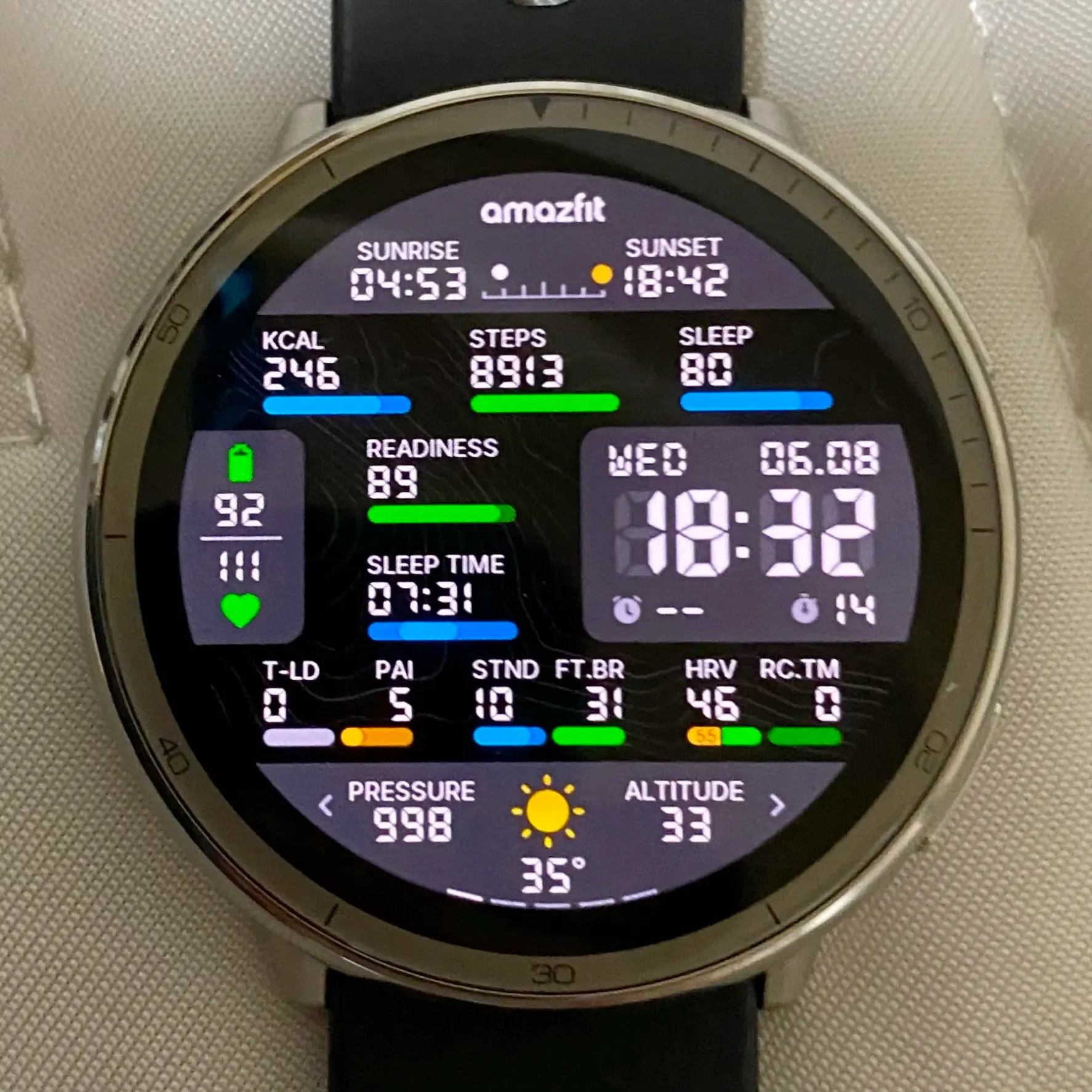
Table of Contents
This article is neither stealth marketing nor an affiliate post.
Lately, my motivation to exercise has been ramping up. So, I decided to buy a smartwatch.
Background
This is the second time I’ve bought something along the lines of a smartwatch.
Back in 2021, I wore a Xiaomi Mi Band 5 for just under a year. My breakdown of reasons for buying it was roughly 40% boosting exercise motivation and 60% timing my sessions in the sauna.
My eyesight is fatally awful, so without glasses or contact lenses, I genuinely cannot see a thing. That kind of situation is completely inevitable in a sauna, which is why I needed something on hand to track the time.
The Mi Band 5 was a great piece of gear. Above all, it was dirt cheap (around 3,000 yen [about $20]), so even in a punishing environment like a sauna, I could wear it without stressing out: “Whatever, it’s only 3,000 yen anyway.”
Back then, I was obsessed with staying in the sauna for exactly six minutes, so knowing the time was essential. Eventually, though, my thinking evolved: optimal duration varies with room temperature anyway, and shouldn’t I just stay until I feel satisfied? With that, the need to take the Mi Band into the sauna evaporated, wiping out 60% of my original reason for buying it.
As for exercise, if I was going to get serious about it, I personally wanted to swim, but public pools almost universally forbid wearing electronic devices.
(Apparently some municipalities are moving toward easing these rules. I really hope that spreads further…)
Furthermore, while it could measure heart rate and workout intensity, I felt the accuracy of the Mi Band 5 was pretty mediocre. To maintain motivation for working out, you really need to be able to trust the numbers to a reasonable degree.
Even though the Mi Band 5 had unbeatable cost performance, the “you get what you pay for” aspect was hard to ignore. In particular, the heavy input lag and choppy screen rendering bugged me quite a bit. Having phone notifications pushed to the band was a neat feature, but the screen was far too small and low-res to read comfortably. On top of that, not a single watch face could display seconds.
And so, with most of my reasons for buying it gone, minor pain points piling up, and the personal quirk that I don’t normally wear a wristwatch—meaning having one on felt constantly distracting—I ended up losing interest.
The Trigger
Fast-forward to about a week ago. A friend recommended running to me, so I thought, “Why not dig out the Mi Band and go for a run?”—only to find neither the charging cable nor the band itself. I had managed to lose it somewhere in my room. That’s what happens when you treat something carelessly just because it’s cheap.
That’s when I arrived at the decision to buy a brand-new smartwatch.
Here were my requirements:
- Record workouts with a reasonably trustworthy level of accuracy
- Smooth operation without stuttering or lag
- Not overly expensive (under 30,000 yen)
From scouring the web—mostly Reddit—it looked like the Amazfit Active 2, released this year, offered phenomenal bang for the buck along with solid accuracy.
These reviews in particular were very helpful:
When I tried it out in person at Yodobashi Camera, screen navigation felt remarkably smooth and responsive. Plus, although I hadn’t originally considered it a requirement, the watch actually has a refined, proper wristwatch feel that looks really sleek.
Standard vs. Premium Edition
Once I settled on the Amazfit Active 2, one final dilemma remained: choosing between the Standard Edition and the Premium Edition.
Compared to the Standard version, the Premium version offers the following:
- Black silicone strap → Black leather strap + orange silicone strap
- Tempered glass → Gorilla Glass
- Added NFC support
- 3,000 yen more expensive
I don’t care that much about appearance, so the strap wasn’t a selling point for me.
Gorilla Glass sounds nice, but I’m not planning on doing any intense, rugged activities that would scratch it up. Realistically, the battery will be the first thing to die anyway.
NFC was somewhat tempting, but after digging into the details, it seemed pretty much useless outside the EU.
To register a credit card, you have to sign up with a third-party service, and that service only supports cards issued by banks in the EU. On top of that, it only supports Mastercard, and I don’t own a Mastercard.
The other potential use for NFC would be Suica (Japan’s transit smart card), but whether that was supported seemed dubious as well. The store display at Yodobashi Camera explicitly stated “Suica not supported,” so I took their word for it.
And so, I opted for the Standard version. Around 17,000 yen.
Review
It’s only been three days since I bought it, but overall, I like it a lot.
Features
I’m currently using a watch face called “Advanced.” It packs in a lot of data, and I love that tapping any metric jumps straight to its details.
Maybe what I really want from a smartwatch is something like an in-game HUD. Having tons of numbers on screen just hypes me up.
Speaking of HUDs, having offline maps stored on the watch and being able to use the built-in GPS is a nice little touch. I haven’t taken it out for real-world use yet, but apparently it looks something like this:
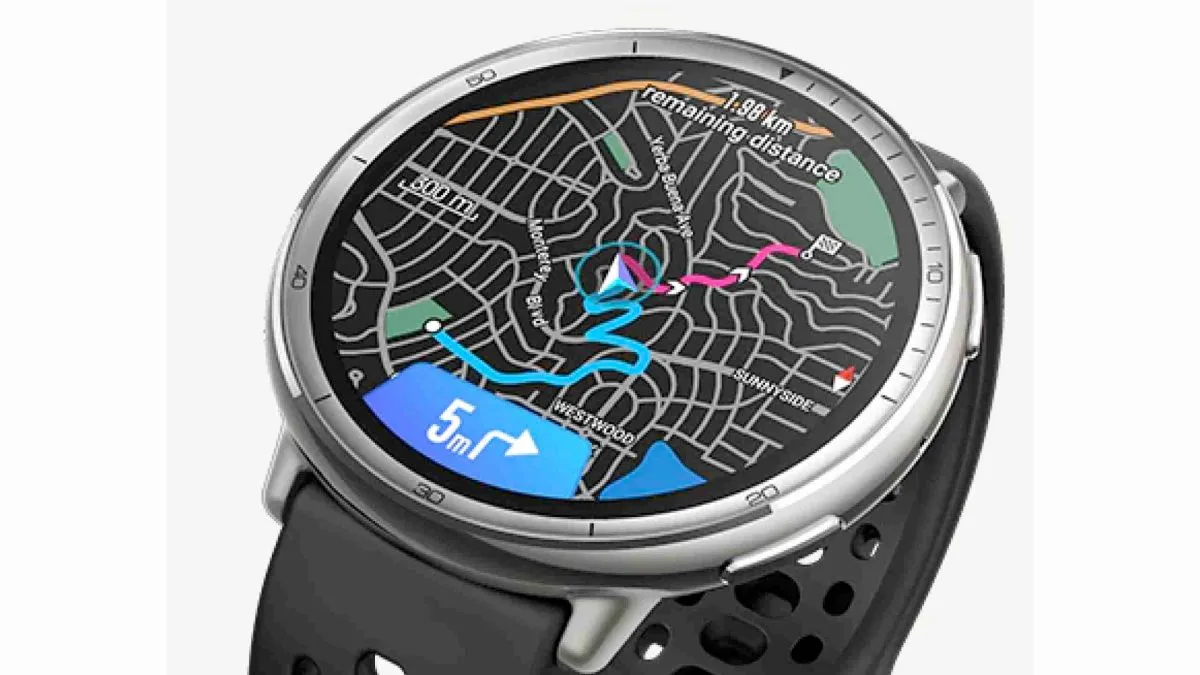
It looks just like the minimap in Genshin Impact. That, too, becomes a motivation to walk.
By the way, there’s also a square-dial Square version out now, but square dials give off a weirdly try-hard Apple Watch vibe that I disliked, so I never considered it. Besides, the minimap in Genshin is round.
The smoothness of the UI is just as I mentioned earlier, and the UX for navigating features is fairly intuitive. With this particular watch face especially, every feature is just one tap away.
Then there’s a somewhat out-of-left-field feature called Zepp Flow. It’s a voice recognition feature powered by GPT-4o: say “heart rate” and it starts measuring your heart rate; say “3-minute timer” and it sets a timer for three minutes and starts it.
So far, I’ve really only used it when cooking instant ramen, but it works pretty much as expected. The Mi Band 5 technically had Alexa integration, but it was completely unusable. Compared to that, this is a massive improvement.
Fit and Comfort
As mentioned, I’ve never worn a wristwatch before. So whether wearing it would feel distracting was a major concern for me—especially since the Amazfit Active 2 is considerably bulkier than the Mi Band.
On that point, I haven’t experienced any discomfort or broken concentration so far. Having a strap with some width might actually be better because it distributes the pressure more evenly.
Battery Life
The official specs advertise 10 days of battery life, but with my current usage pattern, it feels more like around 7 days. Simply taking it off to charge while showering or taking a bath is plenty to keep it running.
The photo above was taken in the evening after walking around a conference all day, and the battery had only dropped by 8%. Later on, though, when I turned on workout mode and played Beat Saber for 50 minutes, it dropped by about 5%.
If you work out heavily every single day, it might run out of juice in around five days, but even then, that should be leagues better than an Apple Watch.
Sensor Accuracy
Since I don’t own any other heart rate sensors or dedicated hardware, I have no way of knowing whether the numbers are actually accurate.
That said, the reading of 483 kcal burned from 50 minutes of Beat Saber matches the numbers you find online.


Sleep tracking also seems impressively accurate. My sample size is still only about n=3, but even when I lie down lazily watching videos, it hasn’t mistakenly flagged me as asleep so far. Checking it the next morning, the recorded sleep time feels totally plausible.
The Zepp App Is Surprisingly Good
Strictly speaking, this isn’t about the watch itself, but the smartphone companion app turned out to be remarkably handy.
It has evolved massively since my Mi Band days. What’s especially nice is the food logging feature: it estimates calories from photos or text descriptions.
Summary
It’s only been a few days since I bought it, but I really like the Amazfit Active 2. So far, I haven’t found any disappointing flaws.
Getting this feature set for 17,000 yen is astonishing. If you’re looking for a smartwatch under 30,000 yen, this is unquestionably one of the strongest contenders.
On the other hand, if on-wrist contactless payments (especially Suica) are a priority for you, or if you want a rich ecosystem of third-party apps, you might want to look elsewhere.
As an intriguing use case, activities logged on the Amazfit Active 2 can be synced to Strava (an exercise tracking app), and Strava activities can then be synced to intervals.icu or pulled via API.
From what I can tell, Strava’s API seems well-designed, but getting access to it is apparently a bit of a hassle. In that case, you can also fetch data via API from intervals.icu.
If leveraged properly, this could lead to some really interesting possibilities…

More articles
- Impressions of Genshin Impact Ver. 7.1 Snezhnaya, Up Through Act IV "A Rekviem for the Underworld"• #Genshin ImpactAfter two years, I've finally caught up with the current release.

- I Bought a Cheap Wideband LNA from AliExpress, the Zeenko ZK06-BM• #RadioI used the Zeenko ZK06-BM to intercept METEOR-M2 4 and got the best satellite image I've ever received.
- On the End of the World• #ScreedIt's Ragnarok.

- Thoughts on Genshin Impact's Nod-Krai Storyline• #Genshin ImpactI finished Nod-Krai.

Notes on games, radio and technology, translated from the Japanese blog.