Factorio: Space Age Is Way Too Much Fun
Table of Contents
This article contains spoilers for Factorio: Space Age.
I’ve fallen hopelessly hard for Factorio recently.
Back when I was younger, I used to play Minecraft tech mods (specifically IC2, IndustrialCraft 2), so I knew with 100% certainty that I would get addicted and actively avoided it. But I finally caved and bought it.
And just as I had anticipated, I should never have touched it.
During my very first session, I played for 32 hours straight. Naturally, my body completely broke down, but I kept playing Factorio anyway, with the result that it took two whole weeks to shake off my cold.
I did some serious soul-searching after that and now take care never to play for more than 24 hours at a stretch, but even so, every single weekend over the past month has been devoured by Factorio.
Current Progress
Right now, I’ve completed expansions to the three inner planets: Vulcanus, Fulgora, and Gleba.
My next target is Aquilo, but from what the briefing says, self-sufficiency is impossible there. So I decided to get my existing infrastructure in order first.
My current interplanetary logistics network looks something like this:
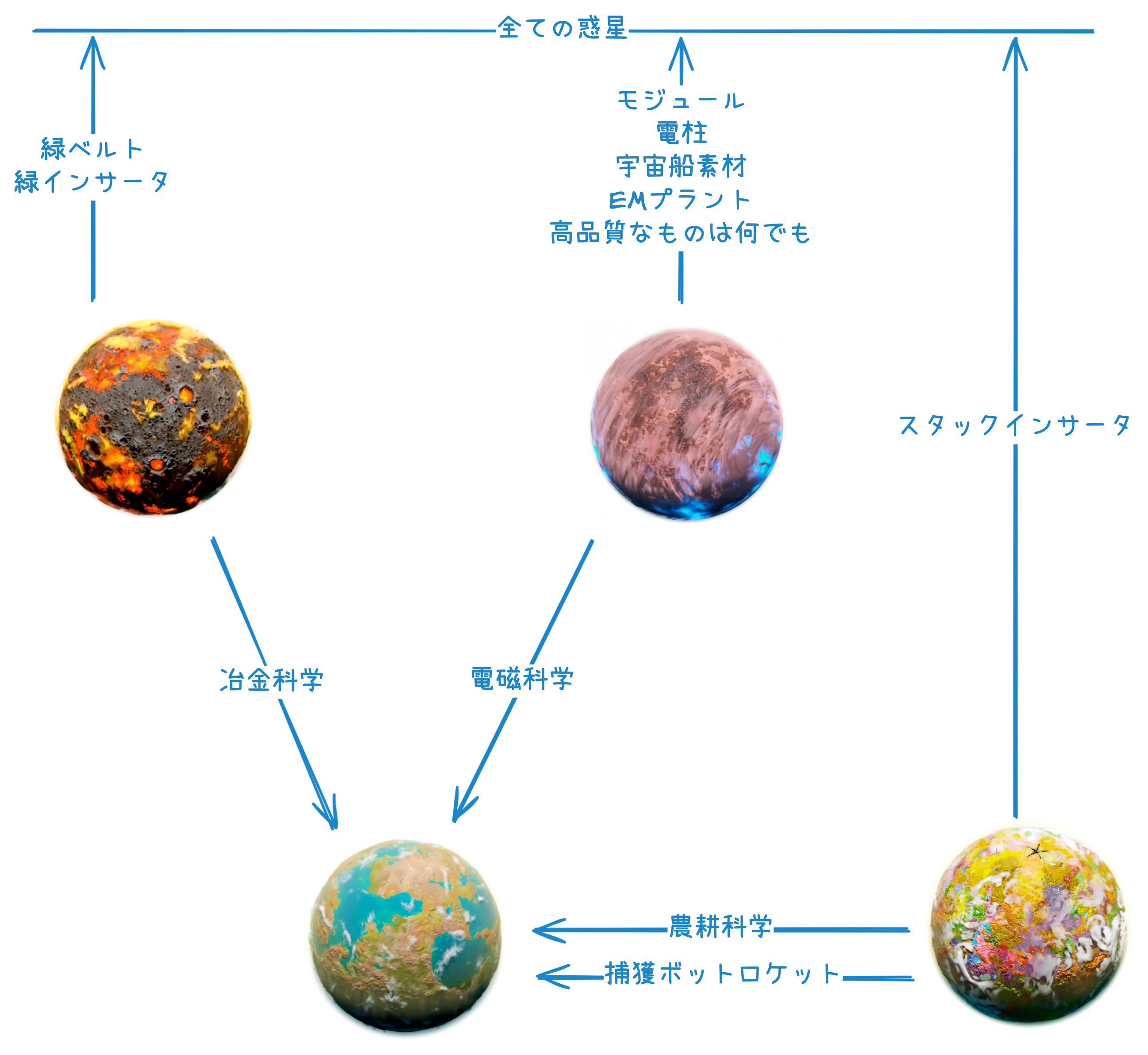
Exporting science packs back to Nauvis and shipping bare-minimum quality-of-life items between planets has become fairly stable.
However, acquiring the Biolab caused science pack demand to explode, leaving me with a severe deficit in basic science packs.
So I’m considering offloading production of the higher-tier basic science packs to planets where their raw materials are abundant. Another goal is to reduce dependency on ore patches and tap into truly infinite resources like asteroids, lava, and biomass.
Here is the plan:
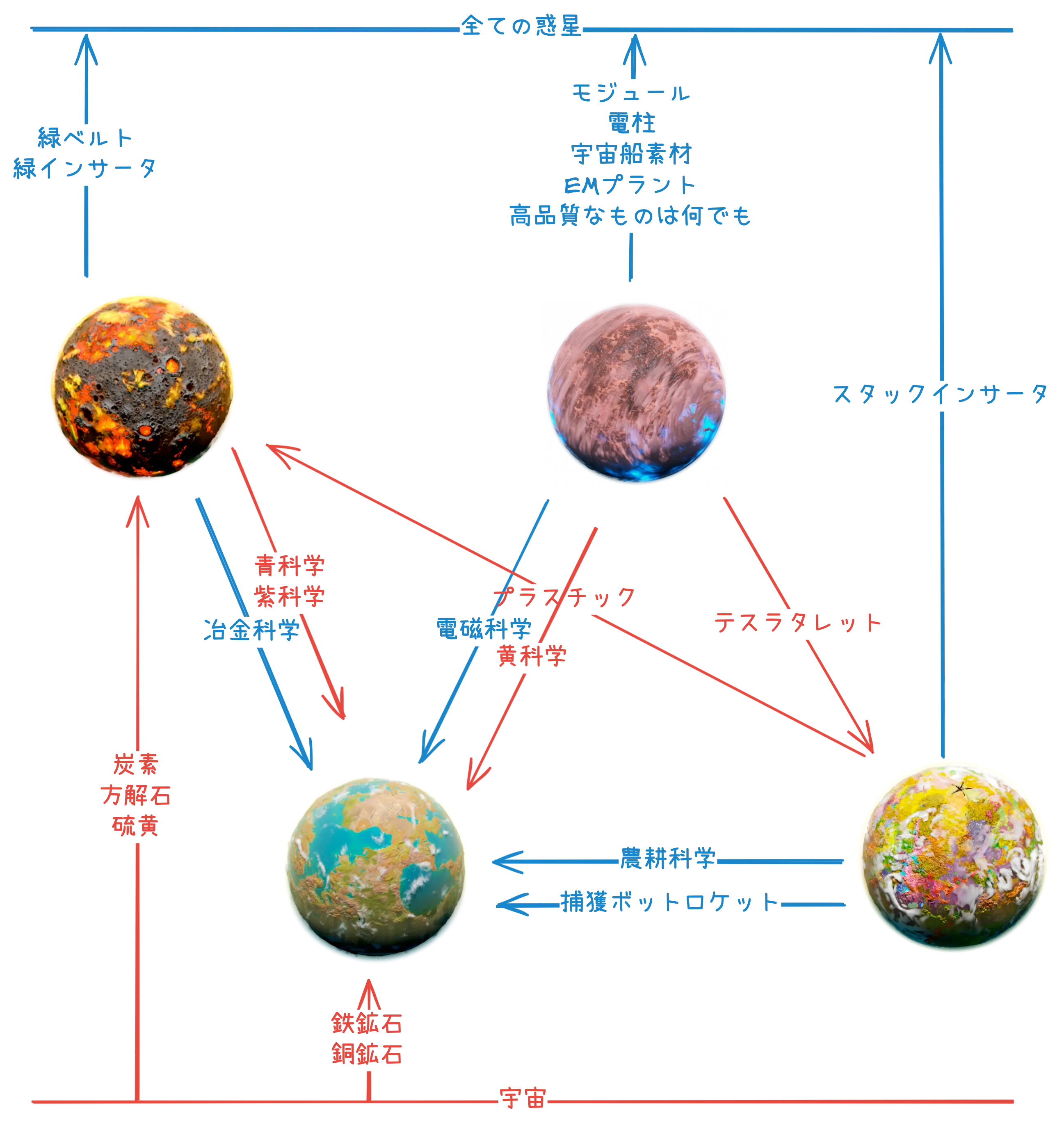
As an urgent priority, I will first build a production base on Vulcanus for purple science, which consumes massive amounts of stone. While I’m at it, I’m thinking it might also be good to produce purple science on Vulcanus as well, though Gleba might actually be better for that.
Another truly urgent priority is reinforcing base defenses on Gleba. Because I use artillery to keep Pentapods from entering the spore cloud, attacks are extremely rare, but they are not zero.
Right now, I only have a few Tesla turrets deployed around the agricultural towers and the main factory area. Up until now that was plenty, but Gleba’s evolution factor has already crossed 50%.
If I start exporting plastic from Gleba, the increased harvesting frequency is bound to expand the spore cloud. Along with that, I’ll need to set up a much more foolproof defensive line.
Against Pentapods, Tesla turrets seem ridiculously effective. For that reason, I need to import a large number of them from Fulgora. Since Tesla turrets require no ammunition, I might not need a permanent Fulgora–Gleba shipping route. Still, even after establishing a defensive perimeter, some losses are bound to occur, and since I want to significantly expand my Gleba base in the future—where well-designed setups yield infinite resources—setting up the logistics seems well worth it.
As a lower-priority task, I’m considering moving yellow science production to Fulgora. Many of the materials required for yellow science are high-tier components, and manufacturing them from scrap is much more efficient.
That said, without having reached Aquilo yet, Fulgora’s cramped land area might not be suited for large-scale production.
Here is the situation on each planet:
Nauvis
As a result of repeated, haphazard expansions, it ended up completely buried under spaghetti and swarms of bots. It’s bad for my PC, and it’s not beautiful.
It’s a total disaster, but charted out, it looks something like this:
So I’m currently working to build a general-purpose rail network and achieve a modular setup grouped by product.
Vulcanus
The first planet I visited. At this stage, the idea of building full-scale factories on each planet hadn’t even occurred to me; I only automated the bare minimum needed to blast off and return to Nauvis. As a result, it’s currently my least developed planet.
Between turret spam and saturation artillery barrages, with a bit of save-scumming I’ve become able to handle up to medium worms (Demolishers). There is a ton of vast, lava-free land just sitting empty. Because of that, I really want to give Vulcanus a massive overhaul.
The planet’s overarching theme is probably “What if everything were liquid?”, but because the rules don’t fundamentally diverge that drastically from the base game, I haven’t quite grasped what makes it uniquely fun yet. That said, the first time I took down a worm with artillery gave me an intense sense of catharsis.
I think human beings are simply powerless against the thrill of territorial expansion.
Fulgora
The second planet I visited. On a modest and imperfect scale, it handles the production of high-quality items: Quality modules (most critical), other modules, space platform structures, electric poles, solar panels, accumulators, and so forth.
The lore of an ancient, once-thriving civilization is fantastic, and the way the recycling mechanics force a playstyle completely different from Nauvis is super interesting.
I laid out an 8-lane sushi belt main bus running north-south across a large island, using inserters to filter out and grab whichever materials are needed. Any materials that reach the far north without being picked up are vaporized at a final disposal site.
Truth be told, it’s not terribly stable; if I don’t drop by to babysit it once in a while, the belts clog up and the whole thing grinds to a halt. Also, for some reason, holmium ore tends to pile up in excess. Maybe I should be producing more of Fulgora’s planetary specialties.
Given those issues, I use the circuit network to monitor both the item count on the sushi main bus and the volume sent to final disposal, configuring alerts to fire whenever they cross designated thresholds.
Gleba
The third planet I visited. Because of the aggressive enemies and the daunting look of the spoilage mechanics, I pushed it to the very end. At the moment, I’m only regularly exporting agricultural science packs and Bioflux—the latter to feed the captive Biters on Nauvis.
In practice, Gleba was exceptionally difficult. I saw someone describe it as: “Too many nutrients is bad, too few nutrients is bad. Gleba is a spoiled child.” But personally, I think saying “Gleba is Gordon Ramsay” fits much better.
A minor misstep—completely running out of nutrients, or belts clogging with products or spoilage—shuts down the entire system, and while you’re scrambling to fix it, the Pentapods’ evolution factor steadily climbs.
What was especially rough was that it completely forbade the “fuck around and find out” style of incremental development. You have to conceptualize the entire operation and design it in advance, only releasing the fruit once everything is practically complete. It forced me to fundamentally overhaul my usual playstyle.
For all those reasons, it was by far the most agonizing planet, but the sheer satisfaction when the system finally ran stably was magnificent. It felt less like building a factory and more like creating a living organism; I spent about ten minutes just gazing at it in a trance. I was amazed at how drastically the entire feel of the game transformed just by introducing the mechanics of freshness and spoilage.
Given that fruit is an infinite resource, the recipes themselves are quite simple compared to other planets, and the output-to-input ratio is massive, as long as you nail the design, churning out vast quantities of items seems remarkably easy. Thanks to advantages like that, it might actually be my favorite planet right now.
As for how the factory operates: a main sushi belt loop carrying fruit supplies each sub-loop sushi belt, and within each sub-loop, all raw ingredients and finished products are handled in a jumbled mix. Because each loop is entirely independent except for its inputs and outputs, even if a failure occurs somewhere, the entire system won’t come crashing down. Spoilage and products are extracted with filter inserters, and spoilage is incinerated—aside from a fixed amount reserved for jump-starting the system after a shutdown.
On Gleba, I really gave it my all with the circuit network. Each sushi belt monitors the item count on it, allowing the main fruit-supply sushi belt to toggle the agricultural towers, and the sub-sushi belts to toggle the fruit-feeding inserters.
Having imported artillery to wipe out all the nests inside the spore cloud, base defense is currently under control. However, the evolution factor has already reached the point where Big Pentapods can spawn, and if I attack an Egg raft, the counterattack will wipe out my entire base (I have already experienced that parallel timeline). Because of that, I’ve halted all artillery operations. With Pentapods creeping steadily toward the spore cloud from beyond range, crisis is looming right on the horizon. I have to get my defenses in order before time runs out.
What Makes Factorio So Addictive?
Factorio is essentially the purest, most concentrated essence of “snowballing expansion” (engine building). At that point, there’s no way it wouldn’t be fun, but that alone still cannot account for this level of obsession.
Let’s begin the usual discussion.
I feel that Factorio is packed at every turn with ingenious touches designed to send the player on a “Hero’s Journey.” And that, I think, is especially pronounced in the Space Age expansion.
The colonized planets represent the “Ordinary World,” uncharted planets the “Special World,” and you bring back planet-specific tech unlocks as the “Elixir”—yet the true boon was the improvement of your own skills as a player all along. That is the structure.
For example, my journey on Vulcanus looked something like this:
- Crossing the First Threshold
- Dropping down onto Vulcanus.
- Belly of the Whale
- Having my brand-new mining drill smashed to pieces by a giant fucking worm.
- The Road of Trials
- Factory expansion. To secure tungsten patches, I had to build artillery and take down the giant fucking worm before resources in the safe zone ran dry.
- Approach to the Inmost Cave
- Slaying the giant fucking worm.
- The catharsis of raining concentrated fire down on that worm and blowing it to pieces was unbeatable.
- Crossing of the Return Threshold
- Building the rocket silo and returning to the space platform.
- Master of the Two Worlds
- Quite literally. I could now leverage technologies and structures from both Nauvis and Vulcanus.
While obtaining handy items like the Big Mining Drill, turbo transport belts (green belts), and Speed Module 3 was certainly wonderful, I think the true boon was “mastering the entire loop of touching down on a new planet and making it back alive.”
In my mind, Fulgora and Gleba tied together under a single theme: “learning the circuit network.” My use of the circuit network started with practical tasks like managing item counts on Fulgora’s sushi belts and firing alerts if the volume of items sent to final disposal spiked.
Those were merely in the realm of “nice to have,” but on Gleba, that kind of engineering became strictly mandatory, forcing me to learn (through pain) how to build more sophisticated, robust systems.
On the surface, Factorio looks like a dry game about pushing efficiency to its absolute mathematical limits. But the fact that its game balance is so meticulously crafted to serve as the scaffolding for each player’s unique journey—or perhaps that very quality itself—is what makes Factorio so compelling, isn’t it?
Step into a World Without Night
Factorio is dangerously fun. If you are an engineer, have ever been addicted to Civilization, and especially if you love fiddling with domestic infrastructure, Factorio will without a shadow of a doubt ruin your life. Under no circumstances should you ever play it.
The factory must grow.
More articles
- Heading to the Solar System Edge in Factorio: Space Age• #FactorioFactorio is in its final stretch.
- I Reached Aquilo in Factorio Space Age• #FactorioA Factorio Space Age play diary, covering the overhaul of my Nauvis rail network, the design of my space platform "Watt Rayson," and the trial and error of reaching the frozen planet Aquilo.
- Quality-of-Life Mods I Use in Factorio 2.0 (Space Age)• #FactorioA look at the quality-of-life Factorio mods I actually use, none of which change the game's systems.
- Impressions of Genshin Impact Ver. 7.1 Snezhnaya, Up Through Act IV "A Rekviem for the Underworld"• #Genshin ImpactAfter two years, I've finally caught up with the current release.


Notes on games, radio and technology, translated from the Japanese blog.