Behind the Scenes of 'Learn Toki Pona Grammar in 30 Minutes!'

Table of Contents
I made a video where you can learn Toki Pona grammar in 30 minutes. Please check it out!
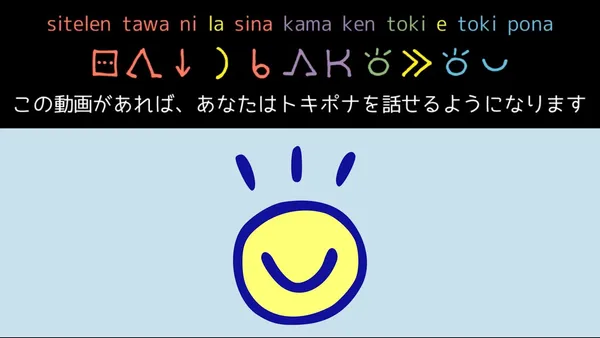
In this post, I’ll share the behind-the-scenes of making this video.
Why Did I Make It?
There were three reasons I made this video.
There Were Far Too Few Japanese Learning Materials
First, because there were far too few Toki Pona learning materials in Japanese. As far as I know, there were zero lesson articles written in Japanese that comprehensively covered the grammar at the time. While there were a fair number of materials offering partial explanations, I felt they were slightly out of sync with the consensus grammar as of 2025.
Also, at the time, there was (almost certainly) no Japanese material introducing vocabulary alongside sitelen pona (the hieroglyphic writing system for Toki Pona). As I explained in the video, since sitelen pona is logographic, learning it in parallel is bound to be much easier to understand, at least for Japanese speakers who are already accustomed to kanji.
I realized just how much clearer it is with sitelen pona side-by-side when I read the following lesson. If you can read English, I recommend checking it out as well:


I Wanted to Try Using Manim
Second, because I wanted to try using Manim. This video was created almost entirely with Manim.


It was originally developed by 3b1b (Grant Sanderson, the math YouTuber), but it was open-sourced so anyone can use it. Currently, it seems using this Community Edition is the way to go.
In this generative AI era, even when making videos, I feel that building them code-first is easier to learn than mastering dedicated GUI tools, and it lets you offload work to AI. So, I decided to make the video using Manim this time.
In fact, the video script is managed by a single JSON file.
{ "タイトル": "", "例文": [ { "sitelen": "luka6 .9 tu6 tu6 .9 tu6 wan6 .9 tu6 .9 wan6 .9 ala6 !9 ala6 !9 ala6 !9 ", "日本語訳": "5, 4, 3, 2, 1, 0! 0! 0!" }, { "sitelen": "mi1 jo2 e0 kili3 luka6 luka6 wan6", "日本語訳": "私は11個の果物を持っています (5+5+1 = 11)" }, { "sitelen": "utala1 nanpa6 mute6 mute6 luka6 luka6 tu6 wan6", "日本語訳": "53番目の戦い(20+20+5+5+2+1 = 53)" } ], "注釈": "", "字幕": "数を表すこれらの単語は最優先で結びつきます。\nこれまでの文法規則の例外となるので、pi は不要です。", "表示時間": 5, "音声ファイル": "155" },By having Manim handle the animation instructions appropriately based on this manuscript data, I was freed from the royal pain of manually tweaking positions and timing. On top of that, starting around the Gemini-1.5 era, LLMs seem to answer Toki Pona grammar questions with reasonable accuracy; when provided with a few-shot example, it colored the words (represented by the numbers at the ends of words) with remarkably high precision.
Setting up the automation took some effort in itself, but with a video this long, my spirit definitely would have broken if I had done it by hand.
I Wanted People to Understand “luka sama mi”
Before this video, I tried my hand at producing my very first vocal song using Toki Pona.
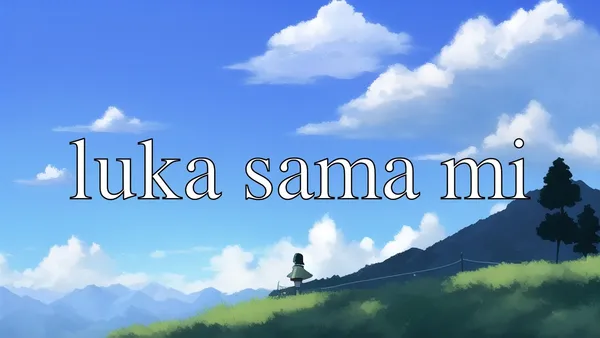
I used Toki Pona because writing lyrics in Japanese felt embarrassing. On the other hand, having nobody understand them is lonely in its own way.
As a result of those ambivalent feelings, I ended up thinking, Screw it, I’ll just make my own Toki Pona lesson video.
Isn’t the Preposition Explanation Way Too Long?
In this video, I dedicate an insane amount of time to explaining prepositions. That’s because prepositions were what confused me the most.
Why is it ona li tawa tomo instead of ona li tawa e tomo? I never really understood this for the longest time. When looking it up in English-speaking spaces, it’s often explained as the difference between transitive and intransitive verbs, but that never really clicked with me.
However, when I finally understood that a prepositional phrase can directly become the predicate, it finally made sense. That gave me the feeling that I truly, completely understood Toki Pona, and gave me the confidence to make the video.
Toki Pona has the largest user base in the English-speaking world, so I feel that English modes of thinking have significantly encroached on its grammar. That’s neither inherently good nor bad, but as a Japanese speaker, it does feel a bit tough.
Why Bomb Defusal?
Once I finished making up to Chapter 8, I wanted to include a long reading comprehension problem at the very end as a final exam. Also, in Chapter 8, when explaining numbers, this sentence appears:
luka. tu tu. tu wan. tu. wan. ala ! ala ! ala !5。4。3。2。1。0! 0! 0!This in itself was complete messing around, but I thought, I really want to hear this in Zundamon’s whisper voice. (Zundamon is a popular Japanese text-to-speech character).
So, looking for a problem that:
- Requires reading a fairly long text
- Tests comprehension of numbers, colors, and parallel expressions
- Has a countdown element at the end
…I hit upon the idea: wouldn’t it be hilarious to play Keep Talking and Nobody Explodes in Toki Pona?
Why 30 Minutes?
Originally, I didn’t intend to fit this video into exactly 30 minutes. But after making everything up to the final exam problem and having Zundamon read it to generate the audio files, the time until explosion came out to roughly 32 minutes.
I thought, Since I’ve come this far, I might as well make it exactly 30 minutes, and have the bomb detonate at 30:00 sharp. So I deleted a few example sentences, and it arrived at its current form.
About the BGM Choices
As explained earlier, luka sama mi was the backdrop for this video. I selected as much of the BGM as possible to match the theme of that song.
As for the exceptions, I’ll plead my case here.
Master of Epic - BREEZE OF MIRIM
- Because it’s one of my absolute favorite tracks in MoE (Master of Epic).
- I wanted listeners to be conscious of the 30-minute time limit.
The Elder Scrolls V: Skyrim - Far Horizons
- Because among the songs I like, this was the only one with the right length.
- Following MoE, I thought some open-world-ish music would fit well.
I.Q. Final - The 2nd Tide
- Because I love this track.
- I wanted to evoke a “second half” feel.
Genshin Impact - Rite of Battle
- Because I love this track.
- As a run-up to Lamentation et Triomphe.
- Being a Mondstadt track, it matches the theme reasonably well.
Genshin Impact - Lamentation et Triomphe
- Because it’s my favorite combat BGM in Genshin Impact.
- In Simulanka, there was one of those “defeat N enemies within the time limit” challenges that I couldn’t beat no matter how many times I tried.
- But after leveling up and understanding elemental reactions, I finally cleared it.
- That experience was so much fun, it became an unforgettable memory.
- Because of that, whenever I hear this track, it makes me feel vaguely rushed—it makes me hyper-aware of a time limit.

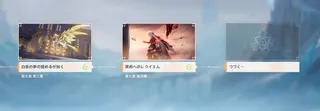
↑ The challenge in question.
Using Lamentation et Triomphe as the bomb defusal theme in particular was an absolute masterstroke; watching it back myself, I’m genuinely captivated by it.
In Closing
Making videos really is a blast. I’d like to keep making them at my own pace going forward.
More articles
- 30-Minute Toki Pona Grammar Lesson: Full Transcript• #Toki PonaFull transcript of the 30-minute Toki Pona grammar lesson video (in Japanese).
- Attempting a Toki Pona Translation of the Lyrics to 'Tokimeki Rendezvous': nasin sama pi pilin sin• #Toki PonaTranslating the lyrics of The Demon Girl Next Door Season 2 OP 'Tokimeki Rendezvous' into the constructed language Toki Pona.

- Explaining Toki Pona Through the Lyrics of "moku Sutolokanopu" (The Beef Stroganoff Song)• #Toki PonaA brief breakdown of moku Sutolokanopu, the Toki Pona version of "The Beef Stroganoff Song" abruptly featured in the anime Symphogear, along with a back-translation.

- Impressions of Genshin Impact Ver. 7.1 Snezhnaya, Up Through Act IV "A Rekviem for the Underworld"• #Genshin ImpactAfter two years, I've finally caught up with the current release.

Notes on games, radio and technology, translated from the Japanese blog.