Thoughts on Completing the Fontaine Archon Quest

Table of Contents
Thoughts on Completing the Fontaine Archon Quest
I finished Archon Quest Chapter IV, which is to say the Fontaine arc. Here are my thoughts.


I completed the Sumeru arc and arrived in Fontaine on 2024-11-06, so this marks my first progress in about five months. That’s because I burned out along the way and didn’t touch the game for about two months.
My primary motivation for playing Genshin had been “to listen to Fontaine’s battle music in Fontaine,” so once that goal was achieved, I lost my drive to keep going.
On top of that, Fontaine was the latest area released when I first started playing Genshin. Because of that, I developed a sort of “syndrome where you can never bring yourself to beat the final boss in an RPG,” and ended up abandoning it halfway through.
However, unless I cleared this, I couldn’t enjoy community-made content from Ver. 4.0 onward without living in constant fear of spoilers. And for some reason, Furina keeps popping up everywhere in fan creations.
(Here’s the original video)

So, I bit the bullet and decided to see it through to the end.
I’d heard people in various places saying that the Fontaine chapter has the best story, and in fact, it really did.
This article contains spoilers for the Fontaine chapter.
Chronological Impressions
I’ll write down my impressions in chronological order.
Act I: Prelude of Blancheur and Noirceur
- Arriving in Fontaine.
- Learning about the prophecy.
- Facing Furina, the god of this region.
- Murder at the opera house and Ace Attorney courtroom drama.
The only prior knowledge I had was that “Fontaine is a nation of justice and equity based on France, ruled by the Hydro Archon Furina.” That meant I was able to play through it almost completely spoiler-free.
The first thing that surprised me upon arriving in this region was the nation’s premise. Trials are held in an opera house, where people enjoy them as theatrical spectacles, and presiding over it all is Furina, the nation’s deity… which, to put it mildly, is in remarkably poor taste. It accelerates the unsettling atmosphere that stems from being modeled after France—the land of guillotines and revolution.
Come to think of it, Fontaine felt perpetually ominous; a distinctly dark atmosphere hung over the entire story. While the word and concept of “death” had certainly surfaced in the main quests before, Fontaine felt like it had an exceptionally high number of realistic depictions of death. In previous scenarios, the deaths of ordinary civilians were rarely shown outright, whereas in Fontaine, regular people die by the dozen. The first instance of that was Act I.
I was a bit bewildered when the House of the Hearth was suddenly brought up, and the Traveler was absolutely livid that Lyney and Lynette belonged to it. I wondered if I’d zoned out and missed a plot point, so I combed through the quest log, but couldn’t find any clear reason. Was there another quest I was supposed to have played beforehand?
Act II: As Light Rain Falls Without Reason
- Learning about Navia and Clorinde’s backgrounds.
- The trial of the serial disappearances of young women.
- “Childe” being declared guilty.
The attempted assassination of Navia using Primordial Seawater, how Navia’s father was killed by Clorinde in a duel, and the truth behind the disappearances that form the central subject of this act. This act, too, was oppressive, drenched in the stench of death.
As for Marcel, the culprit behind the case—I half expected things to drift into some gentle “well, he had his reasons, so let’s forgive him” sentiment, so seeing him ultimately killed by the grudges(?) of his victims was genuinely shocking. All the more so because I remembered hearing from some NPC that this country had never once carried out an execution.
Act III: To the Stars Shining in the Depths
- Undercover investigation in the Fortress of Meropide.
After a gap of about two months since the previous act, everything from here on is content I played through over the past week. Hence, plenty of screenshots.


Why aren’t the numbers consecutive? Is it a typo, or were 100 people thrown into prison in that single split second…? Apparently it’s like this in English too, and someone was wondering about it on Reddit.
The Fortress of Meropide arc was really fun. In the end, it’s the usual linear quest, but the system where your Credit Coupons for the investigation go up and down based on your actions did a lot to sell the sensation of actually infiltrating as an inmate and conducting an open investigation.
To heighten my immersion, I played through this entire act without ever leaving the Fortress of Meropide. A bit of Original Resin went to waste, but I think it was well worth it.

Cute.
Act IV: Cataclysm’s Quickening
- Ace Attorney-style courtroom debate using the investigation results.
- Fontaine is in dire straits due to the Primordial Sea.
- Doubts regarding Furina’s divinity accelerate.
A section that felt very much like the buildup to the grand finale. You debunk rumors about cannibals in the Fortress of Meropide using your investigation findings. The tricks themselves were just so-so, but because I had thoroughly taken my time with the deeply immersive investigation phase, it was quite fun.
Wriothesley’s cutscene was undeniably cool, but wasting two of the three bulkheads they had seemed a little questionable to me.

Sigewinne’s birthday mail happened to arrive right while I was playing, but wait, wasn’t the Fortress of Meropide in the middle of a catastrophic disaster just a few moments ago?
Also, as a side thought: I originally assumed Sigewinne was just a cute loli character, but she turned out to be quite unhinged, which was entertaining. The contents of that mail weren’t particularly peaceful either.
Act V: Masquerade of the Guilty
- The disaster in Poisson.
- The trial against Furina.
- Unraveling the truth.
Tremendous. Putting the god on trial in the courtroom of the Nation of Justice—what a romantic development.
When I stepped into the courtroom and the investigation log didn’t pop up, I was sweating, worried that it might wrap up without the Ace Attorney system, so I was thrilled when it gave me proper Ace Attorney gameplay. On top of that, having the pool of evidence to present encompass every single event I’d experienced in Fontaine was insanely hype. Unifying the gameplay and narrative through the Ace Attorney mechanic was masterful.
The truth revealed was also marvelous, overflowing with catharsis and payoff for earlier foreshadowing. It even cleanly resolved my very first point of bewilderment upon arriving in this country—“Why on earth are trials held in an opera house?”—leaving me going, “Aha!”
Never misses a selfie opportunity, even in an extremely serious scene.
Lore Analysis
During the quest, I was so overwhelmed by the presentation that I couldn’t fully keep up with every plot turn, so I want to organize what actually happened. I suppose it went something like this…?
About the Prophecy
The prophecy handed down in Fontaine from ancient times, said to have been left by the previous Hydro Archon Egeria, goes as follows:
Every person in Fontaine is born with “sin.”
No matter how the Nation of Justice holds trial after trial, this sin cannot be absolved. Until one day, the water levels in Fontaine will rise, and the sinful people will slowly be drowned…
In the end, the people will all be dissolved into the waters, and only the Hydro Archon will remain, weeping on her throne…
Only then will the sins of the people of Fontaine be washed away.
Additionally, four stone slates discovered in the ruins correspond to this prophecy:
Reason dictates that this nation be destroyed. I shall record the history of its future here in its past…


The prophecy and the contents of these slates are a history spanning from past to future, and they must absolutely come to pass. No matter how one attempts to avert them, the events depicted on these slates will inevitably take place. I think it helps to conceptualize this like Steins;Gate, except here, the entity corresponding to the observer is the “Heavenly Principles.”
Each slate illustrates the following history:
The First Slate
- Egeria (the former Hydro Archon) granted the Oceanids’ wish to “live on land.”
- But because she lacked the power to create human beings, she chose the path of “stealing the power of the Primordial Sea.”
- Egeria transformed the Oceanids into human form, creating “pseudo-humans” by sealing the water of the Primordial Sea inside their bodies.
- Consequently, when they come into contact with Primordial Seawater, the water within their bodies is liberated and they revert back to Oceanids.
The Second Slate
- Egeria, and by extension the people of Fontaine, bore the sin of stealing the power of the Primordial Sea.
- Because of this, the Heavenly Principles handed down an inescapable prophecy of doom.
The Third Slate
Everything up to this point was past history; from the third slate onward is future history.
- The Prophecy’s Claim
-
In the end, the people will all be dissolved into the waters
-
- The New Interpretation
- Water symbolizes Fontaine’s “justice and judgment,” and this scene actually depicts Furina standing trial.
The Fourth Slate
-
Only the Hydro Archon will remain, weeping on her throne.
Focalors’s Plan
So, how did Focalors, the true current Hydro Archon, attempt to avert the prophecy?
She decided to deceive the “Heavenly Principles.” In other words, she devised a plan where the events of the prophecy and the slates would occur to the letter, yet Fontaine would not be destroyed.
This plan was executed in the following two stages:
Returning the Dragon’s Ancient Authority by Destroying the Divine Throne of the Hydro Archon
- Focalors separated her “humanity” from her “divinity,” giving the human persona the name Furina.
- Furina was tasked with playing the role of the “god.” While she acted as the Archon, Focalors—inside the Oratrice Mecanique d’Analyse Cardinale—continued to accumulate Indemnitium generated from the trials.
- The purpose of this energy was the death penalty of the “Hydro Archon”—specifically, destroying the Divine Throne (which is best understood as the very concept of the Hydro Archon itself) to return the “ancient dragon’s authority” to the Hydro Dragon. This refers to the “absolute power to command the Hydro element.”
Having Neuvillette Remake Fontainians into True Humans
- Focalors invited Neuvillette (the Dragon Sovereign of Water) to the post of Chief Justice of Fontaine, allowing him to understand humanity.
- Using his returned power, he transformed the blood of all Fontainians into that of true humans.
- With this, the crisis foretold by the prophecy was averted, and the future of Fontaine was secured.
Questions and Answers
That is the resolution of this entire incident.
With that established, I’d like to sort out the points that weren’t immediately obvious to me in a Q&A format.
Why Did Focalors Need 500 Years for This Plan?
- Focalors needed to destroy the Divine Throne of the Hydro Archon and return the original power to Neuvillette.
- However, destroying a Divine Throne required an astronomical amount of energy, which had to be accumulated through the Oratrice Mecanique d’Analyse Cardinale over 500 years.
- Additionally, it was necessary for Neuvillette to spend a long time in human society to foster affection and understanding toward humanity. The plan could not be carried out until she could be certain he would render a verdict of “not guilty” for the people of Fontaine.
Why Did Focalors Have to Deceive the Heavenly Principles?
- Because if an attempt to twist fate were discovered and incurred the wrath of the Heavenly Principles, there was no telling what would happen.
- While it becomes apparent in Act VI that the Heavenly Principles have seemingly been dormant for a long time, Focalors had no way of knowing this from her perspective. Even if there had been signs of it, gambling the lives of all Fontainians without absolute certainty would have been far too dangerous.
Who Was Neuvillette, and What Was His Role?
- Neuvillette is the “ancient Dragon Sovereign of Water,” the entity that originally held dominion over all Hydro across Teyvat.
- However, that authority was stripped away by the Heavenly Principles and transferred to the Hydro Archon (the occupant of the Hydro Archon’s Divine Throne).
Why Does Furina Have No Powers?
- Because Furina is the “human part” separated from Focalors.
- Because living as the most human of humans was also Focalors’s wish for her.
Overall Impressions
The Trial System Was Great
The trial system, the core gameplay mechanic of this quest, was thoroughly enjoyable. Confronting the plaintiff’s assertions with contradictory evidence yields new interpretations, driving the story forward. While the mechanic itself was a rip-off of Ace Attorney to a barely permissible degree, what really cracked me up was that the music was straight-up Ace Attorney flavor as well.
A track in the style of the Defendant Lobby BGM:

A track in the style of a more subdued, relatively modern Cross-Examination BGM from the series:
You can clearly see how these tracks were genuinely influenced by the BGM of the Ace Attorney series from the video below:

In Genshin Impact—or rather, in many RPGs, and frankly in almost every game out there—a critically important challenge is how to fuse gameplay with narrative. Put crudely, players who love game systems couldn’t care less about the story and skip all of it, while players who love the narrative view the gameplay as nothing more than an annoying barrier. Taken to its logical extreme, the former turns into speedrunning, while the latter becomes something akin to a gacha game saddled with a catastrophically boring gameplay loop.
Until now, Genshin had left me with a rather mediocre impression on that front, but shamelessly ripping off the Ace Attorney system seemed to solve it brilliantly. Properly following the story actually contributes to playing with style and skill.
Brilliant Integration of French Elements
I’m terrible at world history, but even I know that the French Revolution kicked off at the Bastille prison and that along the way the king was executed by guillotine.
The narrative developments in the latter half of this Archon Quest were clearly modeled on this history. The drama sparks from the Fortress of Meropide (= prison), civil discontent boils over, and ultimately the Hydro Archon is executed.

I only realized this at the very, very end, but this fixture in the Opera Epiclese is unmistakably a guillotine, isn’t it?
Speaking of the Fortress of Meropide, it was also great how its architecture had a distinct Panopticon vibe. While the Panopticon was invented by England’s Jeremy Bentham,
The philosophy of the Panopticon can be observed in 19th-century French prison architecture, as exemplified by Mazas Prison and Rennes Central Prison. In Discipline and Punish: The Birth of the Prison, French philosopher Michel Foucault introduced the Panopticon as a metaphor for disciplinary social systems.
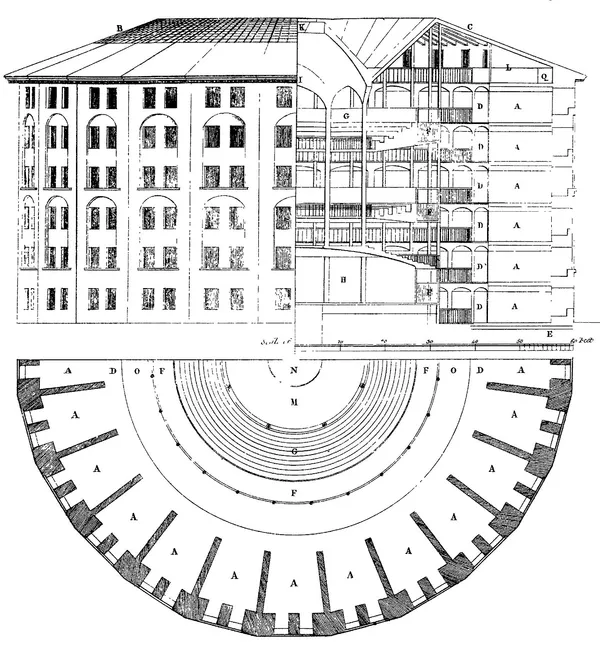
…so apparently, this too is a thoroughly French element.
No Wonder Fontaine’s Characters Are So Beloved
As mentioned earlier, the story was steeped in a relentlessly dark atmosphere from start to finish, but Navia and Furina in particular were just far too pitiful. It is an immutable law of nature that one wants pitiful characters to find happiness, if only in a fictional world.
If the scenario was going to be this exceptional, I should have pulled for Furina even if it meant blowing through all my Primogems. She’s supposed to be strong, too. I threw about 50 pulls at her banner, but lost the 50/50 to Acting Grand Master Jean and threw in the towel.
The Hypothesis That “Genshin Impact’s Archon Quests Trace the Stages of Human Faith in Reverse”
There is a theory that human religious faith progresses through specific developmental stages. Religions across different cultural spheres reportedly follow a common trajectory, which—roughly summarized—asserts the following:
When faith first sprouted in humankind, the earliest gods worshipped were maternal deities. In primitive communities, people centered their worship around the “Mother Goddess” as the bestower of nature’s bounty. Awe toward woman’s power to create life and to destroy lay at the root of this maternal faith. A maternal deity grants unconditional love and bounty to all people. By the same token, even if one wished to seek additional wealth, humans possessed no means to demand it.
Yet as societies advanced, paternal deities came to replace them. With the increasing complexity of society, there arose a need for a god who could provide the foundation for social rules. A paternal deity grants love and bounty only to those who obey the rules, and punishes those who do not.
In modern times, genuine faith has been lost for many people. In place of god, people have come to worship man-made ideologies. Bounty is now brought about by ceaseless expansion of production and consumption.
…Now, looking back, I can’t shake the feeling that the gods of each nation leading up to Fontaine have been tracing these developmental stages in exact reverse order:
- Maternal deity (good): Nahida
- Maternal deity (evil): Raiden Shogun
- Paternal deity: Zhongli
- Absence of god: Venti
If so, Fontaine ought to depict a deity from an even earlier stage—which, according to the “developmental stages of faith” theory, would correspond to a time before faith had ever sprouted in humanity. And indeed, what was depicted in Fontaine was the populace doubting Furina’s divinity—that is, losing their faith entirely. Just as the hypothesis suggests, the reverse development of faith has continued unabated.
As for what lies at an even earlier developmental stage, I have no earthly idea. If the stage before the sprouting of faith is the dawn of humanity itself, then perhaps what will be depicted in the next Archon Quest is the process of humanity’s annihilation.
…What on earth is going to happen in Natlan?
Conclusion
The Fontaine arc was a story of exceptionally high caliber, even among Genshin Impact’s Archon Quests. Up until now, the Sabzeruz Festival arc in Sumeru had been my favorite with its intense sci-fi horror vibes and maximum immersion, but Fontaine feels like it surpassed even that.
While the enormous whale and the whole business with “Childe” felt a bit rushed, and having moments where you couldn’t keep up unless you’d completed quests that weren’t strictly prerequisites broke immersion somewhat, overall it was still a thoroughly satisfying experience.
The imitation of the Ace Attorney system wasn’t just a superficial copy either; it’s wonderful how deeply it tapped into the essence of the experience—the pure joy of “uncovering the truth dialectically.” Pushing this format further to the point where it culminates in twisting fate itself also felt connected to Shu Takumi’s Ghost Trick. My memory of that game has grown pretty hazy, so maybe I should play it again after all these years.
A snapshot of pulling on the gacha to celebrate clearing the Fontaine arc, where Fischl finally came home! I’d been curious about both her character and her combat prowess, so I’m insanely happy.

More articles
- Impressions of Genshin Impact Ver. 7.1 Snezhnaya, Up Through Act IV "A Rekviem for the Underworld"• #Genshin ImpactAfter two years, I've finally caught up with the current release.

- Thoughts on Genshin Impact's Nod-Krai Storyline• #Genshin ImpactI finished Nod-Krai.

- I Had "AI Mona" Analyze the Raw METEOR-M2 4 Weather Satellite Data• #RTL-SDRBased on the raw WAV data of METEOR-M2 4 that I received at a temple in the dead of night, I had Astrologist Mona Megistus (Gemini) explain the whole thing.
- Genshin Impact 2026 Theater of Memories• #Genshin ImpactHow my 2026 went in Genshin Impact.
Notes on games, radio and technology, translated from the Japanese blog.