Why TV Tropes, the Wiki That Catalogs Storytelling Tropes, Is So Fascinating

Table of Contents
TV Tropes is an English-language wiki dedicated to collecting the conventions and recurring storytelling devices (tropes) commonly found in fiction.
I’ve been reading it a lot lately because it’s so fascinating, so I figured I’d write a summary of what the site is all about.
What Is a Trope?
Let’s just translate what the wiki’s Trope page says.
Haven’t I seen this somewhere before…
Merriam-Webster gives a definition of “trope” as a “figure of speech.” In storytelling, a trope is just that — a conceptual figure of speech, a storytelling shorthand for a concept that the audience will recognize and understand instantly.
Above all, a trope is a convention. It can be a plot trick, a setup, a narrative structure, a character type, a linguistic idiom… you know it when you see it. Tropes are not inherently disruptive to a story; however, when the trope itself becomes intrusive, distracting the viewer rather than serving as shorthand, it has become a cliché.
On This Very Wiki, “trope” has the even more general meaning of a pattern in storytelling, not only within the media works themselves, but also in related aspects such as the behind-the-scenes aspects of creation, the technical features of a medium, and the fan experience. The idea being that storytelling is not just writing, it is the whole process of creating and telling/showing a story.
Etymologically, “trope” is from Greek, meaning “turn.” Note: In other words, a trope in literature was a “turn of phrase.” Of course, the meaning of the word has expanded considerably since then.
In short, a trope is a template for crafting a story. A gloomy introvert getting hit by a truck, reincarnating into another world, and being surrounded by cute girls is a trope; a hero journeying into an extraordinary world and returning with the elixir is also a trope.
And TV Tropes is the site that categorizes and compiles all these storytelling templates.
How could you not get completely hooked on reading this?
What Is TV Tropes?
It’s easier to navigate TV Tropes if you keep in mind that its articles are mainly made up of individual pages for works and individual pages for tropes.
- A work’s page contains an overview of the work and a list of how related tropes are used in it.
- A trope’s page contains an overview of the trope and a list of works where it can be observed.
TV Tropes originally started out as a site dedicated entirely to the TV show Buffy the Vampire Slayer. Lately, though, it covers every kind of narrative imaginable, from movies and manga to internet events.
Since there are no strict notability criteria for articles, its atmosphere feels less like Wikipedia and much more like Japan’s Nico Nico Pedia.
An Example: The Demon Girl Next Door
Let’s take a look at the article for The Demon Girl Next Door (Machikado Mazoku).
At the top of the article, there is a brief synopsis and overview of the work, and from there on down, related tropes are listed one after another in alphabetical order.
Let’s translate and introduce just the first two from the top.
Abandoned Hospital Awakening
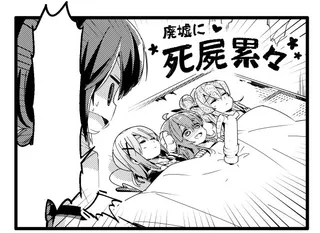
Occurs at the beginning of Volume 5 alongside a zombie apocalypse. It turns out to be just one of Lilith’s terrible fictional drama creations.

General Meaning
As the name suggests, an Abandoned Hospital Awakening is when a character wakes up in an abandoned hospital.
While seen in other genres as well, it’s a particularly popular choice in horror. In most cases, the hospital where they awaken was deserted due to some recent disaster. This helps explain why the character was even there in the first place.
For some reason, it’s especially popular during a zombie apocalypse.
Supertropes include “Abandoned Hospital” and “Waking Up Elsewhere.”
Abandoned Warehouse
The abandoned factory Momo used to train Shamiko is eventually revealed to have been tied to several crucial past events. First, Sakura’s confrontation with Ugallu. And ultimately, whatever incident resulted in the two of them being sealed.
General Meaning
At about the same volume that a grand but derelict house on a hill shouts “supernatural and creepy,” an Abandoned Warehouse screams “let’s rumble.”
If a cordial enemy says “let’s meet in an abandoned warehouse,” you can pretty much drop the “cordial” part right then and there.
If nobody fires or at least brandishes a gun during a warehouse scene, it’s usually only because it’s a children’s show. Even then, it will still involve whatever nerfed magical battle powers the show entails.
Analysis
When you read the general meanings, doesn’t it make you go, Wait, that is literally The Demon Girl Next Door!? Yet these are just tropes—they aren’t referencing any specific work.
And while this is just my personal take, I get the feeling that The Demon Girl Next Door uses an exceptionally large number of these tropes. In fact, as of right now, a staggering 123 tropes are linked to its article.
By understanding tropes, we should be able to analyze The Demon Girl Next Door on a much deeper level… hopefully.
More articles
- Attempting a Toki Pona Translation of the Lyrics to 'Tokimeki Rendezvous': nasin sama pi pilin sin• #Toki PonaTranslating the lyrics of The Demon Girl Next Door Season 2 OP 'Tokimeki Rendezvous' into the constructed language Toki Pona.
- A Hero's Journey Analysis of Dispelling Mikan's Curse and Ugallu's Birth: The Demon Girl Next Door Commentary• #The Demon Girl Next DoorWhy is Volume 4 of The Demon Girl Next Door so emotional?
- The Oath of the Raised Aqueduct• #The Demon Girl Next DoorA declaration that I'm making a doujinshi.
- The Demon Girl Next Door Exhibition: Event Info Summary (Dates, Admission Restrictions, etc.)• #The Demon Girl Next DoorInformation on a past event. There's almost no practical value to this info anymore, but I'm keeping it as a memento.
Notes on games, radio and technology, translated from the Japanese blog.